Pour toutes ces fonctions trigonométriques, on aura pour chacune leur
fonction réciproque
.
Entre une fonction et sa
fonction réciproque
, on a la relation :
$$ f \circ f^{-1} = id$$
Un exemple avec la fonction \(\sin(x)\) et \(\operatorname{Arcsin}(x)\) :
$$ \Biggl \{ \begin{gather*} f : x \longmapsto \sin(x), \hspace{3.1em} \mathbb{R } \longmapsto [-1, \enspace 1] \\ f^{-1} : x \longmapsto \operatorname{Arcsin}(x), \enspace [-1, \enspace 1] \longmapsto \mathbb{R } \end{gather*} $$
$$ \operatorname{Arcsin}(\sin(x)) = x \Longleftrightarrow \sin(\operatorname{Arcsin}(x)) = x $$
Attention à ne pas confondre la notation "\( f^{-1} \)" des
fonctions réciproques
avec celle de l'inverse
.
En effet, on note "\( \cos^{-1}, \ \sin^{-1}, \ \tan^{-1}... \)" pour les
fonctions réciproques
des fonctions trigonométriques \( (arcsin, \ arccos, \ \operatorname{Arctan}...) \), mais c'est une notation différente de "\( f^{-1} \)" qui signifie en général
la fonction inverse
\( (x^{-1} = \frac{1}{x}) \)
.
$$ \cos^2(x) = \cos(x)\cos(x) $$
$$ (mais) $$
$$ \Biggl[ \cos^{-1}(x) = \operatorname{Arccos}(x) \Biggr] \ \neq \ \Biggl[ \Bigl(\cos(x)\Bigr)^{-1} = \frac{1}{\cos(x)} = \sec(x) \Biggr] $$
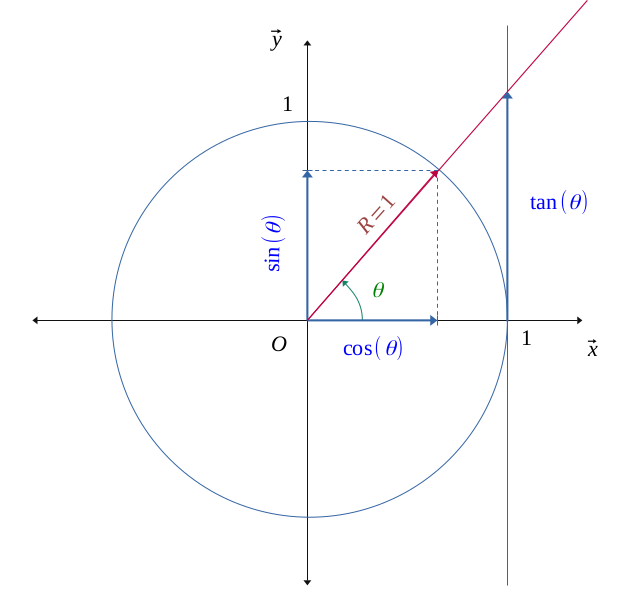
En appliquant
le théorème de Thalès
, on voit bien la relation :
$$ \frac{\cos(\theta)}{1} = \frac{\sin(\theta)}{\tan(\theta)} \Longleftrightarrow \tan(\theta) = \frac{\sin(\theta)}{\cos(\theta)} $$
La fonction \( \sin(x) \) est définie de la manière suivante :
$$ \forall x \in \mathbb{R}, \enspace f(x) = \sin(x) $$
Elle admet pour dérivée :
$$ \forall x \in \mathbb{R}, $$
$$ \sin(x)' = \cos(x) $$
La fonction \( \cos(x) \) est définie de la manière suivante :
$$ \forall x \in \mathbb{R}, \enspace f(x) = \cos(x) $$
Elle admet pour dérivée :
$$ \forall x \in \mathbb{R}, $$
$$ \cos(x)' = -\sin(x) $$
La fonction \( \tan(x) \) est définie de la manière suivante :
$$ \forall k \in \mathbb{Z}, \enspace \forall x \in \biggl[ \mathbb{R} \hspace{0.2em} \backslash \hspace{0.2em} \Bigl \{ \frac{\pi}{2} + k\pi \Bigr \} \biggr], \enspace f(x) = \tan(x) = \frac{\sin(x)}{\cos(x)} $$
Elle admet pour dérivée :
$$ \forall k \in \mathbb{Z}, \enspace \forall x \in \biggl[ \mathbb{R} \hspace{0.2em} \backslash \hspace{0.2em} \Bigl \{ \frac{\pi}{2} + k\pi \Bigr \} \biggr] $$
$$ \tan(x)' = 1 + \tan^2(x) = \frac{1}{\cos^2(x)}= \sec^2(x) $$
La fonction \( \operatorname{Arcsin}(x) \) est
la fonction réciproque
de
la fonction \( \sin(x) \)
, elle est définie de la manière suivante :
$$ \forall x \in [-1, \hspace{0.2em} 1], \enspace f(x) = \operatorname{Arcsin}(x) = \sin^{-1}(x) $$
Elle admet pour dérivée :
$$ \forall x \in \hspace{0.04em} ]-1 ,\hspace{0.2em} 1[, $$
$$ \operatorname{Arcsin}(x)' = \frac{1}{\sqrt{1 - x^2}} $$
La fonction \( \operatorname{Arccos}(x) \) est
la fonction réciproque
de
la fonction \( \cos(x) \)
, elle est définie de la manière suivante :
$$ \forall x \in [-1, \hspace{0.2em} 1], \enspace f(x) = \operatorname{Arccos}(x) = \cos^{-1}(x) $$
Elle admet pour dérivée :
$$ \forall x \in \hspace{0.04em} ]-1 , \hspace{0.2em}1[, $$
$$ \operatorname{Arccos}(x)' = -\frac{1}{\sqrt{1 - x^2}} $$
La fonction \( \operatorname{Arctan}(x) \) est
la fonction réciproque
de
la fonction \( \tan(x) \)
, elle est définie de la manière suivante :
$$ \forall x \in \mathbb{R}, \enspace f(x) = \operatorname{Arctan}(x) = \tan^{-1}(x) $$
Elle admet pour dérivée :
$$ \forall x \in \mathbb{R}, $$
$$ \operatorname{Arctan}(x)' = \frac{1}{1 + x^2} $$
Les trois fonctions trigonométriques sécantes sont les fonctions \( \csc(x), \sec(x) \) et \( \cot(x) \).
Elles sont respectivement les inverses des fonctions \( \sin(x), \cos(x) \) et \( \tan(x) \).
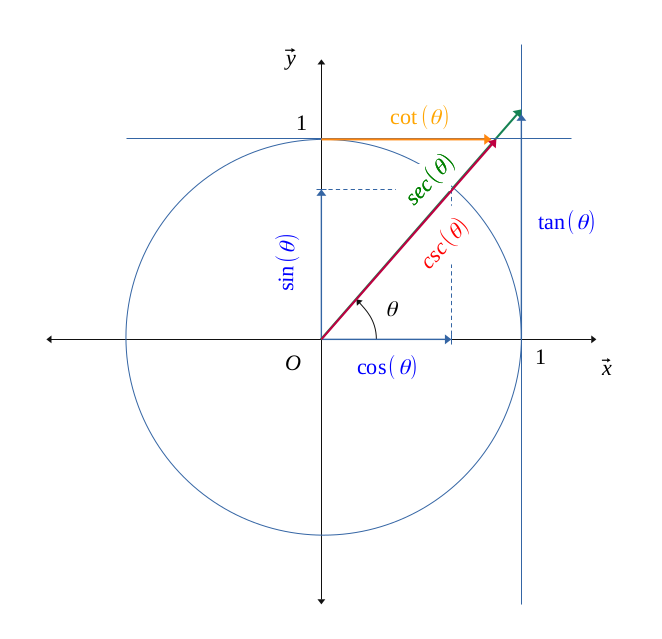
En appliquant
le théorème de Thalès
, on voit bien les relations :
$$ \left \{ \begin{gather*} \frac{\csc(\theta)}{1} = \frac{1}{\sin(\theta)} \Longleftrightarrow \csc(\theta) = \frac{1}{\sin(\theta)} \\ \frac{\sec(\theta)}{1} = \frac{1}{\cos(\theta)} \Longleftrightarrow \sec(\theta) = \frac{1}{\cos(\theta)} \\ \frac{\cot(\theta)}{1} = \frac{\csc(\theta)}{\sec(\theta)} = \frac{1}{\tan(\theta)} \Longleftrightarrow \cot(\theta) = \frac{1}{\tan(\theta)} \end{gather*} \right \} $$
La fonction \( \csc(x) \) est définie de la manière suivante :
$$ \forall k \in \mathbb{Z}, \ \forall x \in \Bigl[ \mathbb{R} \hspace{0.2em} \backslash \hspace{0.2em} \bigl \{ k\pi \bigr \} \Bigr], \enspace f(x) = \csc(x) = \frac{1}{\sin(x)} $$
Elle admet pour dérivée :
$$ \forall k \in \mathbb{Z}, \ \forall x \in \Bigl[ \mathbb{R} \hspace{0.2em} \backslash \hspace{0.2em} \bigl \{ k\pi \bigr \} \Bigr], $$
$$ \csc(x)' = - \csc^2(x)\cos(x) = -\csc(x)\cot(x) $$
On remarque par ailleurs que :
$$ \forall k \in \mathbb{Z}, \ \forall x \in \Bigl[ \mathbb{R} \hspace{0.2em} \backslash \hspace{0.2em} \bigl \{ k\pi \bigr \} \Bigr], $$
$$ \frac{\csc'(x)}{\csc(x)} = -\csc(x)\cos(x) = -\tan(x)$$
La fonction \( \sec(x) \) est définie de la manière suivante :
$$ \forall k \in \mathbb{Z}, \enspace \forall x \in \biggl[ \mathbb{R} \hspace{0.2em} \backslash \hspace{0.2em} \Bigl \{ \frac{\pi}{2} + k\pi \Bigr \} \biggr], \enspace f(x) = \sec(x) = \frac{1}{\cos(x)} $$
Elle admet pour dérivée :
$$ \forall k \in \mathbb{Z}, \enspace \forall x \in \biggl[ \mathbb{R} \hspace{0.2em} \backslash \hspace{0.2em} \Bigl \{ \frac{\pi}{2} + k\pi \Bigr \} \biggr], $$
$$ \sec(x)' = \sec^2(x) \sin(x) = \sec(x)\tan(x) $$
On remarque par ailleurs que :
$$ \forall k \in \mathbb{Z}, \enspace \forall x \in \biggl[ \mathbb{R} \hspace{0.2em} \backslash \hspace{0.2em} \Bigl \{ \frac{\pi}{2} + k\pi \Bigr \} \biggr], $$
$$ \frac{\sec'(x)}{\sec(x)} = \sec(x)\sin(x) = \tan(x)$$
La fonction \( \cot(x) \) est définie de la manière suivante :
$$ \forall k \in \mathbb{Z}, \enspace \forall x \in \Bigl[ \mathbb{R} \hspace{0.2em} \backslash \hspace{0.2em} \bigl \{ k\pi \bigr \} \Bigr] , \enspace f(x) = \cot(x) = \frac{\csc(x)}{\sec(x)} = \frac{1}{\tan(x)} $$
Elle admet pour dérivée :
$$ \forall k \in \mathbb{Z}, \enspace \forall x \in \Bigl[ \mathbb{R} \hspace{0.2em} \backslash \hspace{0.2em} \bigl \{ k\pi \bigr \} \Bigr], $$
$$ \cot(x)' = -(1 + \cot^2(x)) = - \csc^2(x) $$
La fonction \( \operatorname{Arccsc}(x) \) est
la fonction réciproque
de
la fonction \( \csc(x) \)
, elle est définie de la manière suivante :
$$ \forall x \in \hspace{0.04em} ]-\infty, \hspace{0.1em} -1] \cup[1, \hspace{0.1em} +\infty[ , \enspace f(x) = \operatorname{Arccsc}(x) = \csc^{-1}(x) $$
Elle admet pour dérivée :
$$ \forall x \in \hspace{0.04em} ]-\infty, \hspace{0.1em} -1[\hspace{0.1em}\cup \hspace{0.1em}]1, \hspace{0.1em} +\infty[, $$
$$ \operatorname{Arccsc}(x)' = - \frac{1}{ x^2} \times \frac{1}{ \sqrt{1 - \frac{1}{ x^2}}} $$
La fonction \( \operatorname{Arcsec}(x) \) est
la fonction réciproque
de
la fonction \( \sec(x) \)
, elle est définie de la manière suivante :
$$ \forall x \in \hspace{0.04em} ]-\infty, \hspace{0.1em} -1] \cup[1, \hspace{0.1em} +\infty[ , \enspace f(x) = \operatorname{Arcsec}(x) = \sec^{-1}(x) $$
Elle admet pour dérivée :
$$ \forall x \in \hspace{0.04em} ]-\infty, \hspace{0.1em} -1[\hspace{0.1em}\cup \hspace{0.1em}]1, \hspace{0.1em} +\infty[, $$
$$ \operatorname{Arcsec}(x)' = \frac{1}{ x^2} \times \frac{1}{ \sqrt{1 - \frac{1}{ x^2}}} $$
La fonction \( \operatorname{Arccot}(x) \) est
la fonction réciproque
de
la fonction \( \cot(x) \)
, elle est définie de la manière suivante :
$$ \forall x \in \mathbb{R} , \enspace f(x) = \operatorname{Arccot}(x) = \cot^{-1}(x) $$
Elle admet pour dérivée :
$$ \forall x \in \mathbb{R}, $$
$$ \operatorname{Arccot}(x)' = - \frac{1}{ 1 + x^2} $$
Les trois fonctions hyperboliques sont les fonctions \( \sinh(x), \cosh(x) \) et \( \tanh(x) \).
Elles sont le pendant respectif des fonctions \( \sin(x), \cos(x) \) et \( \tan(x) \), notamment au niveau des propriétés.
La fonction \( \sinh(x) \) est définie de la manière suivante :
$$ \forall x \in \mathbb{R}, \enspace f(x) = \sinh(x) = \frac{e^x - e^{-x} }{2} $$
Elle admet pour dérivée :
$$ \forall x \in \mathbb{R}, $$
$$ \sinh(x)' = \cosh(x) $$
La fonction \( \cosh(x) \) est définie de la manière suivante :
$$ \forall x \in \mathbb{R}, \enspace f(x) = \cosh(x) = \frac{e^x + e^{-x} }{2} $$
Elle admet pour dérivée :
$$ \forall x \in \mathbb{R}, $$
$$ \cosh(x)' = \sinh(x) $$
La fonction \( \tanh(x) \) est définie de la manière suivante :
$$ \forall x \in \mathbb{R}, \enspace f(x) = \tanh(x) = \frac{\sinh(x)}{\cosh(x)} = \frac{e^x - e^{-x}}{e^x + e^{-x}} $$
Elle admet pour dérivée :
$$ \forall x \in \mathbb{R}, $$
$$ \tanh(x)' = 1 - \tanh^2(x) = \operatorname{sech}^2(x) $$
La fonction \( \operatorname{Argsinh}(x) \) est
la fonction réciproque
de
la fonction \( \sinh(x) \)
, elle est définie de la manière suivante :
$$ \forall x \in \mathbb{R}, \enspace f(x) = \operatorname{Argsinh}(x)= \sinh^{-1}(x) $$
Par ailleurs, elle peut aussi être définie explicitement par :
$$ \forall x \in \mathbb{R},$$
$$ \operatorname{Argsinh}(x) = \ln \left|x + \sqrt{x^2 + 1}\right| $$
(\(\Longrightarrow\) voir
la démonstration
)
Elle admet pour dérivée :
$$ \forall x \in \mathbb{R}, $$
$$ \operatorname{Argsinh}(x)' = \frac{1}{\sqrt{1 + x^2}} $$
La fonction \( \operatorname{Argcosh}(x) \) est
la fonction réciproque
de
la fonction \( \cosh(x) \)
, elle est définie de la manière suivante :
$$ \forall x \in [1, \hspace{0.1em} +\infty[, \enspace f(x) = \operatorname{Argcosh}(x) = \cosh^{-1}(x) $$
Par ailleurs, elle peut aussi être définie explicitement par :
$$ \forall x \in [1, \hspace{0.1em} +\infty[, $$
$$ \operatorname{Argcosh}(x) = \ln \Bigl| x + \sqrt{x^2 - 1}\Bigr| $$
(\(\Longrightarrow\) voir
la démonstration
)
Elle admet pour dérivée :
$$ \forall x \in \hspace{0.04em} ]1, \hspace{0.1em} +\infty[, $$
$$ \operatorname{Argcosh}(x)' = \frac{1}{\sqrt{x^2 -1}} $$
La fonction \( \operatorname{Argtanh}(x) \) est
la fonction réciproque
de
la fonction \( \tanh(x) \)
, elle est définie de la manière suivante :
$$ \forall x \in \hspace{0.04em} ]-1, \hspace{0.1em} 1[, \enspace f(x) = \operatorname{Argtanh}(x) = \tanh^{-1}(x) $$
Par ailleurs, elle peut aussi être définie explicitement par :
$$\forall x \in \hspace{0.04em} ]-1, \hspace{0.1em} 1[,$$
$$ \operatorname{Argtanh}(x) = \frac{1}{2} \ln \left| \frac{1 + x}{1 - x} \right| $$
(\(\Longrightarrow\) voir
la démonstration
)
Elle admet pour dérivée :
$$ \forall x \in \hspace{0.04em} ]-1, \hspace{0.1em} 1[, $$
$$ \operatorname{Argtanh}(x)' = \frac{1}{1 - x^2} $$
Les trois fonctions sécantes hyperboliques sont les fonctions \( \operatorname{csch}(x), \operatorname{sech}(x) \) et \(\operatorname{coth}(x) \).
Elles sont respectivement les inverses des fonctions \( \sinh(x), \cosh(x) \) et \( \tanh(x) \).
La fonction \( \operatorname{csch}(x) \) est définie de la manière suivante :
$$ \forall x \in \Bigl[ \mathbb{R} \hspace{0.2em} \backslash \hspace{0.2em} \bigl \{ 0 \bigr \} \Bigr], \enspace f(x) = \operatorname{csch}(x) = \frac{1}{\sinh(x)} $$
Elle admet pour dérivée :
$$ \forall x \in \Bigl[ \mathbb{R} \hspace{0.2em} \backslash \hspace{0.2em} \bigl \{ 0 \bigr \} \Bigr], $$
$$ \operatorname{csch}(x)' = - \operatorname{csch}^2(x) \cosh(x) = -\operatorname{csch}(x)\operatorname{coth}(x) $$
On remarque par ailleurs que :
$$ \forall x \in \Bigl[ \mathbb{R} \hspace{0.2em} \backslash \hspace{0.2em} \bigl \{ 0 \bigr \} \Bigr], $$
$$ \frac{\operatorname{csch}'(x)}{\operatorname{csch}(x)} = -\operatorname{csch}(x)\cosh(x) = -\operatorname{coth}(x)$$
La fonction \( \operatorname{sech}(x) \) est définie de la manière suivante :
$$ \forall x \in \mathbb{R}, \enspace f(x) = \operatorname{sech}(x) = \frac{1}{\cosh(x)} $$
Elle admet pour dérivée :
$$ \forall x \in \mathbb{R}, $$
$$ \operatorname{sech}(x)' = -\operatorname{sech}^2(x)\sinh(x) = -\operatorname{sech}(x)\tanh(x) $$
On remarque par ailleurs que :
$$ \forall x \in \mathbb{R}, $$
$$ \frac{\operatorname{sech}'(x)}{\operatorname{sech}(x)} = -\operatorname{sech}(x)\sinh(x) = -\tanh(x)$$
La fonction \( \operatorname{coth}(x) \) est définie de la manière suivante :
$$ \forall x \in \Bigl[ \mathbb{R} \hspace{0.2em} \backslash \hspace{0.2em} \bigl \{ 0 \bigr \} \Bigr], \enspace f(x) = \operatorname{coth}(x) = \frac{1}{\tanh(x)} $$
Elle admet pour dérivée :
$$ \forall x \in \Bigl[ \mathbb{R} \hspace{0.2em} \backslash \hspace{0.2em} \bigl \{ 0 \bigr \} \Bigr], $$
$$ \operatorname{coth}(x)' = 1 - \cot^2(x) = -\operatorname{csch}^2(x)$$
La fonction \( \operatorname{Argcsch}(x) \) est
la fonction réciproque
de
la fonction \( \operatorname{csch}(x) \)
, elle est définie de la manière suivante :
$$\forall x \in \Bigl[ \mathbb{R} \hspace{0.1em} \backslash \hspace{0.2em} \left \{ 0 \right \} \Bigr] , \enspace f(x) = \operatorname{Argcsch}(x) = \operatorname{csch}^{-1}(x) $$
Elle admet pour dérivée :
$$\forall x \in \Bigl[ \mathbb{R} \hspace{0.1em} \backslash \hspace{0.2em} \left \{ 0 \right \} \Bigr] , $$
$$ \operatorname{Argcsch}(x)' = - \frac{1}{ x^2} \times \frac{1}{ \sqrt{1 + \frac{1}{ x^2}}} $$
La fonction \( \operatorname{Argsech}(x) \) est
la fonction réciproque
de
la fonction \( \operatorname{sech}(x) \)
, elle est définie de la manière suivante :
$$ \forall x \in \hspace{0.04em} \bigl]0, \hspace{0.1em} 1 \bigr] , \enspace f(x) = \operatorname{Argsech}(x) = \operatorname{sech}^{-1}(x) $$
Elle admet pour dérivée :
$$ \forall x \in \hspace{0.1em} \bigl]0, \hspace{0.1em} 1 \bigr], $$
$$ \operatorname{Argsech}(x)' = - \frac{1}{ x^2} \times \frac{1}{ \sqrt{\frac{1}{ x^2} - 1}} $$
La fonction \( \operatorname{Argcoth}(x) \) est
la fonction réciproque
de
la fonction \( \operatorname{coth}(x) \)
, elle est définie de la manière suivante :
$$ \forall x \in \hspace{0.04em} ]-\infty, \hspace{0.1em} -1[ \hspace{0.1em} \cup \hspace{0.1em} ]1, \hspace{0.1em} +\infty[ , \enspace f(x) = \operatorname{Argcoth}(x) =\operatorname{coth}^{-1}(x) $$
Elle admet pour dérivée :
$$ \forall x \in \hspace{0.04em} ]-\infty, \hspace{0.1em} -1[ \hspace{0.1em} \cup \hspace{0.1em} ]1, \hspace{0.1em} +\infty[, $$
$$ \operatorname{Argcoth}(x)' = \frac{1}{ 1 - x^2} $$
Démonstrations
La fonction \( \sin(x) \) est définie de la manière suivante :
$$ \forall x \in \mathbb{R}, \enspace f(x) = \sin(x) $$
Avec
la définition de la dérivée
, on a :
$$ \sin(x)' = \lim_{h \to 0 } \enspace \frac{ \sin(x + h) - \sin(x)}{h} $$
Avec
les formules d'addition trigonométriques
, on sait que :
$$ \forall (\alpha, \beta) \in \hspace{0.04em} \mathbb{R}^2, $$
$$ \sin(\alpha + \beta) = \sin(\alpha) \cos(\beta) + \cos(\alpha) \sin(\beta) $$
Soit :
$$ \sin(x)' = \lim_{h \to 0 } \enspace \frac{ \sin(x) \cos(h) + \cos(x) \sin(h) - \sin(x)}{h} $$
Lorsque \( h \to 0\), \( \cos(h) \to 1\) et \( \sin(h) \to h\).
Et,
$$ \sin(x)' = \lim_{h \to 0 } \enspace \frac{ \sin(x) + \cos(x). h - \sin(x)}{h} $$
$$ \sin(x)' = \lim_{h \to 0 } \enspace \frac{\cos(x). h }{h} $$
Soit finalement,
$$ \forall x \in \mathbb{R}, $$
$$ \sin(x)' = \cos(x) $$
La fonction \( \cos(x) \) est définie de la manière suivante :
$$ \forall x \in \mathbb{R}, \enspace f(x) = \cos(x) $$
Avec
la définition de la dérivée
, on a :
$$\cos(x)' = \lim_{h \to 0 } \enspace \frac{ \cos(x + h) - \cos(x)}{h} $$
Avec
les formules d'addition trigonométriques
, on sait que :
$$ \forall (\alpha, \beta) \in \hspace{0.04em} \mathbb{R}^2, $$
$$ \cos(\alpha + \beta) = \cos(\alpha) \cos(\beta) - \sin(\alpha) \sin(\beta) $$
Soit :
$$\cos(x)' = \lim_{h \to 0 } \enspace \frac{ \cos(x) \cos(h) - \sin(x) \sin(h) - \cos(x)}{h} $$
Lorsque \( h \to 0\), \( \cos(h) \to 1\) et \( \sin(h) \to h\).
Et,
$$\cos(x)' = \lim_{h \to 0 } \enspace \frac{ \cos(x) - \sin(x). h - \cos(x)}{h} $$
$$\cos(x)' = \lim_{h \to 0 } \enspace \frac{ - \sin(x). h }{h} $$
Soit finalement,
$$ \forall x \in \mathbb{R}, $$
$$ \cos(x)' = -\sin(x) $$
La fonction \( \tan(x) \) est définie de la manière suivante :
$$ \forall k \in \mathbb{Z}, \enspace \forall x \in \biggl[ \mathbb{R} \hspace{0.2em} \backslash \hspace{0.2em} \Bigl \{ \frac{\pi}{2} + k\pi \Bigr \} \biggr], \enspace f(x) = \tan(x) = \frac{\sin(x)}{\cos(x)} $$
Par définition,
$$ \tan(x)' = \left( \frac{\sin(x)}{\cos(x)} \right)' $$
Avec
la dérivée d'un quotient
, on sait que :
$$ \forall (f,g), \ g \neq 0, $$
$$ \left ( f \over g \right)' = \frac{f'g - g'f}{g^2} $$
Soit dans notre cas :
$$ \tan(x)' = \frac{\cos(x)\cos(x) + \sin(x)\sin(x)}{\cos^2(x)} $$
$$ \tan(x)' = \frac{\cos^2(x) + \sin^2(x)}{\cos^2(x)} $$
$$ \tan(x)' = \frac{\cos^2(x) + \sin^2(x)}{\cos^2(x)} $$
Et finalement,
$$ \forall k \in \mathbb{Z}, \forall x \in \biggl[ \mathbb{R} \hspace{0.2em} \backslash \hspace{0.2em} \Bigl \{ \frac{\pi}{2} + k\pi \Bigr \} \biggr] $$
$$ \tan(x)' = 1 + \tan^2(x) = \frac{1}{\cos^2(x)} = \sec^2(x) $$
La fonction \( \operatorname{Arcsin}(x) \) est
la fonction réciproque
de
la fonction \( \sin(x) \)
, elle est définie de la manière suivante :
$$ \forall x \in [-1, \hspace{0.2em} 1], \enspace f(x) = \operatorname{Arcsin}(x) = \sin^{-1}(x) $$
On peut calculer cette dérivée en passant par
la dérivée d'une fonction réciproque
:
$$ ( f^{-1} )'= \frac{1}{ (f' \circ f^{-1})} $$
$$ \text{avec } \left \{ \begin{gather*} f(x) = \sin(x) \\ f'(x) = \cos(x) \\ f^{-1}(x) = \operatorname{Arcsin}(x) \end{gather*} \right \} $$
Par suite,
$$ \operatorname{Arcsin}(x)' = \frac{1}{\cos(\operatorname{Arcsin}(x))} $$
Par ailleurs,
$$ \cos^2(x) + \sin^2(x) = 1$$
$$ \cos^2(x) = 1 - \sin^2(x) $$
$$ | \cos(x) | = \sqrt{1 - \sin^2(x)} $$
Or, la fonction \(\operatorname{Arcsin}(x)\) étant définie quand \( x \in \bigl[-1; 1\bigr]\) à valeurs dans \(\left[-\frac{\pi}{2}; \frac{\pi}{2} \right]\), la fonction \(\cos(\operatorname{Arcsin}(x))\) est toujours positive car la fonction \(\cos(X)\) est positive quand \(X \in \left[-\frac{\pi}{2}; \frac{\pi}{2} \right]\).
$$x \longmapsto \operatorname{Arcsin}(x)$$
$$\bigl[-1; 1\bigr] \longmapsto \left[-\frac{\pi}{2}; \frac{\pi}{2} \right]$$
$$ \hspace{12em} X \longmapsto \cos(X)$$
$$\hspace{12em} \left[-\frac{\pi}{2}; \frac{\pi}{2} \right] \longmapsto \bigl[0; 1\bigr]$$
Soit dans notre cas, on peut garder uniquement le cas positif :
$$ \cos(\operatorname{Arcsin}(x)) = \sqrt{1 - \sin^2(\operatorname{Arcsin}(x))} $$
Donc en remplaçant on a,
$$ \operatorname{Arcsin}(x)' = \frac{1}{\sqrt{1 - \sin^2(\operatorname{Arcsin}(x))}} $$
Soit finalement,
$$ \forall x \in \hspace{0.04em} ]-1 ,\hspace{0.2em} 1[, $$
$$ \operatorname{Arcsin}(x)' = \frac{1}{\sqrt{1 - x^2}} $$
La fonction \( \operatorname{Arccos}(x) \) est
la fonction réciproque
de
la fonction \( \cos(x) \)
, elle est définie de la manière suivante :
$$ \forall x \in [-1, \hspace{0.2em} 1], \enspace f(x) = \operatorname{Arccos}(x) = \cos^{-1}(x) $$
Exactement par le même procédé que pour
le calcul de \(\operatorname{Arcsin}(x)'\)
ci-dessus :
$$ \operatorname{Arccos}(x)' = - \frac{1}{\sqrt{1 - \cos^2(\operatorname{Arccos}(x))}} $$
Soit finalement,
$$ \forall x \in \hspace{0.04em} ]-1 , \hspace{0.2em}1[, $$
$$ \operatorname{Arccos}(x)' = -\frac{1}{\sqrt{1 - x^2}} $$
La fonction \( \operatorname{Arctan}(x) \) est
la fonction réciproque
de
la fonction \( \tan(x) \)
, elle est définie de la manière suivante :
$$ \forall x \in \mathbb{R}, \enspace f(x) = \operatorname{Arctan}(x) = \tan^{-1}(x) $$
Exactement par le même procédé que pour
le calcul de \(\operatorname{Arcsin}(x)'\)
ci-dessus :
$$ \operatorname{Arctan}(x)' = \frac{1}{1 + \tan^2(\operatorname{Arctan}(x))} $$
Soit finalement,
$$ \forall x \in \mathbb{R}, $$
$$ \operatorname{Arctan}(x)' = \frac{1}{1 + x^2} $$
La fonction \( \csc(x) \) est définie de la manière suivante :
$$ \forall k \in \mathbb{Z}, \ \forall x \in \Bigl[ \mathbb{R} \hspace{0.2em} \backslash \hspace{0.2em} \bigl \{ k\pi \bigr \} \Bigr], \enspace f(x) = \csc(x) = \frac{1}{\sin(x)} $$
Par définition, on a :
$$ \csc(x)' = \biggl(\frac{1}{\sin(x)} \biggr)' $$
Soit ici,
$$ \csc(x)' = -\frac{\cos(x)}{\sin^2(x)} $$
Et finalement,
$$ \forall k \in \mathbb{Z}, \ \forall x \in \Bigl[ \mathbb{R} \hspace{0.2em} \backslash \hspace{0.2em} \bigl \{ k\pi \bigr \} \Bigr], $$
$$ \csc(x)' = - \csc^2(x)\cos(x) = -\csc(x)\cot(x) $$
On remarque par ailleurs que :
$$ \frac{\csc'(x)}{\csc(x)} = \frac{-\csc^2(x)\cos(x)}{\csc(x)} $$
$$ \forall k \in \mathbb{Z}, \ \forall x \in \Bigl[ \mathbb{R} \hspace{0.2em} \backslash \hspace{0.2em} \bigl \{ k\pi \bigr \} \Bigr], $$
$$ \frac{\csc'(x)}{\csc(x)} = -\csc(x)\cos(x) = -\tan(x)$$
La fonction \( \sec(x) \) est définie de la manière suivante :
$$ \forall k \in \mathbb{Z}, \enspace \forall x \in \biggl[ \mathbb{R} \hspace{0.2em} \backslash \hspace{0.2em} \Bigl \{ \frac{\pi}{2} + k\pi \Bigr \} \biggr], \enspace f(x) = \sec(x) = \frac{1}{\cos(x)} $$
Par définition :
$$ \sec(x)' = \biggl(\frac{1}{\cos(x)} \biggr)' $$
On applique encore
la dérivée de l'inverse d'une fonction
:
$$ \sec(x)' = \frac{\sin(x)}{\cos^2(x)} $$
Et finalement,
$$ \forall k \in \mathbb{Z}, \enspace \forall x \in \biggl[ \mathbb{R} \hspace{0.2em} \backslash \hspace{0.2em} \Bigl \{ \frac{\pi}{2} + k\pi \Bigr \} \biggr], $$
$$ \sec(x)' = \sec^2(x) \sin(x) = \sec(x)\tan(x) $$
On remarque par ailleurs que :
$$ \frac{\sec'(x)}{\sec(x)} = \frac{\sec^2(x)\tan(x)}{\sec(x)} $$
$$ \forall k \in \mathbb{Z}, \enspace \forall x \in \biggl[ \mathbb{R} \hspace{0.2em} \backslash \hspace{0.2em} \Bigl \{ \frac{\pi}{2} + k\pi \Bigr \} \biggr], $$
$$ \frac{\sec'(x)}{\sec(x)} = \sec(x)\sin(x) = \tan(x)$$
La fonction \( \cot(x) \) est définie de la manière suivante :
$$ \forall k \in \mathbb{Z}, \enspace \forall x \in \Bigl[ \mathbb{R} \hspace{0.2em} \backslash \hspace{0.2em} \bigl \{ k\pi \bigr \} \Bigr] , \enspace f(x) = \cot(x) = \frac{\csc(x)}{\sec(x)} = \frac{1}{\tan(x)} $$
Par définition :
$$ \cot(x)' = \biggl(\frac{1}{\tan(x)} \biggr)' $$
On applique encore
la dérivée de l'inverse d'une fonction
.
$$ \cot(x)' = - \frac{1 + \tan^2(x)}{\tan^2(x)} $$
Et finalement,
$$ \forall k \in \mathbb{Z}, \enspace \forall x \in \Bigl[ \mathbb{R} \hspace{0.2em} \backslash \hspace{0.2em} \bigl \{ k\pi \bigr \} \Bigr], $$
$$ \cot(x)' = -(1 + \cot^2(x)) = - \csc^2(x) $$
La fonction \( \operatorname{Arccsc}(x) \) est
la fonction réciproque
de
la fonction \( \csc(x) \)
, elle est définie de la manière suivante :
On peut calculer cette dérivée en passant par
la dérivée d'une fonction réciproque
:
$$ ( f^{-1} )'= \frac{1}{ (f' \circ f^{-1})} $$
$$ \text{avec } \left \{ \begin{gather*} f(x) = \csc(x) \\ f'(x) = - \csc^2(x)\cos(x) \\ f^{-1}(x) = \operatorname{Arccsc}(x) \end{gather*} \right \} $$
$$ \operatorname{Arccsc}(x)' = -\frac{1}{\csc^2(\operatorname{Arccsc}(x)) \times \cos(\operatorname{Arccsc}(x))} $$
Par ailleurs,
$$ \cos^2(x) + \sin^2(x) = 1$$
$$ \cos^2(x) = 1 - \sin^2(x) $$
$$ | \cos(x) | = \sqrt{1 - \sin^2(x)} $$
Or, la fonction \(\operatorname{Arccsc}(x)\) étant définie quand \( x \in \bigl[-\infty; -1\bigr] \cup \bigl[1; +\infty\bigr] \) à valeurs dans \(\left[-\frac{\pi}{2}; 0 \right[ \cup \left]0; \frac{\pi}{2} \right] \), la fonction \(\cos(\operatorname{Arcsin}(x))\) est toujours positive car la fonction \(\cos(X)\) est positive quand \( X \in \left[-\frac{\pi}{2}; 0 \right[ \cup \left]0; \frac{\pi}{2} \right] \).
$$\hspace{6em} x \longmapsto \operatorname{Arccsc}(x)$$
$$\bigl[-\infty; -1\bigr] \cup \bigl[1; +\infty\bigr] \longmapsto \left[-\frac{\pi}{2}; 0 \right[ \cup \left]0; \frac{\pi}{2} \right]$$
$$ \hspace{16em} X \longmapsto \cos(X)$$
$$\hspace{16em} \left[-\frac{\pi}{2}; 0 \right[ \cup \left]0; \frac{\pi}{2} \right] \longmapsto \bigl[0; 1\bigr]$$
Soit dans notre cas, on peut garder uniquement le cas positif :
$$ \cos(\operatorname{Arccsc}(x)) = \sqrt{1 - \sin^2(\operatorname{Arccsc}(x))} $$
$$ \operatorname{Arccsc}(x)' = -\frac{1}{\csc^2(\operatorname{Arccsc}(x)) \times \sqrt{1 - \sin^2(\operatorname{Arccsc}(x))}} $$
Mais :
$$ \csc(x) = \frac{1}{\sin(x)} \Longleftrightarrow \sin(x) = \frac{1}{\csc(x)} $$
Soit,
$$ \operatorname{Arccsc}(x)' = - \frac{1}{ x^2} \times \frac{1}{ \sqrt{1 - \frac{1}{\csc^2(\operatorname{Arccsc}(x))}}} $$
Soit finalement,
$$ \forall x \in \hspace{0.04em} ]-\infty, \hspace{0.1em} -1[\hspace{0.1em}\cup \hspace{0.1em}]1, \hspace{0.1em} +\infty[, $$
$$ \operatorname{Arccsc}(x)' = - \frac{1}{ x^2} \times \frac{1}{ \sqrt{1 - \frac{1}{ x^2}}} $$
La fonction \( \operatorname{Arcsec}(x) \) est
la fonction réciproque
de
la fonction \( \sec(x) \)
, elle est définie de la manière suivante :
$$ \forall x \in \hspace{0.04em} ]-\infty, \hspace{0.1em} -1] \cup[1, \hspace{0.1em} +\infty[ , \enspace f(x) = \operatorname{Arcsec}(x) = \sec^{-1}(x) $$
Exactement par le même procédé que pour
le calcul \(\operatorname{Arccsc}(x)'\)
ci-dessus :
$$ \forall x \in \hspace{0.04em} ]-\infty, \hspace{0.1em} -1[\hspace{0.1em}\cup \hspace{0.1em}]1, \hspace{0.1em} +\infty[, $$
$$ \operatorname{Arcsec}(x)' = \frac{1}{ x^2} \times \frac{1}{ \sqrt{1 - \frac{1}{ x^2}}} $$
La fonction \( \sinh(x) \) est définie de la manière suivante :
$$ \forall x \in \mathbb{R}, \enspace f(x) = \sinh(x) = \frac{e^x - e^{-x} }{2} $$
Ici, on va juste faire varier les exponentielles en utilisant la
dérivation en chaîne
:
$$ \sinh(x)' = \biggl(\frac{e^x - e^{-x}}{2} \biggr)' $$
$$ \sinh(x)' = \frac{1}{2} \bigl( e^x + e^{-x} \bigr) $$
$$ \sinh(x)' = \biggl(\frac{e^x + e^{-x}}{2} \biggr) $$
Et finalement,
$$ \forall x \in \mathbb{R}, $$
$$ \sinh(x)' = \cosh(x) $$
La fonction \( \cosh(x) \) est définie de la manière suivante :
$$ \forall x \in \mathbb{R}, \enspace f(x) = \cosh(x) = \frac{e^x + e^{-x} }{2} $$
On utilise exactement le même procédé que pour
le calcul de \(\sinh(x)'\)
:
$$ \cosh(x)' = \biggl(\frac{e^x + e^{-x}}{2} \biggr)' $$
$$ \cosh(x)' = \frac{1}{2} \bigl( e^x - e^{-x} \bigr) $$
$$ \cosh(x)' = \biggl(\frac{e^x - e^{-x}}{2} \biggr) $$
Et finalement,
$$ \forall x \in \mathbb{R}, $$
$$ \cosh(x)' = \sinh(x) $$
La fonction \( \tanh(x) \) est définie de la manière suivante :
$$ \forall x \in \mathbb{R}, \enspace f(x) = \tanh(x) = \frac{\sinh(x)}{\cosh(x)} = \frac{e^x - e^{-x}}{e^x + e^{-x}} $$
Par définition, on a :
$$ \tanh(x)' = \biggl(\frac{e^x - e^{-x}}{e^x + e^{-x}} \biggr)' $$
On applique
la dérivée d'un quotient
:
$$ \tanh(x)' = \frac{(e^x + e^{-x}) (e^x + e^{-x}) - (e^x - e^{-x})(e^x - e^{-x})}{(e^x + e^{-x})^2} $$
$$ \tanh(x)' = \frac{(e^x + e^{-x})^2 - (e^x - e^{-x})^2}{(e^x + e^{-x})^2} $$
$$ \tanh(x)' = 1 - \frac{(e^x - e^{-x})^2}{(e^x + e^{-x})^2} $$
Et finalement,
$$ \forall x \in \mathbb{R}, $$
$$ \tanh(x)' = 1 - \tanh^2(x) = \operatorname{sech}^2(x) $$
La fonction \( \operatorname{Argsinh}(x) \) est
la fonction réciproque
de
la fonction \( \sinh(x) \)
, elle est définie de la manière suivante :
$$ \forall x \in \mathbb{R}, \enspace f(x) = \operatorname{Argsinh}(x)= \sinh^{-1}(x) $$
Par ailleurs, elle peut aussi être définie explicitement par :
$$ \forall x \in \mathbb{R}, \ $$
$$ \operatorname{Argsinh}(x) = \ln \left|x + \sqrt{x^2 + 1}\right| $$
(\(\Longrightarrow\) voir
la démonstration
)
On peut calculer cette dérivée en passant par
la dérivée d'une fonction réciproque
:
$$ ( f^{-1} )'= \frac{1}{ (f' \circ f^{-1})} $$
$$ \text{avec } \left \{ \begin{gather*} f(x) = \sinh(x) \\ f('x) = \cosh(x) \\ f^{-1}(x) = \operatorname{Argsinh}(x) \end{gather*} \right \} $$
$$ \operatorname{Argsinh}(x)' = \frac{1}{\cosh(\operatorname{Argsinh}(x))} $$
Par ailleurs,
$$ \cosh^2(x) -\sinh^2(x) = 1$$
$$ \cosh^2(x) = 1 + \sinh^2(x) $$
$$ | \cosh(x) | = \sqrt{1 +\sinh^2(x)} $$
Comme la fonction \(\cosh(x)\) est toujours positive quand \(x \in \mathbb{R}\), on peut conserver le cas positif :
$$ \cosh(x) = \sqrt{1 + \sinh^2(x)} $$
Soit, en remplaçant on a :
$$ \operatorname{Argsinh}(x)' = \frac{1}{\sqrt{1 + \sinh^2(\operatorname{Argsinh}(x))}} $$
Soit finalement,
$$ \forall x \in \mathbb{R}, $$
$$ \operatorname{Argsinh}(x)' = \frac{1}{\sqrt{1 + x^2}} $$
La fonction \( \operatorname{Argcosh}(x) \) est
la fonction réciproque
de
la fonction \( \cosh(x) \)
, elle est définie de la manière suivante :
$$ \forall x \in [1, \hspace{0.1em} +\infty[, \enspace f(x) = \operatorname{Argcosh}(x) = \cosh^{-1}(x) $$
Par ailleurs, elle peut aussi être définie explicitement par :
$$ \forall x \in [1, \hspace{0.1em} +\infty[, $$
$$\operatorname{Argcosh}(x) = \ln \Bigl| x + \sqrt{x^2 - 1}\Bigr| $$
(\(\Longrightarrow\) voir
la démonstration
)
Exactement par le même procédé que pour
le calcul de \(\operatorname{Argsinh}(x)'\)
ci-dessus :
$$ \forall x \in \hspace{0.04em} ]1, \hspace{0.1em} +\infty[, $$
$$ \operatorname{Argcosh}(x)' = \frac{1}{\sqrt{x^2 -1}} $$
La fonction \( \operatorname{Argtanh}(x) \) est
la fonction réciproque
de
la fonction \( \tanh(x) \)
, elle est définie de la manière suivante :
$$ \forall x \in \hspace{0.04em} ]-1, \hspace{0.1em} 1[, \enspace f(x) = \operatorname{Argtanh}(x) = \tanh^{-1}(x) $$
Par ailleurs, elle peut aussi être définie explicitement par :
$$ \forall x \in \hspace{0.04em} ]-1, \hspace{0.1em} 1[, $$
$$ \operatorname{Argtanh}(x) = \frac{1}{2} \ln \left| \frac{1 + x}{1 - x} \right| $$
(\(\Longrightarrow\) voir
la démonstration
)
Exactement par le même procédé que pour
le calcul de \(\operatorname{Argsinh}(x)'\)
ci-dessus :
$$ \forall x \in \hspace{0.04em} ]-1, \hspace{0.1em} 1[, $$
$$ \operatorname{Argtanh}(x)' = \frac{1}{1 - x^2} $$
La fonction \( \operatorname{csch}(x) \) est définie de la manière suivante :
$$ \forall x \in \Bigl[ \mathbb{R} \hspace{0.2em} \backslash \hspace{0.2em} \bigl \{ 0 \bigr \} \Bigr], \enspace f(x) = \operatorname{csch}(x) = \frac{1}{\sinh(x)} $$
Par définition, on a :
$$ \operatorname{csch}(x)' = \biggl(\frac{1}{\sinh(x)} \biggr)' $$
Soit ici,
$$ \operatorname{csch}(x)' = -\frac{\cosh(x)}{\sinh^2(x)} $$
Et finalement,
$$ \forall x \in \Bigl[ \mathbb{R} \hspace{0.2em} \backslash \hspace{0.2em} \bigl \{ 0 \bigr \} \Bigr], $$
$$ \operatorname{csch}(x)' = - \operatorname{csch}^2(x) \cosh(x) = -\operatorname{csch}(x)\operatorname{coth}(x) $$
On remarque par ailleurs que :
$$ \forall x \in \Bigl[ \mathbb{R} \hspace{0.2em} \backslash \hspace{0.2em} \bigl \{ 0 \bigr \} \Bigr], $$
$$ \frac{\operatorname{csch}'(x)}{\operatorname{csch}(x)} = -\operatorname{csch}(x)\cosh(x) = -\operatorname{coth}(x)$$
La fonction \( \operatorname{sech}(x) \) est définie de la manière suivante :
$$ \forall x \in \mathbb{R}, \enspace f(x) = \operatorname{sech}(x) = \frac{1}{\cosh(x)} $$
Par définition, on a :
$$ \operatorname{sech}(x)' = \biggl(\frac{1}{\cosh(x)} \biggr)' $$
On applique encore
la dérivée de l'inverse d'une fonction
.
$$ \operatorname{sech}(x)' = -\frac{\sinh(x)}{\cosh^2(x)} $$
Et finalement,
$$ \forall x \in \mathbb{R}, $$
$$ \operatorname{sech}(x)' = -\operatorname{sech}^2(x)\sinh(x) = -\operatorname{sech}(x)\tanh(x) $$
On remarque par ailleurs que :
$$ \forall x \in \mathbb{R}, $$
$$ \frac{\operatorname{sech}'(x)}{\operatorname{sech}(x)} = -\operatorname{sech}(x)\sinh(x) = -\tanh(x)$$
La fonction \( \operatorname{coth}(x) \) est définie de la manière suivante :
$$ \forall x \in \Bigl[ \mathbb{R} \hspace{0.2em} \backslash \hspace{0.2em} \bigl \{ 0 \bigr \} \Bigr], \enspace f(x) = \operatorname{coth}(x) = \frac{1}{\tanh(x)} $$
Par définition, on a :
$$ \operatorname{coth}(x)' = \biggl(\frac{1}{\tanh(x)} \biggr)' $$
On applique encore
la dérivée de l'inverse d'une fonction
.
$$ \operatorname{coth}(x)' = - \frac{1 - \tanh^2(x)}{\tanh^2(x)} $$
Et finalement,
$$ \forall x \in \Bigl[ \mathbb{R} \hspace{0.2em} \backslash \hspace{0.2em} \bigl \{ 0 \bigr \} \Bigr], $$
$$ \operatorname{coth}(x)' = 1 - \cot^2(x) = -\operatorname{csch}^2(x) $$
La fonction \( \operatorname{Argcsch}(x) \) est
la fonction réciproque
de
la fonction \( \operatorname{csch}(x) \)
, elle est définie de la manière suivante :
$$\forall x \in \Bigl[ \mathbb{R} \hspace{0.1em} \backslash \hspace{0.2em} \left \{ 0 \right \} \Bigr] , \enspace f(x) = \operatorname{Argcsch}(x) = \operatorname{csch}^{-1}(x) $$
On peut calculer cette dérivée en passant par
la dérivée d'une fonction réciproque
:
$$ ( f^{-1} )'= \frac{1}{ (f' \circ f^{-1})} $$
$$ \text{avec } \left \{ \begin{gather*} f(x) = \operatorname{csch}(x) \\ f'(x) = - \operatorname{csch}^2(x) \ \cosh(x) \\ f^{-1}(x) = \operatorname{Argcsch}(x) \end{gather*} \right \} $$
$$ \operatorname{Argcsch}(x)' = \frac{1}{-\operatorname{csch}^2(\operatorname{Argcsch}(x)) \times \cosh(\operatorname{Argcsch}(x))} $$
Par ailleurs,
$$ \cosh^2(x) -\sinh^2(x) = 1$$
$$ \cosh^2(x) = 1 + \sinh^2(x) $$
$$ | \cosh(x) | = \sqrt{1 +\sinh^2(x)} $$
Comme la fonction \(\cosh(x)\) est toujours positive quand \(x \in \mathbb{R}\), on dire conserver le cas positif :
$$ \cosh(x) = \sqrt{1 + \sinh^2(x)} $$
Soit,
$$ \operatorname{Argcsch}(x)' = -\frac{1}{\operatorname{csch}^2(\operatorname{Argcsch}(x)) \times \sqrt{1 +\sinh^2(\operatorname{Argcsch}(x))}} $$
Mais :
$$ \operatorname{csch}(x) = \frac{1}{\sinh(x)} \Longleftrightarrow \sinh(x) = \frac{1}{\operatorname{csch}(x)} $$
Soit,
$$ \operatorname{Argcsch}(x)' = - \frac{1}{ x^2} \times \frac{1}{ \sqrt{1+ \frac{1}{\operatorname{csch}^2(\operatorname{Argcsch}(x))}}} $$
Soit finalement,
$$\forall x \in \Bigl[ \mathbb{R} \hspace{0.1em} \backslash \hspace{0.2em} \left \{ 0 \right \} \Bigr] , $$
$$ \operatorname{Argcsch}(x)' = - \frac{1}{ x^2} \times \frac{1}{ \sqrt{1 + \frac{1}{ x^2}}} $$
La fonction \( \operatorname{Argsech}(x) \) est
la fonction réciproque
de
la fonction \( \operatorname{sech}(x) \)
, elle est définie de la manière suivante :
$$ \forall x \in \hspace{0.04em} \bigl]0, \hspace{0.1em} 1 \bigr] , \enspace f(x) = \operatorname{Argsech}(x) = \operatorname{sech}^{-1}(x) $$
Exactement par le même procédé que pour
le calcul de \(\operatorname{Argcsch}(x)'\)
ci-dessus :
$$ \forall x \in \hspace{0.1em} \bigl]0, \hspace{0.1em} 1 \bigr], $$
$$ \operatorname{Argsech}(x)' = - \frac{1}{ x^2} \frac{1}{ \sqrt{1 + \frac{1}{ x^2}}} $$
La fonction \( \operatorname{Argcoth}(x) \) est
la fonction réciproque
de
la fonction \( \operatorname{coth}(x) \)
, elle est définie de la manière suivante :
$$ \forall x \in \hspace{0.04em} ]-\infty, \hspace{0.1em} -1[ \hspace{0.1em} \cup \hspace{0.1em} ]1, \hspace{0.1em} +\infty[ , \enspace f(x) = \operatorname{Argcoth}(x) =\operatorname{coth}^{-1}(x) $$
Exactement par le même procédé que pour
le calcul de \(\operatorname{Argcsch}(x)'\)
ci-dessus :
$$ \forall x \in \hspace{0.04em} ]-\infty, \hspace{0.1em} -1[ \hspace{0.1em} \cup \hspace{0.1em} ]1, \hspace{0.1em} +\infty[, $$
$$ \operatorname{Argcoth}(x)' = \frac{1}{ 1 - x^2} $$






 Index
Index
 Retour en haut de page