For all these trigonometric functions, we will also have their respective
reciprocal function
.
Between a function and its
reciprocal function
, we do have the following relation:
$$ f \circ f^{-1} = id$$
Here is an example with \(\sin(x)\) and \(\operatorname{Arcsin}(x)\) :
$$ \Biggl \{ \begin{gather*} f : x \longmapsto \sin(x), \hspace{3.1em} \mathbb{R } \longmapsto [-1, \enspace 1] \\ f^{-1} : x \longmapsto \operatorname{Arcsin}(x), \enspace [-1, \enspace 1] \longmapsto \mathbb{R } \end{gather*} $$
$$ \operatorname{Arcsin}(\sin(x)) = x \Longleftrightarrow \sin(\operatorname{Arcsin}(x)) = x $$
Be careful not to be confused with the notation "\( f^{-1} \)" of
reciprocal functions
with that of an inverse
.
Indeed, we note "\( \cos^{-1}, \ \sin^{-1}, \ \tan^{-1}... \)" for trigonometric
reciprocal functions
\( (arcsin, \ arccos, \ \operatorname{Arctan}...) \), but this is a different notation from "\( f^{-1} \)" which generally means
the inverse function
\( (x^{-1} = \frac{1}{x}) \)
.
$$ \cos^2(x) = \cos(x)\cos(x) $$
$$ (but) $$
$$ \Biggl[ \cos^{-1}(x) = \operatorname{Arccos}(x) \Biggr] \ \neq \ \Biggl[ \Bigl(\cos(x)\Bigr)^{-1} = \frac{1}{\cos(x)} = \sec(x) \Biggr] $$
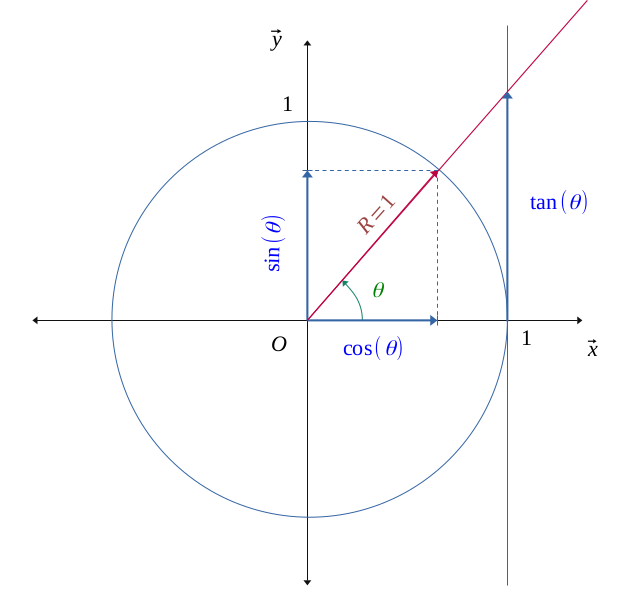
Applying
the Thales' theorem
, we definitely see the following relation:
$$ \frac{\cos(\theta)}{1} = \frac{\sin(\theta)}{\tan(\theta)} \Longleftrightarrow \tan(\theta) = \frac{\sin(\theta)}{\cos(\theta)} $$
The \( \sin(x) \) function is defined as follows:
$$ \forall x \in \mathbb{R}, \enspace f(x) = \sin(x) $$
Its derivative is:
$$ \forall x \in \mathbb{R}, $$
$$ \sin(x)' = \cos(x) $$
The \( \cos(x) \) function is defined as follows:
$$ \forall x \in \mathbb{R}, \enspace f(x) = \cos(x) $$
Its derivative is:
$$ \forall x \in \mathbb{R}, $$
$$ \cos(x)' = -\sin(x) $$
The \( \tan(x) \) function is defined as follows:
$$ \forall k \in \mathbb{Z}, \enspace \forall x \in \biggl[ \mathbb{R} \hspace{0.2em} \backslash \hspace{0.2em} \Bigl \{ \frac{\pi}{2} + k\pi \Bigr \} \biggr], \enspace f(x) = \tan(x) = \frac{\sin(x)}{\cos(x)} $$
Its derivative is:
$$ \forall k \in \mathbb{Z}, \forall x \in \biggl[ \mathbb{R} \hspace{0.2em} \backslash \hspace{0.2em} \Bigl \{ \frac{\pi}{2} + k\pi \Bigr \} \biggr] $$
$$ \tan(x)' = 1 + \tan^2(x) = \frac{1}{\cos^2(x)}= \sec^2(x) $$
The \( \operatorname{Arcsin}(x) \) is
the reciprocal function
of
the \( \sin(x) \) function
, it is defined as follows:
$$ \forall x \in [-1, \hspace{0.2em} 1], \enspace f(x) = \operatorname{Arcsin}(x) = \sin^{-1}(x) $$
Its derivative is:
$$ \forall x \in \hspace{0.04em} ]-1 ,\hspace{0.2em} 1[, $$
$$ \operatorname{Arcsin}(x)' = \frac{1}{\sqrt{1 - x^2}} $$
The \( \operatorname{Arccos}(x) \) function is
the reciprocal function
of
the \( \cos(x) \) function
, it is defined as follows:
$$ \forall x \in [-1, \hspace{0.2em} 1], \enspace f(x) = \operatorname{Arccos}(x) = \cos^{-1}(x) $$
Its derivative is:
$$ \forall x \in \hspace{0.04em} ]-1 , \hspace{0.2em}1[, $$
$$ \operatorname{Arccos}(x)' = -\frac{1}{\sqrt{1 - x^2}} $$
The \( \operatorname{Arctan}(x) \) function is
the reciprocal function
of
the \( \tan(x) \) function
, it is defined as follows:
$$ \forall x \in \mathbb{R}, \enspace f(x) = \operatorname{Arctan}(x) = \tan^{-1}(x) $$
Its derivative is:
$$ \forall x \in \mathbb{R}, $$
$$ \operatorname{Arctan}(x)' = \frac{1}{1 + x^2} $$
The three secant trigonometric functions are the \( \csc(x), \sec(x) \) and \( \cot(x) \) functions.
They are respectively the inverses of the \( \sin(x), \cos(x) \) and \( \tan(x) \) functions.
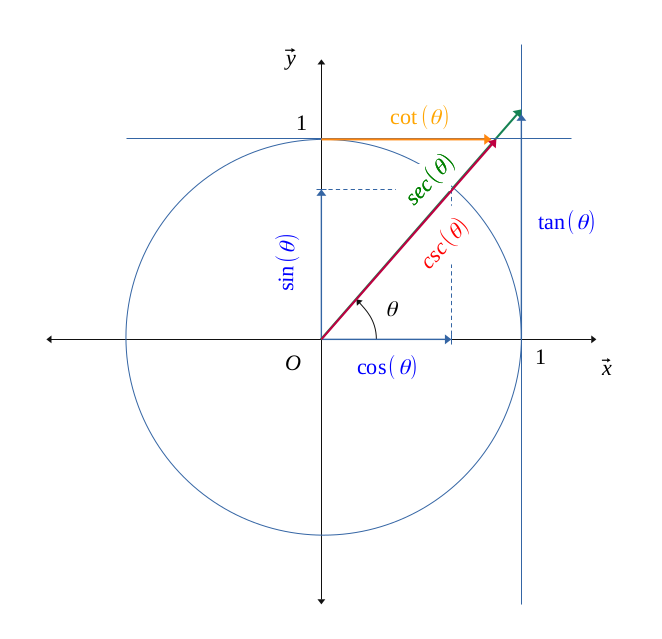
Applying
the Thales' theorem
, we definitely see the following relation:
$$ \left \{ \begin{gather*} \frac{\csc(\theta)}{1} = \frac{1}{\sin(\theta)} \Longleftrightarrow \csc(\theta) = \frac{1}{\sin(\theta)} \\ \frac{\sec(\theta)}{1} = \frac{1}{\cos(\theta)} \Longleftrightarrow \sec(\theta) = \frac{1}{\cos(\theta)} \\ \frac{\cot(\theta)}{1} = \frac{\csc(\theta)}{\sec(\theta)} = \frac{1}{\tan(\theta)} \Longleftrightarrow \cot(\theta) = \frac{1}{\tan(\theta)} \end{gather*} \right \} $$
The \( \csc(x) \) function is defined as follows:
$$ \forall k \in \mathbb{Z}, \ \forall x \in \Bigl[ \mathbb{R} \hspace{0.2em} \backslash \hspace{0.2em} \bigl \{ k\pi \bigr \} \Bigr], \enspace f(x) = \csc(x) = \frac{1}{\sin(x)} $$
Its derivative is:
$$ \forall k \in \mathbb{Z}, \ \forall x \in \Bigl[ \mathbb{R} \hspace{0.2em} \backslash \hspace{0.2em} \bigl \{ k\pi \bigr \} \Bigr], $$
$$ \csc(x)' = - \csc^2(x)\cos(x) = -\csc(x)\cot(x) $$
Furthermore, we do notice that:
$$ \forall k \in \mathbb{Z}, \ \forall x \in \Bigl[ \mathbb{R} \hspace{0.2em} \backslash \hspace{0.2em} \bigl \{ k\pi \bigr \} \Bigr], $$
$$ \frac{\csc'(x)}{\csc(x)} = -\csc(x)\cos(x) = -\tan(x)$$
The \( \sec(x) \) function is defined as follows:
$$ \forall k \in \mathbb{Z}, \enspace \forall x \in \biggl[ \mathbb{R} \hspace{0.2em} \backslash \hspace{0.2em} \Bigl \{ \frac{\pi}{2} + k\pi \Bigr \} \biggr], \enspace f(x) = \sec(x) = \frac{1}{\cos(x)} $$
Its derivative is:
$$ \forall k \in \mathbb{Z}, \enspace \forall x \in \biggl[ \mathbb{R} \hspace{0.2em} \backslash \hspace{0.2em} \Bigl \{ \frac{\pi}{2} + k\pi \Bigr \} \biggr], $$
$$ \sec(x)' = \sec^2(x) \sin(x) = \sec(x)\tan(x) $$
Furthermore, we do notice that:
$$ \forall k \in \mathbb{Z}, \enspace \forall x \in \biggl[ \mathbb{R} \hspace{0.2em} \backslash \hspace{0.2em} \Bigl \{ \frac{\pi}{2} + k\pi \Bigr \} \biggr], $$
$$ \frac{\sec'(x)}{\sec(x)} = \sec(x)\sin(x) = \tan(x)$$
The \( \cot(x) \) function is defined as follows:
$$ \forall k \in \mathbb{Z}, \enspace \forall x \in \Bigl[ \mathbb{R} \hspace{0.2em} \backslash \hspace{0.2em} \bigl \{ k\pi \bigr \} \Bigr] , \enspace f(x) = \cot(x) = \frac{\csc(x)}{\sec(x)} = \frac{1}{\tan(x)} $$
Its derivative is:
$$ \forall k \in \mathbb{Z}, \enspace \forall x \in \Bigl[ \mathbb{R} \hspace{0.2em} \backslash \hspace{0.2em} \bigl \{ k\pi \bigr \} \Bigr], $$
$$ \cot(x)' = -(1 + \cot^2(x)) = - \csc^2(x) $$
The \( \operatorname{Arccsc}(x) \) is
the reciprocal function
of
the \( \csc(x) \) function
, it is defined as follows:
$$ \forall x \in \hspace{0.04em} ]-\infty, \hspace{0.1em} -1] \cup[1, \hspace{0.1em} +\infty[ , \enspace f(x) = \operatorname{Arccsc}(x) = \csc^{-1}(x) $$
Its derivative is:
$$ \forall x \in \hspace{0.04em} ]-\infty, \hspace{0.1em} -1[\hspace{0.1em}\cup \hspace{0.1em}]1, \hspace{0.1em} +\infty[, $$
$$ \operatorname{Arccsc}(x)' = - \frac{1}{ x^2} \times \frac{1}{ \sqrt{1 - \frac{1}{ x^2}}} $$
The \( \operatorname{Arcsec}(x) \) is
the reciprocal function
of
the \( \sec(x) \)
function, it is defined as follows:
$$ \forall x \in \hspace{0.04em} ]-\infty, \hspace{0.1em} -1] \cup[1, \hspace{0.1em} +\infty[ , \enspace f(x) = \operatorname{Arcsec}(x) = \sec^{-1}(x) $$
Its derivative is:
$$ \forall x \in \hspace{0.04em} ]-\infty, \hspace{0.1em} -1[\hspace{0.1em}\cup \hspace{0.1em}]1, \hspace{0.1em} +\infty[, $$
$$ \operatorname{Arcsec}(x)' = \frac{1}{ x^2} \times \frac{1}{ \sqrt{1 - \frac{1}{ x^2}}} $$
The \( \operatorname{Arccot}(x) \) is
the reciprocal function
of
the \( \cot(x) \) function
, it is defined as follows:
$$ \forall x \in \mathbb{R} , \enspace f(x) = \operatorname{Arccot}(x) = \cot^{-1}(x) $$
Its derivative is:
$$ \forall x \in \mathbb{R}, $$
$$ \operatorname{Arccot}(x)' = - \frac{1}{ 1 + x^2} $$
The three hyperbolic functions are the \( \sinh(x), \cosh(x) \) and \( \tanh(x) \) functions.
They are the twins of the \( \sin(x), \cos(x) \) and \( \tan(x) \) functions, and notably concerning their properties.
The \( \sinh(x) \) function is defined as follows:
$$ \forall x \in \mathbb{R}, \enspace f(x) = \sinh(x) = \frac{e^x - e^{-x} }{2} $$
Its derivative is:
$$ \forall x \in \mathbb{R}, $$
$$ \sinh(x)' = \cosh(x) $$
The \( \cosh(x) \) function is defined as follows:
$$ \forall x \in \mathbb{R}, \enspace f(x) = \cosh(x) = \frac{e^x + e^{-x} }{2} $$
Its derivative is:
$$ \forall x \in \mathbb{R}, $$
$$ \cosh(x)' = \sinh(x) $$
The \( \tanh(x) \) function is defined as follows:
$$ \forall x \in \mathbb{R}, \enspace f(x) = \tanh(x) = \frac{\sinh(x)}{\cosh(x)} = \frac{e^x - e^{-x}}{e^x + e^{-x}} $$
Its derivative is:
$$ \forall x \in \mathbb{R}, $$
$$ \tanh(x)' = 1 - \tanh^2(x) = \operatorname{sech}^2(x) $$
The \( \operatorname{Argsinh}(x) \) is
the reciprocal function
of
the \( \sinh(x) \) function
, it is defined as follows:
$$ \forall x \in \mathbb{R}, \enspace f(x) = \operatorname{Argsinh}(x)= \sinh^{-1}(x) $$
In addition, we can define it more explicitly by :
$$ \forall x \in \mathbb{R},$$
$$ \operatorname{Argsinh}(x) = \ln \left|x + \sqrt{x^2 + 1}\right| $$
(\(\Longrightarrow\) see
demonstration of it
)
Its derivative is:
$$ \forall x \in \mathbb{R}, $$
$$ \operatorname{Argsinh}(x)' = \frac{1}{\sqrt{1 + x^2}} $$
The \( \operatorname{Argcosh}(x) \) is
the reciprocal function
of
the \( \cosh(x) \) function
, it is defined as follows:
$$ \forall x \in [1, \hspace{0.1em} +\infty[, \enspace f(x) = \operatorname{Argcosh}(x) = \cosh^{-1}(x) $$
In addition, we can define it more explicitly by :
$$ \forall x \in [1, \hspace{0.1em} +\infty[, $$
$$ \operatorname{Argcosh}(x) = \ln \Bigl| x + \sqrt{x^2 - 1}\Bigr| $$
(\(\Longrightarrow\) see
demonstration of it
)
Its derivative is:
$$ \forall x \in \hspace{0.04em} ]1, \hspace{0.1em} +\infty[, $$
$$ \operatorname{Argcosh}(x)' = \frac{1}{\sqrt{x^2 -1}} $$
The \( \operatorname{Argtanh}(x) \) is
the reciprocal function
of
the \( \tanh(x) \) function
, it is defined as follows:
$$ \forall x \in \hspace{0.04em} ]-1, \hspace{0.1em} 1[, \enspace f(x) = \operatorname{Argtanh}(x) = \tanh^{-1}(x) $$
In addition, we can define it more explicitly by :
$$ \forall x \in \hspace{0.04em} ]-1, \hspace{0.1em} 1[, $$
$$ \operatorname{Argtanh}(x) = \frac{1}{2} \ln \left| \frac{1 + x}{1 - x} \right| $$
(\(\Longrightarrow\) see
demonstration of it
)
Its derivative is:
$$ \forall x \in \hspace{0.04em} ]-1, \hspace{0.1em} 1[, $$
$$ \operatorname{Argtanh}(x)' = \frac{1}{1 - x^2} $$
The three hyperbolic secant functions are the \( \operatorname{csch}(x), \operatorname{sech}(x) \) and \( \operatorname{coth}(x) \) functions.
They are respectively the inverses of the \( \sinh(x), \cosh(x) \) and \( \tanh(x) \) functions.
The \( \operatorname{csch}(x) \) function is defined as follows:
$$ \forall x \in \Bigl[ \mathbb{R} \hspace{0.2em} \backslash \hspace{0.2em} \bigl \{ 0 \bigr \} \Bigr], \enspace f(x) = \operatorname{csch}(x) = \frac{1}{\sinh(x)} $$
Its derivative is:
$$ \forall x \in \Bigl[ \mathbb{R} \hspace{0.2em} \backslash \hspace{0.2em} \bigl \{ 0 \bigr \} \Bigr], $$
$$ \operatorname{csch}(x)' = - \operatorname{csch}^2(x) \cosh(x) = -\operatorname{csch}(x)\operatorname{coth}(x) $$
Furthermore, we do notice that:
$$ \forall x \in \Bigl[ \mathbb{R} \hspace{0.2em} \backslash \hspace{0.2em} \bigl \{ 0 \bigr \} \Bigr], $$
$$ \frac{\operatorname{csch}'(x)}{\operatorname{csch}(x)} = -\operatorname{csch}(x)\cosh(x) = -\operatorname{coth}(x)$$
The \( \operatorname{sech}(x) \) function is defined as follows:
$$ \forall x \in \mathbb{R}, \enspace f(x) = \operatorname{sech}(x) = \frac{1}{\cosh(x)} $$
Its derivative is:
$$ \forall x \in \mathbb{R}, $$
$$ \operatorname{sech}(x)' = -\operatorname{sech}^2(x)\sinh(x) = -\operatorname{sech}(x)\tanh(x) $$
The \( \operatorname{coth}(x) \) function is defined as follows:
$$ \forall x \in \Bigl[ \mathbb{R} \hspace{0.2em} \backslash \hspace{0.2em} \bigl \{ 0 \bigr \} \Bigr], \enspace f(x) = \operatorname{coth}(x) = \frac{1}{\tanh(x)} $$
Its derivative is:
$$ \forall x \in \Bigl[ \mathbb{R} \hspace{0.2em} \backslash \hspace{0.2em} \bigl \{ 0 \bigr \} \Bigr], $$
$$ \operatorname{coth}(x)' = 1 - \cot^2(x) = -\operatorname{csch}^2(x)$$
The \( \operatorname{Argcsch}(x) \) is
the reciprocal function
of
the \( \operatorname{csch}(x) \) function
, it is defined as follows:
$$\forall x \in \Bigl[ \mathbb{R} \hspace{0.1em} \backslash \hspace{0.2em} \left \{ 0 \right \} \Bigr] , \enspace f(x) = \operatorname{Argcsch}(x) = \operatorname{csch}^{-1}(x) $$
Its derivative is:
$$\forall x \in \Bigl[ \mathbb{R} \hspace{0.1em} \backslash \hspace{0.2em} \left \{ 0 \right \} \Bigr] , $$
$$ \operatorname{Argcsch}(x)' = - \frac{1}{ x^2} \times \frac{1}{ \sqrt{1 + \frac{1}{ x^2}}} $$
The \( \operatorname{Argsech}(x) \) is
the reciprocal function
of
the \( \operatorname{sech}(x) \) function
, it is defined as follows:
$$ \forall x \in \hspace{0.04em} \bigl]0, \hspace{0.1em} 1 \bigr] , \enspace f(x) = \operatorname{Argsech}(x) = \operatorname{sech}^{-1}(x) $$
Its derivative is:
$$ \forall x \in \hspace{0.1em} \bigl]0, \hspace{0.1em} 1 \bigr], $$
$$ \operatorname{Argsech}(x)' = - \frac{1}{ x^2} \times \frac{1}{ \sqrt{\frac{1}{ x^2} - 1}} $$
The \( \operatorname{Argcoth}(x) \) is
the reciprocal function
of
the \( \operatorname{coth}(x) \) function
, it is defined as follows:
$$ \forall x \in \hspace{0.04em} ]-\infty, \hspace{0.1em} -1[ \hspace{0.1em} \cup \hspace{0.1em} ]1, \hspace{0.1em} +\infty[ , \enspace f(x) = \operatorname{Argcoth}(x) =\operatorname{coth}^{-1}(x) $$
Its derivative is:
$$ \forall x \in \hspace{0.04em} ]-\infty, \hspace{0.1em} -1[ \hspace{0.1em} \cup \hspace{0.1em} ]1, \hspace{0.1em} +\infty[, $$
$$ \operatorname{Argcoth}(x)' = \frac{1}{ 1 - x^2} $$
Click on the title to access to the recap table.
Proofs
The \( \sin(x) \) function is defined as follows:
$$ \forall x \in \mathbb{R}, \enspace f(x) = \sin(x) $$
With
the definition of the derivative
, we do have:
$$ \sin(x)' = \lim_{h \to 0 } \enspace \frac{ \sin(x + h) - \sin(x)}{h} $$
We know from
the trigonometric addition formulas
that:
$$ \forall (\alpha, \beta) \in \hspace{0.04em} \mathbb{R}^2, $$
$$ \sin(\alpha + \beta) = \sin(\alpha) \cos(\beta) + \cos(\alpha) \sin(\beta) $$
So:
$$ \sin(x)' = \lim_{h \to 0 } \enspace \frac{ \sin(x) \cos(h) + \cos(x) \sin(h) - \sin(x)}{h} $$
When \( h \to 0\), \( \cos(h) \to 1\) and \( \sin(h) \to h\).
Then,
$$ \sin(x)' = \lim_{h \to 0 } \enspace \frac{ \sin(x) + \cos(x). h - \sin(x)}{h} $$
$$ \sin(x)' = \lim_{h \to 0 } \enspace \frac{\cos(x). h }{h} $$
And finally,
$$ \forall x \in \mathbb{R}, $$
$$ \sin(x)' = \cos(x) $$
The \( \cos(x) \) function is defined as follows:
$$ \forall x \in \mathbb{R}, \enspace f(x) = \cos(x) $$
With
the definition of the derivative
, we do have:
$$\cos(x)' = \lim_{h \to 0 } \enspace \frac{ \cos(x + h) - \cos(x)}{h} $$
We know from
the trigonometric addition formulas
that:
$$ \forall (\alpha, \beta) \in \hspace{0.04em} \mathbb{R}^2, $$
$$ \cos(\alpha + \beta) = \cos(\alpha) \cos(\beta) - \sin(\alpha) \sin(\beta) $$
So:
$$\cos(x)' = \lim_{h \to 0 } \enspace \frac{ \cos(x) \cos(h) - \sin(x) \sin(h) - \cos(x)}{h} $$
When \( h \to 0\), \( \cos(h) \to 1\) and \( \sin(h) \to h\).
Then,
$$\cos(x)' = \lim_{h \to 0 } \enspace \frac{ \cos(x) - \sin(x). h - \cos(x)}{h} $$
$$\cos(x)' = \lim_{h \to 0 } \enspace \frac{ - \sin(x). h }{h} $$
And finally,
$$ \forall x \in \mathbb{R}, $$
$$ \cos(x)' = -\sin(x) $$
The \( \tan(x) \) function is defined as follows:
$$ \forall k \in \mathbb{Z}, \enspace \forall x \in \biggl[ \mathbb{R} \hspace{0.2em} \backslash \hspace{0.2em} \Bigl \{ \frac{\pi}{2} + k\pi \Bigr \} \biggr], \enspace f(x) = \tan(x) = \frac{\sin(x)}{\cos(x)} $$
By definition:
$$ \tan(x)' = \left( \frac{\sin(x)}{\cos(x)} \right)' $$
So in our case:
$$ \tan(x)' = \frac{\cos(x)\cos(x) + \sin(x)\sin(x)}{\cos^2(x)} $$
$$ \tan(x)' = \frac{\cos^2(x) + \sin^2(x)}{\cos^2(x)} $$
$$ \tan(x)' = \frac{\cos^2(x) + \sin^2(x)}{\cos^2(x)} $$
And finally we do have,
$$ \forall k \in \mathbb{Z}, \forall x \in \biggl[ \mathbb{R} \hspace{0.2em} \backslash \hspace{0.2em} \Bigl \{ \frac{\pi}{2} + k\pi \Bigr \} \biggr] $$
$$ \tan(x)' = 1 + \tan^2(x) = \frac{1}{\cos^2(x)} = \sec^2(x) $$
The \( \operatorname{Arcsin}(x) \) is
the reciprocal function
of
the \( \sin(x) \) function
, it is defined as follows:
$$ \forall x \in [-1, \hspace{0.2em} 1], \enspace f(x) = \operatorname{Arcsin}(x) = \sin^{-1}(x) $$
We can calculate this derivative using
the derivative of a reciprocal function
:
$$ ( f^{-1} )'= \frac{1}{ (f' \circ f^{-1})} $$
$$ \text{avec } \left \{ \begin{gather*} f(x) = \sin(x) \\ f'(x) = \cos(x) \\ f^{-1}(x) = \operatorname{Arcsin}(x) \end{gather*} \right \} $$
Consequently,
$$ \operatorname{Arcsin}(x)' = \frac{1}{\cos(\operatorname{Arcsin}(x))} $$
Furthermore,
$$ \cos^2(x) + \sin^2(x) = 1$$
$$ \cos^2(x) = 1 - \sin^2(x) $$
$$ | \cos(x) | = \sqrt{1 - \sin^2(x)} $$
But, the \(\operatorname{Arcsin}(x)\) function being defined when \( x \in \bigl[-1; 1\bigr]\) with values in \(\left[-\frac{\pi}{2}; \frac{\pi}{2} \right]\), the \(\cos(\operatorname{Arcsin}(x))\) function is always positive because the \(\cos(X)\) function is positive when \(X \in \left[-\frac{\pi}{2}; \frac{\pi}{2} \right]\).
$$x \longmapsto \operatorname{Arcsin}(x)$$
$$\bigl[-1; 1\bigr] \longmapsto \left[-\frac{\pi}{2}; \frac{\pi}{2} \right]$$
$$ \hspace{12em} X \longmapsto \cos(X)$$
$$\hspace{12em} \left[-\frac{\pi}{2}; \frac{\pi}{2} \right] \longmapsto \bigl[0; 1\bigr]$$
So in our case, when can keep only the positive case:
$$ \cos(\operatorname{Arcsin}(x)) = \sqrt{1 - \sin^2(\operatorname{Arcsin}(x))} $$
Thus, replacing it, we do have,
$$ \operatorname{Arcsin}(x)' = \frac{1}{\sqrt{1 - \sin^2(\operatorname{Arcsin}(x))}} $$
And as a result,
$$ \forall x \in \hspace{0.04em} ]-1 ,\hspace{0.2em} 1[, $$
$$ \operatorname{Arcsin}(x)' = \frac{1}{\sqrt{1 - x^2}} $$
The \( \operatorname{Arccos}(x) \) function is
the reciprocal function
of
the \( \cos(x) \) function
, it is defined as follows:
$$ \forall x \in [-1, \hspace{0.2em} 1], \enspace f(x) = \operatorname{Arccos}(x) = \cos^{-1}(x) $$
By the same reasoning as before with
\(\operatorname{Arcsin}(x)'\) calculation
:
$$ \operatorname{Arccos}(x)' = - \frac{1}{\sqrt{1 - \cos^2(\operatorname{Arccos}(x))}} $$
And finally,
$$ \forall x \in \hspace{0.04em} ]-1 , \hspace{0.2em}1[, $$
$$ \operatorname{Arccos}(x)' = -\frac{1}{\sqrt{1 - x^2}} $$
The \( \operatorname{Arctan}(x) \) function is
the reciprocal function
of
the \( \tan(x) \) function
, it is defined as follows:
$$ \forall x \in \mathbb{R}, \enspace f(x) = \operatorname{Arctan}(x) = \tan^{-1}(x) $$
By the same reasoning as before with
\(\operatorname{Arcsin}(x)'\) calculation
:
$$ \operatorname{Arctan}(x)' = \frac{1}{1 + \tan^2(\operatorname{Arctan}(x))} $$
And finally,
$$ \forall x \in \mathbb{R}, $$
$$ \operatorname{Arctan}(x)' = \frac{1}{1 + x^2} $$
The \( \csc(x) \) function is defined as follows:
$$ \forall k \in \mathbb{Z},\ \forall x \in \Bigl[ \mathbb{R} \hspace{0.2em} \backslash \hspace{0.2em} \bigl \{ k\pi \bigr \} \Bigr], \enspace f(x) = \csc(x) = \frac{1}{\sin(x)} $$
By definition:
$$ \csc(x)' = \biggl(\frac{1}{\sin(x)} \biggr)' $$
So in our case,
$$ \csc(x)' = -\frac{\cos(x)}{\sin^2(x)} $$
And finally,
$$ \forall k \in \mathbb{Z}, \ \forall x \in \Bigl[ \mathbb{R} \hspace{0.2em} \backslash \hspace{0.2em} \bigl \{ k\pi \bigr \} \Bigr], $$
$$ \csc(x)' = - \csc^2(x)\cos(x) = -\csc(x)\cot(x)$$
Furthermore, we do notice that:
$$ \frac{\csc'(x)}{\csc(x)} = \frac{-\csc^2(x)\cos(x)}{\csc(x)} $$
$$ \forall k \in \mathbb{Z}, \ \forall x \in \Bigl[ \mathbb{R} \hspace{0.2em} \backslash \hspace{0.2em} \bigl \{ k\pi \bigr \} \Bigr], $$
$$ \frac{\csc'(x)}{\csc(x)} = -\csc(x)\cos(x) = -\tan(x)$$
The \( \sec(x) \) function is defined as follows:
$$ \forall k \in \mathbb{Z}, \enspace \forall x \in \biggl[ \mathbb{R} \hspace{0.2em} \backslash \hspace{0.2em} \Bigl \{ \frac{\pi}{2} + k\pi \Bigr \} \biggr], \enspace f(x) = \sec(x) = \frac{1}{\cos(x)} $$
By definition:
$$ \sec(x)' = \biggl(\frac{1}{\cos(x)} \biggr)' $$
We apply again
the inverse of a function's derivative
:
$$ \sec(x)' = \frac{\sin(x)}{\cos^2(x)} $$
And finally,
$$ \forall k \in \mathbb{Z}, \enspace \forall x \in \biggl[ \mathbb{R} \hspace{0.2em} \backslash \hspace{0.2em} \Bigl \{ \frac{\pi}{2} + k\pi \Bigr \} \biggr], $$
$$ \sec(x)' = \sec^2(x) \sin(x) = \sec(x)\tan(x) $$
Furthermore, we do notice that:
$$ \frac{\sec'(x)}{\sec(x)} = \frac{\sec^2(x)\tan(x)}{\sec(x)} $$
$$ \forall k \in \mathbb{Z}, \enspace \forall x \in \biggl[ \mathbb{R} \hspace{0.2em} \backslash \hspace{0.2em} \Bigl \{ \frac{\pi}{2} + k\pi \Bigr \} \biggr], $$
$$ \frac{\sec'(x)}{\sec(x)} = \sec(x)\sin(x) = \tan(x)$$
The \( \cot(x) \) function is defined as follows:
$$ \forall k \in \mathbb{Z}, \enspace \forall x \in \Bigl[ \mathbb{R} \hspace{0.2em} \backslash \hspace{0.2em} \bigl \{ k\pi \bigr \} \Bigr] , \enspace f(x) = \cot(x) = \frac{\csc(x)}{\sec(x)} = \frac{1}{\tan(x)} $$
By definition:
$$ \cot(x)' = \biggl(\frac{1}{\tan(x)} \biggr)' $$
We apply again
the inverse of a function's derivative
:
$$ \cot(x)' = - \frac{1 + \tan^2(x)}{\tan^2(x)} $$
And finally,
$$ \forall k \in \mathbb{Z}, \enspace \forall x \in \Bigl[ \mathbb{R} \hspace{0.2em} \backslash \hspace{0.2em} \bigl \{ k\pi \bigr \} \Bigr], $$
$$ \cot(x)' = -(1 + \cot^2(x)) = - \csc^2(x) $$
The \( \operatorname{Arccsc}(x) \) is
the reciprocal function
of
the \( \csc(x) \) function
, it is defined as follows:
$$ \forall x \in \hspace{0.04em} ]-\infty, \hspace{0.1em} -1] \cup[1, \hspace{0.1em} +\infty[ , \enspace f(x) = \operatorname{Arccsc}(x) = \csc^{-1}(x) $$
We can calculate this derivative using
the derivative of a reciprocal function
:
$$ ( f^{-1} )'= \frac{1}{ (f' \circ f^{-1})} $$
$$ \text{avec } \left \{ \begin{gather*} f(x) = \csc(x) \\ f'(x) = - \csc^2(x)\cos(x) \\ f^{-1}(x) = \operatorname{Arccsc}(x) \end{gather*} \right \} $$
$$ \operatorname{Arccsc}(x)' = -\frac{1}{\csc^2(\operatorname{Arccsc}(x)) \times \cos(\operatorname{Arccsc}(x))} $$
Furthermore,
$$ \cos^2(x) + \sin^2(x) = 1$$
$$ \cos^2(x) = 1 - \sin^2(x) $$
$$ | \cos(x) | = \sqrt{1 - \sin^2(x)} $$
But, the \(\operatorname{Arccsc}(x)\) function is defined when \( x \in \bigl[-\infty; -1\bigr] \cup \bigl[1; +\infty\bigr] \) with values in \(\left[-\frac{\pi}{2}; 0 \right[ \cup \left]0; \frac{\pi}{2} \right] \), the \(\cos(\operatorname{Arcsin}(x))\) function is always positive because the \(\cos(X)\) function is positive when \( X \in \left[-\frac{\pi}{2}; 0 \right[ \cup \left]0; \frac{\pi}{2} \right] \).
$$\hspace{6em} x \longmapsto \operatorname{Arccsc}(x)$$
$$\bigl[-\infty; -1\bigr] \cup \bigl[1; +\infty\bigr] \longmapsto \left[-\frac{\pi}{2}; 0 \right[ \cup \left]0; \frac{\pi}{2} \right]$$
$$ \hspace{16em} X \longmapsto \cos(X)$$
$$\hspace{16em} \left[-\frac{\pi}{2}; 0 \right[ \cup \left]0; \frac{\pi}{2} \right] \longmapsto \bigl[0; 1\bigr]$$
So in our case, when can keep only the positive case:
$$ \cos(\operatorname{Arccsc}(x)) = \sqrt{1 - \sin^2(\operatorname{Arccsc}(x))} $$
$$ \operatorname{Arccsc}(x)' = -\frac{1}{\csc^2(\operatorname{Arccsc}(x)) \times \sqrt{1 - \sin^2(\operatorname{Arccsc}(x))}} $$
But:
$$ \csc(x) = \frac{1}{\sin(x)} \Longleftrightarrow \sin(x) = \frac{1}{\csc(x)} $$
So,
$$ \operatorname{Arccsc}(x)' = - \frac{1}{ x^2} \times \frac{1}{ \sqrt{1 - \frac{1}{\csc^2(\operatorname{Arccsc}(x))}}} $$
Soit finalement,
$$ \forall x \in \hspace{0.04em} ]-\infty, \hspace{0.1em} -1[\hspace{0.1em}\cup \hspace{0.1em}]1, \hspace{0.1em} +\infty[, $$
$$ \operatorname{Arccsc}(x)' = - \frac{1}{ x^2} \times \frac{1}{ \sqrt{1 - \frac{1}{ x^2}}} $$
The \( \operatorname{Arcsec}(x) \) is
the reciprocal function
of
the \( \sec(x) \)
function, it is defined as follows:
$$ \forall x \in \hspace{0.04em} ]-\infty, \hspace{0.1em} -1] \cup[1, \hspace{0.1em} +\infty[ , \enspace f(x) = \operatorname{Arcsec}(x) = \sec^{-1}(x) $$
By the same reasoning as before with
\(\operatorname{Arccsc}(x)'\) calculation
:
$$ \forall x \in \hspace{0.04em} ]-\infty, \hspace{0.1em} -1[\hspace{0.1em}\cup \hspace{0.1em}]1, \hspace{0.1em} +\infty[, $$
$$ \operatorname{Arcsec}(x)' = \frac{1}{ x^2} \times \frac{1}{ \sqrt{1 - \frac{1}{ x^2}}} $$
The \( \sinh(x) \) function is defined as follows:
$$ \forall x \in \mathbb{R}, \enspace f(x) = \sinh(x) = \frac{e^x - e^{-x} }{2} $$
Here, we will use
a chain derivation
to derivate exponentials:
$$ \sinh(x)' = \biggl(\frac{e^x - e^{-x}}{2} \biggr)' $$
$$ \sinh(x)' = \frac{1}{2} \bigl( e^x + e^{-x} \bigr) $$
$$ \sinh(x)' = \biggl(\frac{e^x + e^{-x}}{2} \biggr) $$
And finally,
$$ \forall x \in \mathbb{R}, $$
$$ \sinh(x)' = \cosh(x) $$
The \( \cosh(x) \) function is defined as follows:
$$ \forall x \in \mathbb{R}, \enspace f(x) = \cosh(x) = \frac{e^x + e^{-x} }{2} $$
By the same reasoning as before with
\(\sinh(x)'\) calculation
:
$$ \cosh(x)' = \biggl(\frac{e^x + e^{-x}}{2} \biggr)' $$
$$ \cosh(x)' = \frac{1}{2} \bigl( e^x - e^{-x} \bigr) $$
$$ \cosh(x)' = \biggl(\frac{e^x - e^{-x}}{2} \biggr) $$
And finally,
$$ \forall x \in \mathbb{R}, $$
$$ \cosh(x)' = \sinh(x) $$
The \( \tanh(x) \) function is defined as follows:
$$ \forall x \in \mathbb{R}, \enspace f(x) = \tanh(x) = \frac{\sinh(x)}{\cosh(x)} = \frac{e^x - e^{-x}}{e^x + e^{-x}} $$
By definition:
$$ \tanh(x)' = \biggl(\frac{e^x - e^{-x}}{e^x + e^{-x}} \biggr)' $$
Let us apply
the derivative of a quotient
:
$$ \tanh(x)' = \frac{(e^x + e^{-x}) (e^x + e^{-x}) - (e^x - e^{-x})(e^x - e^{-x})}{(e^x + e^{-x})^2} $$
$$ \tanh(x)' = \frac{(e^x + e^{-x})^2 - (e^x - e^{-x})^2}{(e^x + e^{-x})^2} $$
$$ \tanh(x)' = 1 - \frac{(e^x - e^{-x})^2}{(e^x + e^{-x})^2} $$
And finally,
$$ \forall x \in \mathbb{R}, $$
$$ \tanh(x)' = 1 - \tanh^2(x) = \operatorname{sech}^2(x) $$
The \( \operatorname{Argsinh}(x) \) is
the reciprocal function
of
the \( \sinh(x) \) function
, it is defined as follows:
$$ \forall x \in \mathbb{R}, \enspace f(x) = \operatorname{Argsinh}(x)= \sinh^{-1}(x) $$
In addition, we can define it more explicitly by :
$$ \forall x \in \mathbb{R}, $$
$$ \operatorname{Argsinh}(x) = \ln \left|x + \sqrt{x^2 + 1}\right| $$
(\(\Longrightarrow\) see
demonstration of it
)
We can calculate this derivative using
the derivative of a reciprocal function
:
$$ ( f^{-1} )'= \frac{1}{ (f' \circ f^{-1})} $$
$$ \text{avec } \left \{ \begin{gather*} f(x) = \sinh(x) \\ f('x) = \cosh(x) \\ f^{-1}(x) = \operatorname{Argsinh}(x) \end{gather*} \right \} $$
$$ \operatorname{Argsinh}(x)' = \frac{1}{\cosh(\operatorname{Argsinh}(x))} $$
Furthermore,
$$ \cosh^2(x) -\sinh^2(x) = 1$$
$$ \cosh^2(x) = 1 + \sinh^2(x) $$
$$ | \cosh(x) | = \sqrt{1 +\sinh^2(x)} $$
Since the \(\cosh(x)\) function is always positive when \(x \in \mathbb{R}\), we can keep the positive case:
$$ \cosh(x) = \sqrt{1 + \sinh^2(x)} $$
So, replacing it we do have :
$$ \operatorname{Argsinh}(x)' = \frac{1}{\sqrt{1 + \sinh^2(\operatorname{Argsinh}(x))}} $$
And finally,
$$ \forall x \in \mathbb{R}, $$
$$ \operatorname{Argsinh}(x)' = \frac{1}{\sqrt{1 + x^2}} $$
The \( \operatorname{Argcosh}(x) \) is
the reciprocal function
of
the \( \cosh(x) \) function
, it is defined as follows:
$$ \forall x \in [1, \hspace{0.1em} +\infty[, \enspace f(x) = \operatorname{Argcosh}(x) = \cosh^{-1}(x) $$
In addition, we can define it more explicitly by :
$$ \forall x \in [1, \hspace{0.1em} +\infty[, $$
$$ \operatorname{Argcosh}(x) = \ln \Bigl| x + \sqrt{x^2 - 1}\Bigr| $$
(\(\Longrightarrow\) see
demonstration of it
)
By the same reasoning as before with
\(\operatorname{Argsinh}(x)'\) calculation
:
$$ \forall x \in \hspace{0.04em} ]1, \hspace{0.1em} +\infty[, $$
$$ \operatorname{Argcosh}(x)' = \frac{1}{\sqrt{x^2 -1}} $$
The \( \operatorname{Argtanh}(x) \) is
the reciprocal function
of
the \( \tanh(x) \) function
, it is defined as follows:
$$ \forall x \in \hspace{0.04em} ]-1, \hspace{0.1em} 1[, \enspace f(x) = \operatorname{Argtanh}(x) = \tanh^{-1}(x) $$
In addition, we can define it more explicitly by :
$$ \forall x \in \hspace{0.04em} ]-1, \hspace{0.1em} 1[, \forall x \in [1, \hspace{0.1em} +\infty[, $$
$$ \ \operatorname{Argtanh}(x) = \frac{1}{2} \ln \left| \frac{1 + x}{1 - x} \right| $$
(\(\Longrightarrow\) see
demonstration of it
)
By the same reasoning as before with
\(\operatorname{Argsinh}(x)'\) calculation
:
$$ \forall x \in \hspace{0.04em} ]-1, \hspace{0.1em} 1[, $$
$$ \operatorname{Argtanh}(x)' = \frac{1}{1 - x^2} $$
The \( \operatorname{csch}(x) \) function is defined as follows:
$$ \forall x \in \Bigl[ \mathbb{R} \hspace{0.2em} \backslash \hspace{0.2em} \bigl \{ 0 \bigr \} \Bigr], \enspace f(x) = \operatorname{csch}(x) = \frac{1}{\sinh(x)} $$
By definition:
$$ \operatorname{csch}(x)' = \biggl(\frac{1}{\sinh(x)} \biggr)' $$
So in our case,
$$ \operatorname{csch}(x)' = -\frac{\cosh(x)}{\sinh^2(x)} $$
And finally,
$$ \forall x \in \Bigl[ \mathbb{R} \hspace{0.2em} \backslash \hspace{0.2em} \bigl \{ 0 \bigr \} \Bigr], $$
$$ \operatorname{csch}(x)' = - \operatorname{csch}^2(x) \cosh(x) = -\operatorname{csch}(x)\operatorname{coth}(x) $$
Furthermore, we do notice that:
$$ \forall x \in \Bigl[ \mathbb{R} \hspace{0.2em} \backslash \hspace{0.2em} \bigl \{ 0 \bigr \} \Bigr], $$
$$ \frac{\operatorname{csch}'(x)}{\operatorname{csch}(x)} = -\operatorname{csch}(x)\cosh(x) = -\operatorname{coth}(x)$$
The \( \operatorname{sech}(x) \) function is defined as follows:
$$ \forall x \in \mathbb{R}, \enspace f(x) = \operatorname{sech}(x) = \frac{1}{\cosh(x)} $$
By definition:
$$ \operatorname{sech}(x)' = \biggl(\frac{1}{\cosh(x)} \biggr)' $$
We apply again
the inverse of a function's derivative
:
$$ \operatorname{sech}(x)' = -\frac{\sinh(x)}{\cosh^2(x)} $$
And finally,
$$ \forall x \in \mathbb{R}, $$
$$ \operatorname{sech}(x)' = -\operatorname{sech}^2(x)\sinh(x) = -\operatorname{sech}(x)\tanh(x) $$
Furthermore, we do notice that:
$$ \forall x \in \mathbb{R}, $$
$$ \frac{\operatorname{sech}'(x)}{\operatorname{sech}(x)} = -\operatorname{sech}(x)\sinh(x) = -\tanh(x)$$
The \( \operatorname{coth}(x) \) function is defined as follows:
$$ \forall x \in \Bigl[ \mathbb{R} \hspace{0.2em} \backslash \hspace{0.2em} \bigl \{ 0 \bigr \} \Bigr], \enspace f(x) = \operatorname{coth}(x) = \frac{1}{\tanh(x)} $$
By definition:
$$ \operatorname{coth}(x)' = \biggl(\frac{1}{\tanh(x)} \biggr)' $$
We apply again
the inverse of a function's derivative
:
$$ \operatorname{coth}(x)' = - \frac{1 - \tanh^2(x)}{\tanh^2(x)} $$
And as a result,
$$ \forall x \in \Bigl[ \mathbb{R} \hspace{0.2em} \backslash \hspace{0.2em} \bigl \{ 0 \bigr \} \Bigr], $$
$$ \operatorname{coth}(x)' = 1 - \cot^2(x) = -\operatorname{csch}^2(x)$$
The \( \operatorname{Argcsch}(x) \) is
the reciprocal function
of
the \( \operatorname{csch}(x) \) function
, it is defined as follows:
$$\forall x \in \Bigl[ \mathbb{R} \hspace{0.1em} \backslash \hspace{0.2em} \left \{ 0 \right \} \Bigr] , \enspace f(x) = \operatorname{Argcsch}(x) = \operatorname{csch}^{-1}(x) $$
We can calculate this derivative using
the derivative of a reciprocal function
:
$$ ( f^{-1} )'= \frac{1}{ (f' \circ f^{-1})} $$
$$ \text{with } \left \{ \begin{gather*} f(x) = \operatorname{csch}(x) \\ f'(x) = - \operatorname{csch}^2(x) \ \cosh(x) \\ f^{-1}(x) = \operatorname{Argcsch}(x) \end{gather*} \right \} $$
$$ \operatorname{Argcsch}(x)' = \frac{1}{-\operatorname{csch}^2(\operatorname{Argcsch}(x)) \times \hspace{0.2em} \cosh(\operatorname{Argcsch}(x))} $$
Furthermore,
$$ \cosh^2(x) -\sinh^2(x) = 1$$
$$ \cosh^2(x) = 1 + \sinh^2(x) $$
$$ | \cosh(x) | = \sqrt{1 +\sinh^2(x)} $$
Since the \(\cosh(x)\) function is always positive when \(x \in \mathbb{R}\), we can keep the positive case:
$$ \cosh(x) = \sqrt{1 + \sinh^2(x)} $$
So,
$$ \operatorname{Argcsch}(x)' = -\frac{1}{\operatorname{csch}^2(\operatorname{Argcsch}(x)) \times \sqrt{1 +\sinh^2(\operatorname{Argcsch}(x))}} $$
But:
$$ \operatorname{csch}(x) = \frac{1}{\sinh(x)} \Longleftrightarrow \sinh(x) = \frac{1}{\operatorname{csch}(x)} $$
Soit,
$$ \operatorname{Argcsch}(x)' = - \frac{1}{ x^2} \times \frac{1}{ \sqrt{1+ \frac{1}{\operatorname{csch}^2(\operatorname{Argcsch}(x))}}} $$
And as a result,
$$\forall x \in \Bigl[ \mathbb{R} \hspace{0.1em} \backslash \hspace{0.2em} \left \{ 0 \right \} \Bigr] , $$
$$ \operatorname{Argcsch}(x)' = - \frac{1}{ x^2} \times \frac{1}{ \sqrt{1 + \frac{1}{ x^2}}} $$
The \( \operatorname{Argcoth}(x) \) is
the reciprocal function
of
the \( \operatorname{coth}(x) \) function
, it is defined as follows:
$$ \forall x \in \hspace{0.04em} ]-\infty, \hspace{0.1em} -1[ \hspace{0.1em} \cup \hspace{0.1em} ]1, \hspace{0.1em} +\infty[ , \enspace f(x) = \operatorname{Argcoth}(x) =\operatorname{coth}^{-1}(x) $$
By the same reasoning as before with
\(\operatorname{Argcsch}(x)'\) calculation
:
$$ \forall x \in \hspace{0.04em} ]-\infty, \hspace{0.1em} -1[ \hspace{0.1em} \cup \hspace{0.1em} ]1, \hspace{0.1em} +\infty[, $$
$$ \operatorname{Argcoth}(x)' = \frac{1}{ 1 - x^2} $$






 Index
Index
 Back to top