




 Index
Index
Two triangles are said to be similar when they have their respective lengths proportional and their respective angles equal.
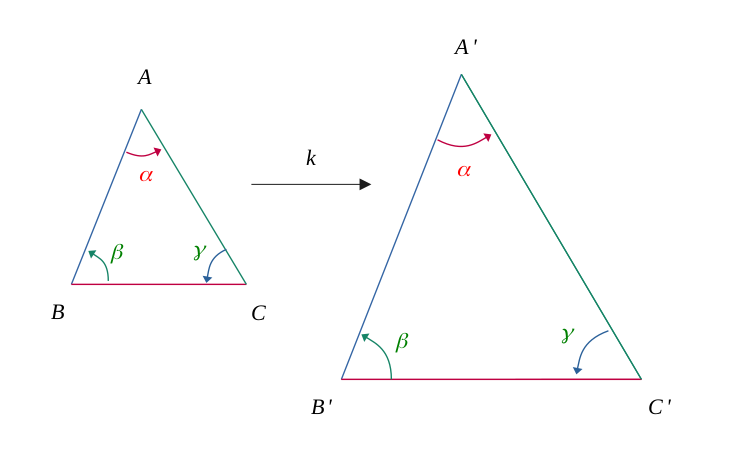
This implies a ratio \(k\) between the respective lengths, corresponding to an enlargement, a shrinkage or a preservation (if \(k = 1\)).
There are mainly three cases of triangle similarities.
Two triangles are similar if their three respective sides are proportional .
Two triangles are similar if they have at least two pairwise equal angles .
Two triangles are similar if they have a common angle and their two respective lengths are proportional .
Case 1: Three respective proportional sides
Let us consider a triangle \(ABC\) and its image \(A'B'C'\) with the three respective proportional sides.
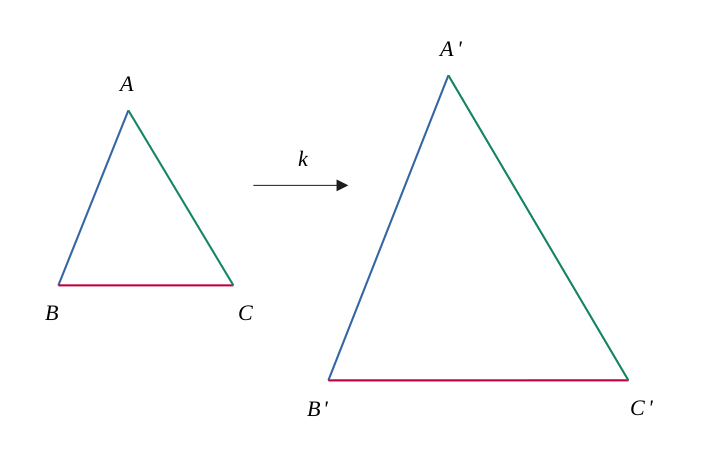
The triangle \(A'B'C'\) is therefore an enlargement (or a shrinkage depending on \(k\)) of the starting triangle \(ABC\).
The angles are also well preserved, this can be verified on the angle \( \beta \) because:
Thanks to both expressions \( (1)\) and \( (2)\), we can see that:
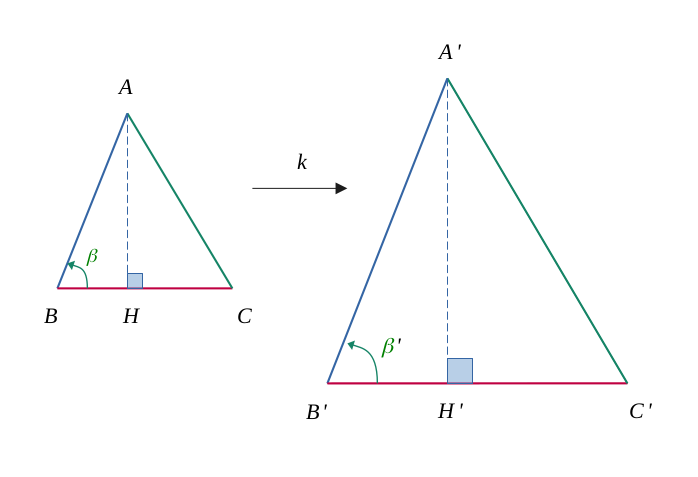
By repeating the same process for the angles \( \alpha \) and \( \gamma \) respectively corresponding to the vertices \( A \) and \( C \), we can assert that:
These two triangles have the same respective angle measurements.
And finally,
Two triangles are similar if their three respective sides are proportional .
Case 2: Two pairwise equal angles
Let us consider two nested triangles \(ABC \) and \(ADE \), having two angles in common:
-
- \(\alpha\) corresponding to the common vertex \(A\)
-
- \(\beta\) corresponding to the vertices \(B\) and \(D\)
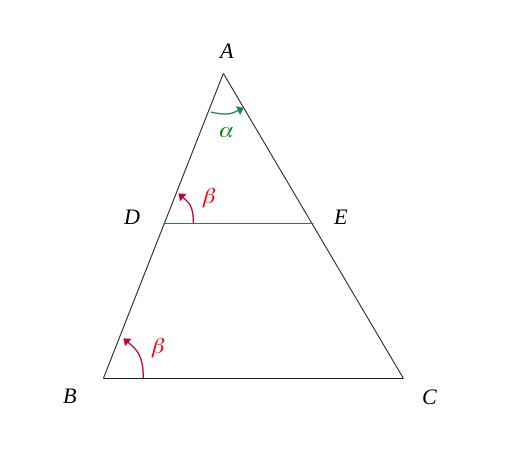
Having two pairwise equal angles, it is obvious that the third is also in common because the sum of the angles of a triangle always equals \( \pi\). The third angle \( \gamma \) is therefore equal to:
Thus, we do have the following equations:
Furthermore, the lengths \(BC \) and \(DE \) intersecting the same line \((AB) \) with an equal angle, we do have that \( (BC) \parallel (DE) \).
We can therefore apply Thales' theorem . We do have the following relations:
We definitely have the three proportional lengths as well as the respective equal angles.
Then finally,
Two triangles are similar if they have at least two pairwise equal angles .
Case 3: A common angle and two proportional lengths
Let us consider two nested triangles \(ABC \) and \(ADE \), having a common vertex \(A\) with a corresponding common angle \(\alpha\), as well as two respective sides of the same proportion starting from this vextex, and such as:
Then,
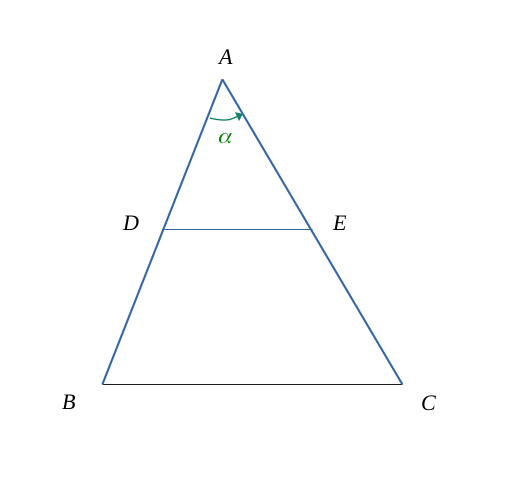
Now, by the converse of Thales's theorem, we know that the lines \((BC)\) and \((DE)\) are parallel to each other.
Consequently, according to the direct theorem, the third ratio \(\frac{DE}{BC}\) is also equal to the other two, such that:
Furthermore, we saw with the first case of similarities above that this also implied the preservation of the respective angles.
Thus,
Two triangles are similar if they have a common angle and their two respective lengths are proportional .
 Back to top