





 Index
Index
The properties of fractions
Elementary operations
Multiplication
Multiplying fractions together is the same as multiplying all the numerators (resp. all the denominators) together.
Division
Dividing by a fraction is the same as multiplying by its inverse.
Addition / substraction
Adding (resp. subtracting) fractions together requires putting them under a common denominator.
Properties
Cross product
Ratio between respectives numerators and denominators
The same ratios are possibles replacing all \( (+) \) by \( (-) \).
Ratio between respectives sums an differences
Addition of numerators and denominators
The same relation is possible replacing \( (+) \) by \( (-) \).
-
Generalization
On the whole, with a serie of \(n \) numerators and \(m \) denominators:
$$ \forall F \in \mathbb{Q}, \enspace \forall (a, c, e ...) \in \hspace{0.04em} \mathbb{N}^n, \enspace (b, d, f...) \in \hspace{0.04em} \mathbb{N}^m, \enspace \ \Bigl \{ (b \textcolor{rgb(157 171 234)}{\pm} d \textcolor{rgb(93 183 129)}{\pm} f \textcolor{rgb(232 124 124)}{\pm} ...) \Bigr \} \ \neq 0, $$$$ F = \frac{a}{b} = \frac{c}{d} = \frac{e}{f} = \ ... \ \Longrightarrow F = \frac{a \textcolor{rgb(157 171 234)}{\pm} c \textcolor{rgb(93 183 129)}{\pm} e \textcolor{rgb(232 124 124)}{\pm} \ ...}{b \textcolor{rgb(157 171 234)}{\pm} d \textcolor{rgb(93 183 129)}{\pm} f \textcolor{rgb(232 124 124)}{\pm} \ ...}$$$$ (\text{with the same-colour signs being the same}) $$
The properties of the powers of x (for natural exponents)
Let \( n\in \mathbb{N}\) be natural number and \( x \in \mathbb{R}\) a real number.
We call \(x^n\) a number \(x\) multiplied \(n\) times by itself:
All these formulas are demonstrated only for natural exponents \((n \in \mathbb{N})\).
Product/quotient of powers (having the same base)
Number to the power of zero
Inverse of a power
Power of a product/quotient
Power of a power
The geometrical identity
We call geometrical identity, or Bernoulli's formula , the following expression:
The Newton's binomial \(: (a + b)^n \)
Newton's binomial tells us that :
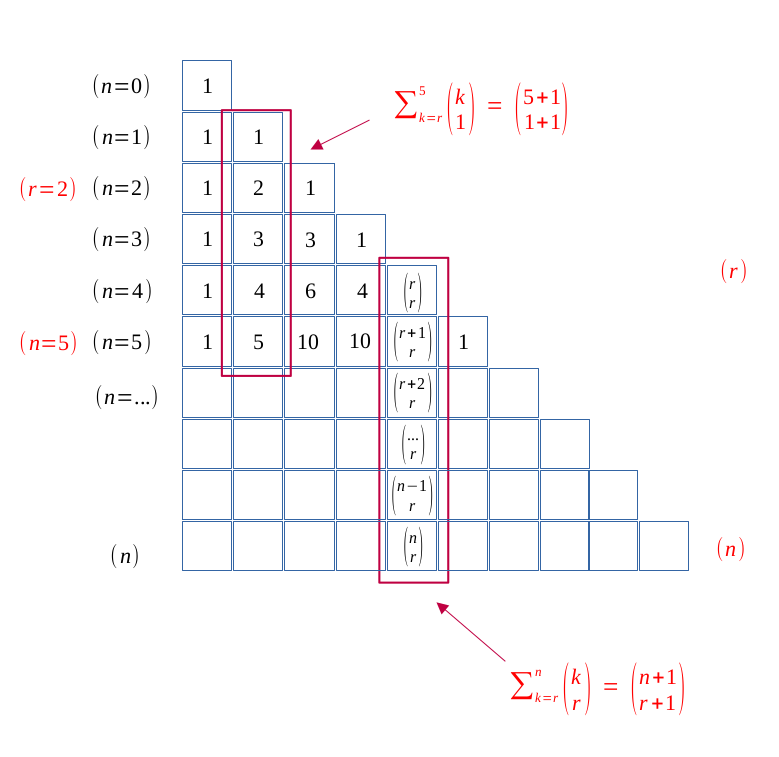
We can use the Pascal's triangle to find binomials coefficients \(\binom{n}{p}\).
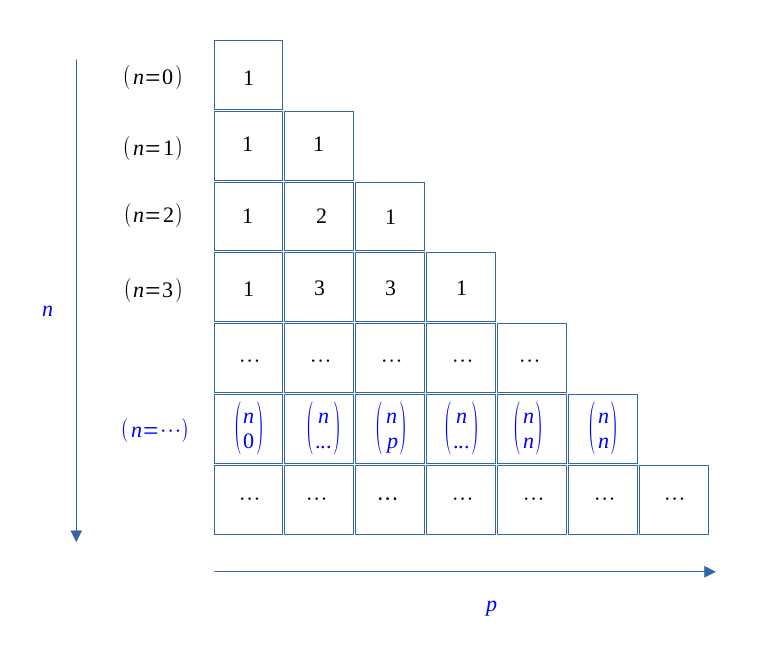
The properties of the binomial\(: \binom{n}{p}\)
Let \((p,n) \in \hspace{0.04em}\mathbb{N}^2 \) be two natural numbers with \( p \leqslant n \).
We call \(\binom{n}{p} \) ("\( p \) among \( n \)") to number of ways to take \( p \) elements among a set of \( n \) elements.
We also call it the binomial, and meets the following definition:
"0 among n" / "n among n"
"1 among n"
Symmetry
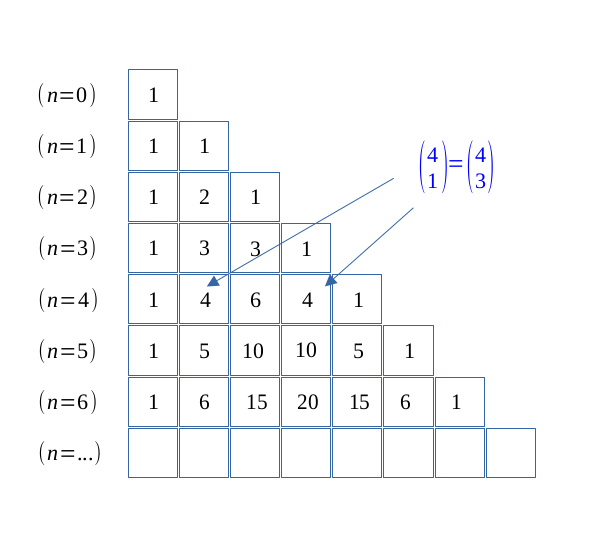
The pawn's formula
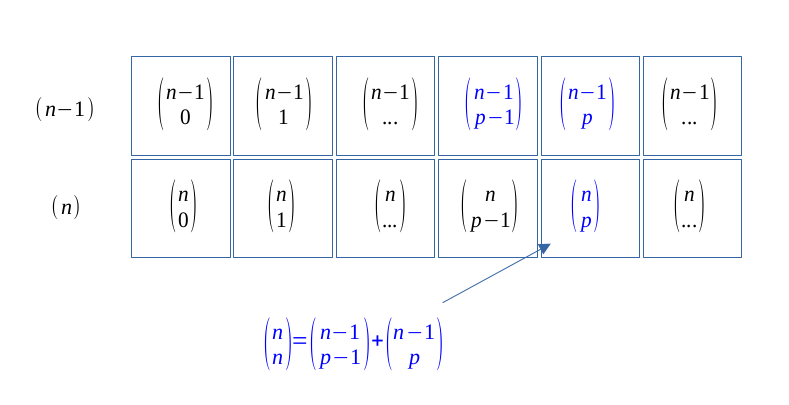
The Pascal's formula
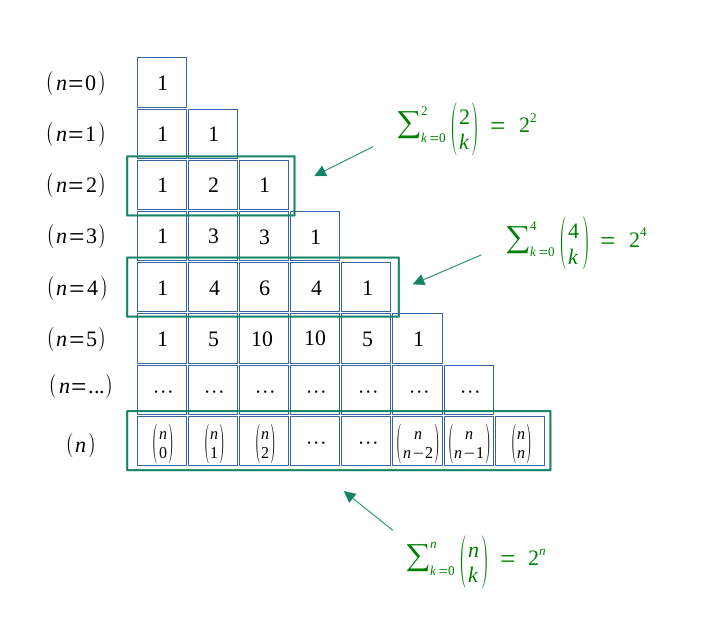
Horizontal sum from 0 to n
Vertical sum from r to n
Combinatorial analysis and enumerating formulas
All the formulas that follow will always have two cases:
- without repetition
-
with repetition : in this case there will be a bar above to mean "with repetition"
For example, if we note the arrangements without repetition \(A_n\), we will note \(\overline{A_n}\) those with possible repetition.
Permutations
The number of permutations of the elements of a set (without repetition)
For any set \(E\) of \(n\) elements, the number of possible permutations without repetition is:
The number of permutations of the elements of a set (with repetition)
For any set \(E = \{e_1, e_2, e_3, \ ..., \ e_n \}\) with \(k_1, k_2, k_3, ...,k_{n}\) the number of occurrences of each element, the number of possible permutations is:
Arrangements (with a certain order)
The number of arrangements of the elements of a set (without repetition)
The number of arrangements without repetition of \(p\) elements taken from a set of \(n\) are worth:
The number of arrangements of the elements of a set (with repetition)
The number of arrangements with repetition of \(p\) elements taken from a set of \(n\) are worth:
Combinations (without any order)
The number of ways to take distinct elements from a set (without repetition)
The number of ways to take \(p\) elements (distinct and without repetition) in a set of \(n\) elements are worth:
(\(\Longrightarrow\) voir les propriétés du binôme )
The number of ways to take distinct elements from a set (with repetition)
The number of ways to take \(p\) elements (distinct and with repetition) in a set of \(n\) elements are worth:
The number of possible parts of a set
The number of possible parts of a set \(E = \{e_1, e_2, e_3, \ ..., e_n\}\), that's to say :
is worth :
The properties of matrices
For what follows, it is important to establish the following definitions:
-
Operations on matrices
-
Matrices addition
Let \((A,B) \in \hspace{0.03em} \mathcal{M}_{n,p} (\mathbb{K})^2\) be two matrices of the same size.
$$ \forall (i, j) \in [\![1, n]\!] \times [\![1, p]\!],$$$$(A + B)_{i,j} = a_{i,j} + b_{i,j} $$In other words, we add each element of the left matrix with the element located at the same position of the right one:
$$ A + B = \begin{pmatrix} a_{1,1} & a_{1,2} & a_{1,3} & \dots & a_{1, p} \\ a_{2,1} & a_{2,2} & a_{2,3} & \dots & a_{2, p} \\ \hspace{0.5em} \vdots & \hspace{0.5em} \vdots & \hspace{0.5em} \vdots & \ddots & \hspace{0.5em} \vdots \\ a_{n,1} & a_{n,2} & a_{n,3} & \dots & a_{n, p} \end{pmatrix} + \begin{pmatrix} b_{1,1} & b_{1,2} & b_{1,3} & \dots & b_{1, p} \\ b_{2,1} & b_{2,2} & b_{2,3} & \dots & b_{2, p} \\ \hspace{0.5em} \vdots & \hspace{0.5em} \vdots & \hspace{0.5em} \vdots & \ddots & \hspace{0.5em} \vdots \\ b_{n,1} & b_{n,2} & b_{n,3} & \dots & b_{n, p} \end{pmatrix} $$$$ A + B = \begin{pmatrix} a_{1,1} + b_{1,1} & a_{1,2} + b_{1,2} & a_{1,3} + b_{1,3} & \dots & a_{1, p} + b_{1, p} \\ a_{2,1} + b_{2,1} & a_{2,2} + b_{2,2} & a_{2,3} + b_{2,3} & \dots & a_{2, p} + b_{2,p} \\ \hspace{2em} \vdots & \hspace{2em} \vdots & \hspace{2em} \vdots & \ddots & \hspace{2em} \vdots \\ a_{n,1} + b_{n,1} & a_{n,2} + b_{n,2} & a_{n,3} + b_{n,3} & \dots & a_{n, p} + b_{n,p} \end{pmatrix} $$ -
Matrices product
Let \(A \in \hspace{0.03em} \mathcal{M}_{n,p} (\mathbb{K})\) and \(B \in \hspace{0.03em} \mathcal{M}_{p,q} (\mathbb{K})\) be two matrices.
To multiply two matrices, we need the left matrix to have the same number of columns as the number of rows of the right one (here \(p\)). As a result, we obtain a matrix \(AB \in \hspace{0.03em} \mathcal{M}_{n,q} (\mathbb{K})\), so having \(n\) lines and \(q\) columns.
$$ \forall (i, j) \in [\![1, n]\!] \times [\![1, q]\!],$$$$(A \times B)_{i,j} = \sum_{k = 1}^p a_{i,k} \times b_{k,j} $$For example:
$$ A \times B = \begin{pmatrix} a_{1,1} & a_{1,2} & a_{1,3} & \dots & a_{1, p} \\ a_{2,1} & a_{2,2} & a_{2,3} & \dots & a_{2, p} \\ \hspace{0.5em} \vdots & \hspace{0.5em} \vdots & \hspace{0.5em} \vdots & \ddots & \hspace{0.5em} \vdots \\ a_{n,1} & a_{n,2} & a_{n,3} & \dots & a_{n, p} \end{pmatrix} \times \begin{pmatrix} b_{1,1} & b_{1,2} & b_{1,3} & \dots & b_{1, q} \\ b_{2,1} & b_{2,2} & b_{2,3} & \dots & b_{2, q} \\ \hspace{0.5em} \vdots & \hspace{0.5em} \vdots & \hspace{0.5em} \vdots & \ddots & \hspace{0.5em} \vdots \\ b_{p,1} & b_{p,2} & b_{p,3} & \dots & b_{p, q} \end{pmatrix} $$$$ A \times B = \begin{pmatrix} \Bigl[a_{1,1} b_{1,1} + a_{1,2} b_{2,1} \ + \ ... \ + \ a_{1,p} b_{p,1} \Bigr] & \Bigl[a_{1,1} b_{1,2} + a_{1,2} b_{2,2} \ + \ ... \ + \ a_{1,p} b_{p,2}\Bigr] & \hspace{1em} \dots \dots \dots \hspace{1em} & \Bigl[a_{1,1} b_{1,q} + a_{1,2} b_{2,q} \ + \ ... \ + \ a_{1,p} b_{p,q}\Bigr] \\ \Bigl[a_{2,1} b_{1,1} + a_{2,2} b_{2,1} \ + \ ... \ + \ a_{2,p} b_{p,1}\Bigr] & \Bigl[a_{2,1} b_{1,2} + a_{2,2} b_{2,2} \ + \ ... \ + \ a_{2,p} b_{p,2}\Bigr] & \hspace{1em} \dots \dots \dots \hspace{1em} & \Bigl[a_{2,1} b_{1,q} + a_{2,2} b_{2,q} \ + \ ... \ + \ a_{2,p} b_{p,q}\Bigr] \\ \hspace{8em} \vdots & \hspace{8em} \vdots & \hspace{1em} \ddots & \hspace{8em} \vdots \\ \hspace{8em} \vdots & \hspace{8em} \vdots & \hspace{1em} \ddots & \hspace{8em} \vdots \\ \Bigl[a_{n,1} b_{1,1} + a_{n,2} b_{2,1} \ + \ ... \ + \ a_{n,p} b_{p,1}\Bigr] & \Bigl[a_{n,1} b_{1,2} + a_{2,2} b_{2,2} \ + \ ... \ + \ a_{n,p} b_{p,2}\Bigr] & \hspace{1em} \dots \dots \dots \hspace{1em} & \Bigl[a_{n,1} b_{1,q} + a_{n,2} b_{2,q} \ + \ ... \ + \ a_{n,p} b_{p,q}\Bigr] \end{pmatrix} $$Be careful, in a general way the matrices product does not have commutative law: \( (A \times B) \neq (B \times A) \) .
-
Multiplication of a matrix by a scalar \(\lambda\)
Let \(A \in \hspace{0.03em} \mathcal{M}_{n,p} (\mathbb{K})\) be a matrix.
When a matrix is multiplied by a scalar, it affects all its elements.
$$ \forall (i, j) \in [\![1, n]\!] \times [\![1, p]\!],$$$$(\lambda A)_{i,j} = \lambda \ a_{i,j} $$For example:
$$ A = \begin{pmatrix} a_{1,1} & a_{1,2} & a_{1,3} & \dots & a_{1, p} \\ a_{2,1} & a_{2,2} & a_{2,3} & \dots & a_{2, p} \\ \hspace{0.5em} \vdots & \hspace{0.5em} \vdots & \hspace{0.5em} \vdots & \ddots & \hspace{0.5em} \vdots \\ a_{n,1} & a_{n,2} & a_{n,3} & \dots & a_{n, p} \end{pmatrix} $$$$ \lambda A = \begin{pmatrix} \lambda \ a_{1,1} & \lambda \ a_{1,2} & \lambda \ a_{1,3} & \dots & \lambda \ a_{1, p} \\ \lambda \ a_{2,1} & \lambda \ a_{2,2} & \lambda \ a_{2,3} & \dots & \lambda \ a_{2, p} \\ \hspace{0.5em} \vdots & \hspace{0.5em} \vdots & \hspace{0.5em} \vdots & \ddots & \hspace{0.5em} \vdots \\ \lambda \ a_{n,1} & \lambda \ a_{n,2} & \lambda \ a_{n,3} & \dots & \lambda \ a_{n, p} \end{pmatrix} $$ -
Linear combination of matrices
Let \((A,B) \in \hspace{0.03em} \mathcal{M}_{n,p} (\mathbb{K})^2\) be two matrices of the same size and \((\lambda, \mu) \in \hspace{0.04em} \mathbb{R}^2\).
With the previous properties of addition and multiplication by a scalar , we can create linear combinations and:
$$(\lambda A + \mu B)_{i,j} = \lambda \ a_{i,j} + \mu \ b_{i,j} $$ -
Matrix transposition
Let \(A \in \hspace{0.03em} \mathcal{M}_{n}(\mathbb{K})\) be a squared matrix of size \(n\).
Matrix transposition consists in reverse lines and columns indices for each elements. We note \(A^T\) (sometimes \(^t A\)) the transposed of the matrix \(A\).
$$ \forall (i, j) \in [\![1, n]\!]^2,$$$$ \left(A^T \right)_{i,j} \hspace{0.03em} = a_{j,i} $$For example:
$$ A = \begin{pmatrix} a_{1,1} & \textcolor{rgb(232 124 124)}{a_{1,2}} & \textcolor{rgb(232 124 124)}{a_{1,3}} & \textcolor{rgb(232 124 124)}{\dots} & \textcolor{rgb(232 124 124)}{a_{1, n}} \\ \textcolor{rgb(93 183 129)}{a_{2,1}} & a_{2,2} & \textcolor{rgb(232 124 124)}{a_{2,3}} & \textcolor{rgb(232 124 124)}{\dots} & \textcolor{rgb(232 124 124)}{a_{2, n}} \\ \textcolor{rgb(93 183 129)}{a_{3,1}} & \textcolor{rgb(93 183 129)}{a_{3,2}} & a_{3,3} & \textcolor{rgb(232 124 124)}{\dots} & \textcolor{rgb(232 124 124)}{a_{3, n}} \\ \hspace{1em} \textcolor{rgb(93 183 129)}{\vdots} & \hspace{1em} \textcolor{rgb(93 183 129)}{\vdots} & \hspace{1em} \textcolor{rgb(93 183 129)}{\vdots} & \ddots & \hspace{1em} \textcolor{rgb(232 124 124)}{\vdots} \\ \textcolor{rgb(93 183 129)}{a_{n,1}} & \textcolor{rgb(93 183 129)}{a_{n,2}} & \textcolor{rgb(93 183 129)}{a_{n,3}} & \textcolor{rgb(93 183 129)}{\dots} & a_{n, n} \\ \end{pmatrix} $$So, its transposed is:
$$ A^T = \begin{pmatrix} a_{1,1} & \textcolor{rgb(93 183 129)}{a_{2,1}} & \textcolor{rgb(93 183 129)}{a_{3,1}} & \textcolor{rgb(93 183 129)}{\dots} & \textcolor{rgb(93 183 129)}{a_{n, 1}} \\ \textcolor{rgb(232 124 124)}{a_{1,2}} & a_{2,2} & \textcolor{rgb(93 183 129)}{a_{3,2}} & \textcolor{rgb(93 183 129)}{\dots} & \textcolor{rgb(93 183 129)}{a_{n, 2}} \\ \textcolor{rgb(232 124 124)}{a_{1,3}} & \textcolor{rgb(232 124 124)}{a_{2,3}} & a_{3,3} & \textcolor{rgb(93 183 129)}{\dots} & \textcolor{rgb(93 183 129)}{a_{n, 3}} \\ \hspace{0.8em} \textcolor{rgb(232 124 124)}{\vdots} & \hspace{0.8em} \textcolor{rgb(232 124 124)}{\vdots} & \hspace{0.8em} \textcolor{rgb(232 124 124)}{\vdots} & \ddots & \hspace{0.8em} \textcolor{rgb(93 183 129)}{\vdots} \\ \textcolor{rgb(232 124 124)}{a_{1,n}} & \textcolor{rgb(232 124 124)}{a_{2,n}} & \textcolor{rgb(232 124 124)}{a_{3,n}} & \textcolor{rgb(232 124 124)}{\dots} & a_{n, n} \\ \end{pmatrix} $$Only the diagonal remains intact, because when \(i = j\), then \(a_{i,j} = a_{j,i}\).
-
Inversion of a matrix
Let \(A \in \hspace{0.03em} \mathcal{M}_{n,p} (\mathbb{K})\) be a matrix.
The inverse of the matrix \(A\) is the matrix written \(A^{-1}\) and the same size, such as: \(A A^{-1} = I_n\).
To check if a matrix can be inverted, we do have to compute its determinant, and:
$$ A \text{ is inversible } \Longleftrightarrow det(A) \neq 0 $$ -
Comatrix
Let \(A \in \hspace{0.03em} \mathcal{M}_{n}(\mathbb{K})\) be a squared matrix of size \(n\).
The comatrix of the matrix \(A\) is the matrix noted \(com(A)\), such as:
$$ \forall (i, j) \in [\![1, n]\!]^2,$$$$ com(A)_{i,j} \hspace{0.03em} = C_{i,j} $$$$ \text{où } \ \left \{ \begin{gather*} C_{i,j} : \text{cofactors of the element } a_{i, j} \\ M_{i, j} : \text{minor of the element } a_{i, j} \end{gather*} \right \} $$\(C_{i, j}\) : cofactors of the element \(a_{i, j}\)
$$ C_{i,j} = (-1)^{i + j} \times det(M_{i, j}) $$\(M_{i, j}\) : minor of the element \(a_{i, j}\)
The minor of \(a_{i, j}\) is the undermatrix of \(A\) without the line \(i\) and the column \(j\).
For example, starting from the following matrix \(A\), the minor \(\textcolor{rgb(157 171 234)}{M_{1,1}}\) appears in blue:
$$ A = \begin{pmatrix} a_{1,1} & a_{1,2} & a_{1,3} & \dots & a_{1, p} \\ a_{2,1} & \textcolor{rgb(157 171 234)}{a_{2,2}} & \textcolor{rgb(157 171 234)}{a_{2,3}} & \dots & \textcolor{rgb(157 171 234)}{a_{2, p}} \\ a_{3,1} & \textcolor{rgb(157 171 234)}{a_{3,2}} & \textcolor{rgb(157 171 234)}{a_{3,3}} & \dots & \textcolor{rgb(157 171 234)}{a_{3, p}} \\ \hspace{0.5em} \vdots & \hspace{0.5em} \textcolor{rgb(157 171 234)}{\vdots} & \hspace{0.5em} \textcolor{rgb(157 171 234)}{\vdots} & \textcolor{rgb(157 171 234)}{\ddots} & \hspace{0.5em} \textcolor{rgb(157 171 234)}{\vdots} \\ a_{n,1} & \textcolor{rgb(157 171 234)}{a_{n,2}} & \textcolor{rgb(157 171 234)}{a_{n,3}} & \dots & \textcolor{rgb(157 171 234)}{a_{n, p}} \end{pmatrix} $$So,
$$ \textcolor{rgb(157 171 234)}{ M_{1,1} = \begin{pmatrix} a_{2,2} & a_{2,3} & \dots & a_{2, p} \\ a_{3,2} & a_{3,3} & \dots & a_{3, p} \\ \vdots & \hspace{0.5em} \vdots & \ddots & \hspace{0.5em} \textcolor{rgb(157 171 234)}{\vdots} \\ a_{n,2} & a_{n,3} & \dots & a_{n, p} \end{pmatrix} } $$For example, starting from the following matrix \(A\):
$$ A = \begin{pmatrix} a_{1,1} & a_{1,2} & a_{1,3} \\ a_{2,1} & a_{2,2} & a_{2,3} \\ a_{3,1} & a_{3,2} & a_{3,3} \end{pmatrix} $$Its comatrix is worth:
$$ com(A) = \begin{pmatrix} \textcolor{rgb(93 183 129)}{+}\begin{vmatrix} a_{2,2} & a_{2,3} \\ a_{3,2} & a_{3,3} \end{vmatrix} & \textcolor{rgb(232 124 124)}{-}\begin{vmatrix} a_{2,1} & a_{2,3} \\ a_{3,1} & a_{3,3} \end{vmatrix} & \textcolor{rgb(93 183 129)}{+}\begin{vmatrix} a_{2,1} & a_{2,2} \\ a_{3,1} & a_{3,2} \end{vmatrix} \\ \textcolor{rgb(232 124 124)}{-}\begin{vmatrix} a_{1,2} & a_{1,3} \\ a_{3,2} & a_{3,3} \end{vmatrix} & \textcolor{rgb(93 183 129)}{+}\begin{vmatrix} a_{1,1} & a_{1,3} \\ a_{3,1} & a_{3,3} \end{vmatrix} & \textcolor{rgb(232 124 124)}{-}\begin{vmatrix} a_{1,1} & a_{1,2} \\ a_{3,1} & a_{3,2} \end{vmatrix} \\ \textcolor{rgb(93 183 129)}{+}\begin{vmatrix} a_{1,2} & a_{1,3} \\ a_{2,2} & a_{2,3} \end{vmatrix} & \textcolor{rgb(232 124 124)}{-}\begin{vmatrix} a_{1,1} & a_{1,3} \\ a_{2,1} & a_{2,3} \end{vmatrix} & \textcolor{rgb(93 183 129)}{+}\begin{vmatrix} a_{1,1} & a_{1,2} \\ a_{2,1} & a_{2,2} \end{vmatrix} \end{pmatrix} $$ -
Matricial writing of a system of linear equations
A system of linear equations \( (S)\), where the unknown are the variables \(x_{i,j}\), can be written as a product matrix system :
$$ (S) \enspace \left \{ \begin{gather*} a_1 x_{1,1} + a_2 x_{1,2} + a_3 x_{1,3} + \hspace{0.1em}... \hspace{0.1em}+ a_n x_{1,p} = b_1 \\ a_1 x_{2,1} + a_2 x_{2,2} + a_3 x_{2,3} + \hspace{0.1em}... \hspace{0.1em}+ a_n x_{2,p} = b_2 \\ ........................ ............. \ = \ ..\\ a_1 x_{n,1} + a_2 x_{n,2} + a_3 x_{n,3} + \hspace{0.1em}... \hspace{0.1em}+ a_n x_{n,p} = b_n \\ \end{gather*} \right \} $$$$ \Longleftrightarrow$$$$ \underbrace{ \begin{pmatrix} x_{1,1} & x_{1,2} & x_{1,3} & \dots & x_{1, p} \\ x_{2,1} & x_{2,2} & x_{2,3} & \dots & x_{2, p} \\ \hspace{0.8em} \vdots & \hspace{0.8em} \vdots & \hspace{0.8em} \vdots & \ddots & \hspace{0.8em} \vdots \\ x_{n,1} & x_{n,2} & x_{n,3} & \dots & x_{n, p} \\ \end{pmatrix} } _\text{X} \times \underbrace{ \begin{pmatrix} a_1 \\ a_2 \\ \hspace{0.3em}\vdots \\ a_n \end{pmatrix} } _\text{A} = \underbrace{ \begin{pmatrix} b_1 \\ b_2 \\ \hspace{0.3em}\vdots \\ b_n \end{pmatrix} } _\text{B} \ \Longleftrightarrow \ XA = B, \ \text{with } \left \{ \begin{gather*} X \in \hspace{0.03em} \mathcal{M}_{n,p} (\mathbb{K}) \\ A \in \hspace{0.03em} \mathcal{M}_{1,p} (\mathbb{K}) \\ B \in \hspace{0.03em} \mathcal{M}_{1,p} (\mathbb{K}) \end{gather*} \right \} $$ -
Trace of a matrix
Let \(A \in \hspace{0.03em} \mathcal{M}_{n}(\mathbb{K})\) be a squared matrix of size \(n\).
We call the trace of a matrix, the sum of all its diagonal elements:
$$ A = \begin{pmatrix} \textcolor{rgb(157 171 234)}{a_{1,1}} & a_{1,2} & a_{1,3} & \dots & a_{1,n} \\ a_{2,1} & \textcolor{rgb(157 171 234)}{a_{2,2}} & a_{2,3} & \dots & a_{2,n} \\ a_{3,1} & a_{3,2} & \textcolor{rgb(157 171 234)}{a_{3,3}} & \dots & a_{3,n} \\ \hspace{0.1em}\vdots & \hspace{0.1em} \vdots & \hspace{0.1em} \vdots & \textcolor{rgb(157 171 234)}{\ddots} & \hspace{0.1em} \vdots \\ a_{n,1} & a_{n,2} & a_{n,3} & \dots & \textcolor{rgb(157 171 234)}{a_{n,n}} \end{pmatrix} $$$$Tr(A) = \sum_{k = 1}^n a_{k,k} = a_{1,1} + a_{2,2} \ + \ ... \ + a_{n,n}$$
-
Matrices addition
-
Specific matrices
-
Diagonal matrix
A diagonal is a squared matrix where all the elements are \(0\) except on the main diagonal:
$$ D_n = \begin{pmatrix} \textcolor{rgb(157 171 234)}{d_{1,1}} & 0 & 0 & \dots & 0 \\ 0 & \textcolor{rgb(157 171 234)}{d_{2,2}} & 0 & \dots & 0 \\ 0 & 0 & \textcolor{rgb(157 171 234)}{d_{3,3}} & \dots & 0 \\ \hspace{0.1em}\vdots & \hspace{0.1em} \vdots & \hspace{0.1em} \vdots & \textcolor{rgb(157 171 234)}{\ddots} & \hspace{0.1em} \vdots \\ 0 & 0 & 0 & \dots & \textcolor{rgb(157 171 234)}{d_{n,n}} \end{pmatrix} $$$$ \forall (i, j) \in [\![1, n]\!]^2, \ (i \neq j) \Longrightarrow d_{i,j} = 0$$We also note the diagonal matrix \(D_n\) only in relation with its diagonal elements : \(D_n = diag(\lambda_1, \lambda_2, \ ..., \lambda_n)\).
-
Identity matrix
Identity matrix \(I_n\) are defined as follows:
$$ I_n = \begin{pmatrix} \textcolor{rgb(157 171 234)}{1} & 0 & 0 & \dots & 0 \\ 0 & \textcolor{rgb(157 171 234)}{1} & 0 & \dots & 0 \\ 0 & 0 & \textcolor{rgb(157 171 234)}{1} & \dots & 0 \\ \vdots & \vdots & \vdots & \textcolor{rgb(157 171 234)}{\ddots} & \vdots \\ 0 & 0 & 0 & \dots & \textcolor{rgb(157 171 234)}{1} \\ \end{pmatrix} $$It is the square matrix of size \(n\) having the value \(1\) on its main diagonal, and \(0\) everywhere else. It's a specific case of diagonal matrix. For example,
$$ I_3 = \begin{pmatrix} \textcolor{rgb(157 171 234)}{1} & 0 & 0 \\ 0 & \textcolor{rgb(157 171 234)}{1} & 0 \\ 0 & 0 & \textcolor{rgb(157 171 234)}{1} \end{pmatrix} $$ -
Matrix of ones
Matrix of ones \(J_n\) is the square matrix of size \(n\) where all elements are worth \(1\):
$$ J_n = \begin{pmatrix} 1 & 1 & 1 & \dots & 1 \\ 1 & 1 & 1 & \dots & 1 \\ 1 & 1 & 1 & \dots & 1 \\ \vdots & \vdots & \vdots & \textcolor{rgb(157 171 234)}{\ddots} & \vdots \\ 1 & 1 & 1 & \dots & 1 \\ \end{pmatrix} $$So, for exemple \(J_3\) is worth:
$$ J_3 = \begin{pmatrix} 1 & 1 & 1 \\ 1 & 1 & 1 \\ 1 & 1 & 1 \\ \end{pmatrix} $$
-
Diagonal matrix
Matrix product
Associativity
Distributivity
Bilinearity
Multiplication by the identity
Diagonal product matrix
-
Product of two diagonal matrices$$ \forall \Bigl[ D_1 = diag(\lambda_1, \lambda_2, \ ..., \lambda_n), \ D_2 = diag(\mu_1, \mu_2, \ ..., \mu_n) \Bigr] \in \hspace{0.03em} \mathcal{M}_{n}(\mathbb{K})^2, $$$$ D_1 \times D_2 = D_2 \times D_1 = diag \left(\lambda_1 \mu_1, \lambda_2 \mu_2, \ ..., \lambda_n \mu_n \right) $$
-
A diagonal matrix raised to the power of \(n\)$$ \forall \Bigl[ D = diag(\lambda_1, \lambda_2, \ ..., \lambda_n) \Bigr] \in \hspace{0.03em} \mathcal{M}_{n}(\mathbb{K}), $$$$ D^m = diag \left(\lambda_1^m, \lambda_2^m, \ ..., \lambda_n^m \right) $$
Matrix comatrix, transposed and determinant
Link between matrix, comatrix, transposed and determinant
Matrix transposition
Linearity of transposition
Transposed of a product
Inversion of matrix
Computation of l'inverse
Inverse of the inverse
Inverse of a transposed matrix
Inverse of a product
Both expressions \((9)\) and \((10)\) have the same behaviour:
So, the order of transposition or inversion has no importance,
Traces of matrix
Linearity of the trace
Trace of a product
Powers of matrices
Powers of the matrix of ones
Let \(J_n\) bet the matrix of ones of size \(n\).
 Back to top