




 Index
Index
En analyse réelle, la règle de L'Hôpital (ou théorème de Bernoulli-L'Hôpital) est un outil fondamental permettant de lever des formes indéterminées du type \(\left[\frac{0}{0}\right]\) ou \(\left[\frac{\infty}{\infty}\right]\) lors du calcul de limites de quotients de fonctions. Elle établit que, sous certaines conditions de régularité, la limite du rapport de deux fonctions est égale à la limite du rapport de leurs dérivées.
Soient \(I\) un intervalle ouvert de \(\mathbb{R}\) et \(\alpha\) un point appartenant à l'adhérence de \(I\) dans la droite réelle achevée, c'est-à-dire \(\alpha \in \overline{\mathbb{R}} = \mathbb{R} \cup \{-\infty, +\infty\}\). Soient \(f\) et \(g\) deux fonctions définies et dérivables sur \(I\setminus\{\alpha\}\).
Pour que la règle puisse être licitement appliquée, les trois hypothèses fondamentales suivantes doivent être simultanément vérifiées :
Conditions générales d'application
- \(g'(x) \neq 0\) pour tout \(x \in I\) suffisamment proche de \(\alpha\).
- Les fonctions induisent une forme indéterminée en \(\alpha\), soit par annulation conjointe :
$$ \lim_{x \to \alpha} f(x) = 0 \quad \text{et} \quad \lim_{x \to \alpha} g(x) = 0 $$soit par divergence conjointe (indépendamment du signe des infinis) :$$ \lim_{x \to \alpha} |f(x)| = +\infty \quad \text{et} \quad \lim_{x \to \alpha} |g(x)| = +\infty $$
- La limite du quotient des dérivées existe dans \(\overline{\mathbb{R}}\), c'est-à-dire :
$$ \lim_{x \to \alpha} \frac{f'(x)}{g'(x)} = l \quad \text{où } l \in \overline{\mathbb{R}} $$
Si ces conditions sont remplies, alors la limite du rapport des fonctions existe également et lui est égale :
Soient \(I\) un intervalle ouvert de \(\mathbb{R}\) et \(\alpha\) un point appartenant à l'adhérence de \(I\) dans la droite réelle achevée, c'est-à-dire \(\alpha \in \overline{\mathbb{R}} = \mathbb{R} \cup \{-\infty, +\infty\}\). Soient \(f\) et \(g\) deux fonctions définies et dérivables sur \(I\setminus\{\alpha\}\).
-
Forme indéterminée de type [zéro/zéro] \( : \left[ \frac{0}{0} \right] \)
$$ \Biggl \{ \begin{gather*} \lim_{x \to \alpha} \ f(x) = 0 \\ \lim_{x \to \alpha} \ g(x) = 0 \end{gather*} \qquad (H) $$Si l'on souhaite calculer :
$$ \lim_{x \to \alpha} \enspace \frac{f(x)}{g(x)} $$On se retrouve avec une forme indéterminée de type \( \left[ \frac{0}{0} \right]\).
$$ \lim_{x \to \alpha} \enspace \frac{f(x)}{g(x)} = \left[ \frac{0}{0} \right] $$Grâce au théorème des accroissements finis généralisé (ou théorème de la moyenne de Cauchy ), on sait que :
$$ \forall (f, \ g) \text{ continues sur } \bigl[a,b \bigr]^2 \text{ et dérivables sur } \bigl ]a,b \bigr[^2, $$$$ \exists c \in \bigl ]a,b \bigr[, \enspace \frac{f'(c)}{g'(c)} = \frac{f(b) - f(a)}{g(b) - g(a)} $$Dans notre cas,
$$ \forall x \in I, \enspace \exists c \in \hspace{0.04em} ]\alpha, x[, \enspace \frac{f'(c)}{g'(c)} = \frac{f(x) - f(\alpha)}{g(x) - g(\alpha)} \qquad (1) $$Mais, avec \( (H) \) l'expression \( (1) \) devient \( (2) \) :
$$ \forall x \in I, \enspace \exists c \in \hspace{0.04em} ]\alpha, x[, \enspace \frac{f'(c)}{g'(c)} = \frac{f(x)}{g(x)} \qquad (2) $$Par suite,
$$ \forall x \in I, \enspace \exists c \in \hspace{0.04em} ]\alpha, x[, \ \lim_{x \to \alpha} \enspace \frac{f'(c)}{g'(c)} = \lim_{x \to \alpha} \enspace \frac{f(x)}{g(x)} = l \qquad (3)$$Or, comme \( \alpha < c < x\), on a les deux implications suivantes :
$$ x \to \alpha \Longrightarrow c \to \alpha \Longrightarrow c \to x $$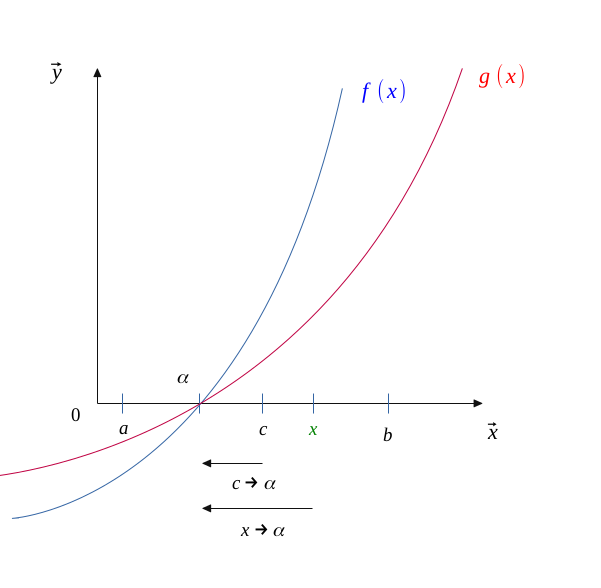
Par conséquent si \( x \to \alpha \), alors \( c \to x \) et on peut réécrire \( (3) \) sous forme \( (3') \) :
$$ \lim_{x \to \alpha} \enspace \frac{f'(x)}{g'(x)} = \lim_{x \to \alpha} \enspace \frac{f(x)}{g(x)} = l \qquad (3') $$Soit finalement,
$$ \forall x \in I \setminus \{\alpha\}, \enspace \forall \alpha \in \overline{\mathbb{R}}, \enspace g(x) \neq 0 \quad \text{et} \quad g'(x) \neq 0, $$$$ \left \{ \begin{gather*} \lim_{x \to \alpha} \ f(x) = 0, \\ \lim_{x \to \alpha} \ g(x) = 0 \\ \\ \lim_{x \to \alpha} \ \frac{f'(x)}{g'(x)} = l \end{gather*} \right \} \Longrightarrow \lim_{x \to \alpha} \enspace \frac{f(x)}{g(x)} = l \qquad \bigl(\text{Règle de L'Hôpital} \bigr) $$-
Cas 1 : levée de l'indétermination
D'après cette règle, si : \( \lim_{x \to \alpha} \enspace f'(x) \neq 0 \) ou bien \( \lim_{x \to \alpha} \enspace g'(x) \neq 0 \), alors la limite de \( \frac{f}{g} \) s'obtient directement.
-
Cas 2 : forme toujours indéterminée
Dès lors que l'on est toujours sur une une forme indéterminée , on recommence le processus jusqu'à lever l'indétermination.
-
Cas 1 : levée de l'indétermination
-
Forme indéterminée de type [infini/infini] \( : \left[ \frac{\pm \infty}{\pm \infty} \right]\)
De la même manière, on peut montrer que cela fonctionne aussi lorsque, à la place de \( (H)\) nous avons une nouvelle hypothèse \( (H')\), telle que :
$$ \Biggl \{ \begin{gather*} \lim_{x \to \alpha} \enspace f(x) = \pm \infty \\ \lim_{x \to \alpha} \enspace g(x) = \pm \infty \end{gather*} \qquad (H') $$On a alors en passant à la limite, une nouvelle forme indéterminée de type \( \left[ \frac{\pm \infty}{\pm \infty} \right]\) :
$$ \lim_{x \to \alpha} \enspace \frac{f(x)}{g(x)} = \left[ \frac{\pm \infty}{\pm \infty} \right] $$Réécrivons l'expression \( (1) \) trouvée précédemment :
$$ \forall x \in I, \enspace \exists c \in \hspace{0.04em} ]\alpha, x[, \enspace \frac{f'(c)}{g'(c)} = \frac{f(x) - f(\alpha)}{g(x) - g(\alpha)} \qquad (1) $$En passant à la limite, on a :
$$ \forall x \in I, \enspace \exists c \in \hspace{0.04em} ]\alpha, x[, \ \lim_{x \to \alpha} \enspace \frac{f'(c)}{g'(c)} = \lim_{x \to \alpha} \enspace \frac{f(x) - f(\alpha)}{g(x) - g(\alpha)}= l \qquad (4)$$Comme \( f(\alpha) \) et \( g(\alpha) \) sont tous deux constants et sachant \( (H') \), on peut écrire que :
$$ \lim_{x \to \alpha} \enspace \frac{f(x) - f(\alpha)}{g(x) - g(\alpha)}= \lim_{x \to \alpha} \frac{f(x)}{g(x)} = l \qquad (4') $$Alors, grâce à \( (4) \) et \( (4') \) on obtient \( (5)\) :
$$ \forall x \in I, \enspace \exists c \in \hspace{0.04em} ]\alpha, x[, \ \lim_{x \to \alpha} \enspace \frac{f'(c)}{g'(c)} = \lim_{x \to \alpha} \enspace \frac{f(x)}{g(x)}= l \qquad (5)$$Enfin, de la même manière que précédemment, on a une réaction en chaîne lorsque \(x \to a\) :
$$ x \to \alpha \Longrightarrow c \to \alpha \Longrightarrow c \to x $$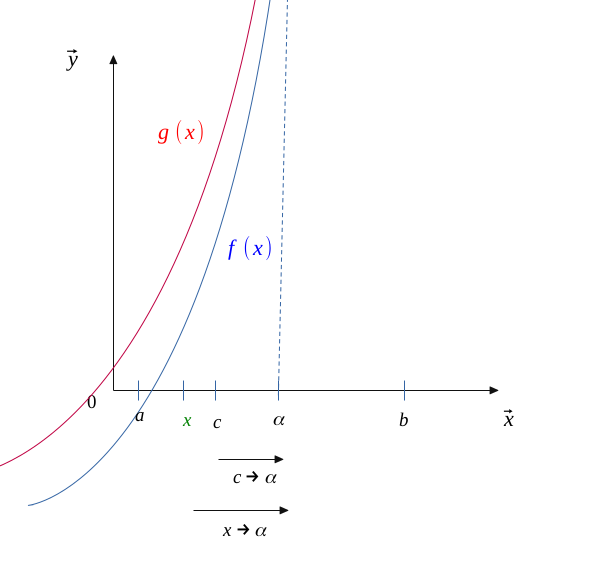
Par conséquent si \( x \to \alpha \), alors \( c \to x \) et on peut réécrire \( (5) \) sous forme \( (5') \) :
$$ \lim_{x \to \alpha} \enspace \frac{f'(x)}{g'(x)} = \lim_{x \to \alpha} \enspace \frac{f(x)}{g(x)} = l \qquad (5') $$Soit finalement,
$$ \forall x \in I \setminus \{\alpha\}, \enspace \forall \alpha \in \overline{\mathbb{R}}, \enspace g(x) \neq 0 \quad \text{et} \quad g'(x) \neq 0, $$$$ \left \{ \begin{gather*} \lim_{x \to \alpha} \ f(x) = \pm \infty, \\ \lim_{x \to \alpha} \ g(x) = \pm \infty \\ \\ \lim_{x \to \alpha} \ \frac{f'(x)}{g'(x)} = l \end{gather*} \right \} \Longrightarrow \lim_{x \to \alpha} \enspace \frac{f(x)}{g(x)} = l \qquad \qquad \bigl(\text{Règle de L'Hôpital} \bigr)^* $$ -
Forme indéterminée de type [zéro fois l'infini] \( : \bigl[ 0 \times \pm \infty \bigr]\)
Enfin, avec un produit \( fg \) ayant une indétermination de type \( [0] \times {[ \pm \infty]}\), telle que :
$$ \lim_{x \to \alpha} \enspace f(x) g(x) = \bigl[ 0 \times \pm \infty \bigr] $$$$ \text{avec } \Biggl \{ \begin{gather*} \lim_{x \to \alpha} \enspace f(x) = 0 \\ \lim_{x \to \alpha} \enspace g(x) = \pm \infty \end{gather*} $$On pourra considérer plutôt un quotient et appliquer la règle, tel que :
$$ \lim_{x \to \alpha} \enspace f(x) g(x) = \lim_{x \to \alpha} \enspace \frac{f(x)}{\frac{1}{g(x)}}$$ -
Conclusion
$$ \forall x \in I \setminus \{\alpha\}, \enspace \forall \alpha \in \overline{\mathbb{R}}, \enspace g(x) \neq 0 \quad \text{et} \quad g'(x) \neq 0, $$$$ \left \{ \begin{gather*} \lim_{x \to \alpha} \ f(x) = 0 \text{ ou }\pm \infty, \\ \lim_{x \to \alpha} \ g(x) = 0 \text{ ou }\pm \infty \\ \\ \lim_{x \to \alpha} \ \frac{f'(x)}{g'(x)} = l \end{gather*} \right \} \Longrightarrow \lim_{x \to \alpha} \enspace \frac{f(x)}{g(x)} = l \qquad \qquad \bigl(\text{Règle de L'Hôpital} \bigr) $$
Exemples
-
Exemple 1
$$ \lim_{x \to 0^+} \enspace \frac{\sin(x)}{x} = \left[ \frac{0^+}{0^+} \right] $$On tombe sur une forme indéterminée de type \( \left[ \frac{0}{0} \right]\).
On applique la règle :
$$ \lim_{x \to 0^+} \enspace \frac{\sin(x)}{x} = \lim_{x \to 0} \enspace \frac{\cos(x)}{1}= 1 $$ -
Exemple 2
$$ \lim_{x \to +\infty} \enspace \frac{e^x}{x^n} = \left[ \frac{+ \infty}{+ \infty} \right] $$En appliquant la règle en série, le numérateur va rester fixe, mais le dénominateur va devenir constant à partir de la \(n\)-ième dérivation :
$$ \lim_{x \to +\infty} \enspace \frac{e^x}{x^n} = \lim_{x \to +\infty} \enspace \frac{e^x}{nx^{n-1}} $$$$ \lim_{x \to +\infty} \enspace \frac{e^x}{x^n} = \lim_{x \to +\infty} \enspace \frac{e^x}{n(n-1)x^{n-2}} $$$$ \lim_{x \to +\infty} \enspace \frac{e^x}{x^n} \enspace = \enspace... \enspace = \enspace \lim_{x \to +\infty} \enspace \frac{e^x}{n!} = + \infty $$ -
Exemple 3
$$ \lim_{x \to 0^+} \ x^n \ln(x) = \bigl[ 0^+ \times - \infty \bigr] $$$$ \text{avec } \Biggl \{ \begin{gather*} \lim_{x \to 0^+} \ x^n = \ 0^+ \\ \lim_{x \to 0^+} \ \ln(x) = - \infty \end{gather*} $$Pour appliquer la règle, on va considérer le quotient pour le calcul de la limite :
$$ \lim_{x \to 0^+} \ x^n \ln(x) = \lim_{x \to 0^+} \ \frac{\ln(x)}{x^{-n}} $$À ce moment-là, la règle nous donne que :
$$ \lim_{x \to 0^+} \ x^n \ln(x) = \lim_{x \to 0^+} \ \frac{\frac{1}{x}}{-nx^{-n-1}} $$$$ \lim_{x \to 0^+} \ x^n \ln(x) = \lim_{x \to 0^+} \ \frac{1}{-nx^{-n}} $$$$ \lim_{x \to 0^+} \ x^n \ln(x) = \lim_{x \to 0^+} \ - \frac{x^{n}}{n} = \ 0^+ $$ -
Exemple 4
$$ \lim_{x \to 0^+} \ \frac{\ln(1 + x)}{x} = \left[ \frac{0^+}{0^+} \right] $$$$ \lim_{x \to 0^+} \ \frac{\ln(1 + x)}{x} = \lim_{x \to 0^+} \ \frac{\frac{1}{1 + x}}{1} = 1 $$ -
Exemple 5
$$ \lim_{x \to 0^+} \ \frac{e^x - 1}{x} = \left[ \frac{0^+}{0^+} \right] $$$$ \lim_{x \to 0^+} \ \frac{e^x - 1}{x} = \lim_{x \to 0^+} \ \frac{e^x}{1} = 1 $$
 Retour en haut de page