



 Index
Index
In real analysis, L'Hôpital's rule (or the Bernoulli-L'Hôpital theorem) is a fundamental tool used to evaluate indeterminate forms of the type \(\left[\frac{0}{0}\right]\) or \(\left[\frac{\infty}{\infty}\right]\) when computing limits of quotients of functions. It states that, under specific regularity conditions, the limit of the ratio of two functions is equal to the limit of the ratio of their derivatives.
Let \(I\) be an open interval in \(\mathbb{R}\) and \(\alpha\) be a point belonging to the closure of \(I\) in the extended real number line, meaning \(\alpha \in \overline{\mathbb{R}} = \mathbb{R} \cup \{-\infty, +\infty\}\). Let \(f\) and \(g\) be two functions defined and differentiable on \(I\setminus\{\alpha\}\).
For the rule to be lawfully applied, the following three fundamental hypotheses must be simultaneously satisfied:
General Conditions of Application
- \(g'(x) \neq 0\) for all \(x \in I\) sufficiently close to \(\alpha\).
- The functions induce an indeterminate form at \(\alpha\), either by joint vanishing:
$$ \lim_{x \to \alpha} f(x) = 0 \quad \text{and} \quad \lim_{x \to \alpha} g(x) = 0 $$or by joint divergence (regardless of the sign of the infinities):$$ \lim_{x \to \alpha} |f(x)| = +\infty \quad \text{and} \quad \lim_{x \to \alpha} |g(x)| = +\infty $$
- The limit of the quotient of the derivatives exists in \(\overline{\mathbb{R}}\), that is:
$$ \lim_{x \to \alpha} \frac{f'(x)}{g'(x)} = l \quad \text{where } l \in \overline{\mathbb{R}} $$
If these conditions are met, then the limit of the ratio of the functions also exists and is equal to it:
Let \(I\) be an open interval in \(\mathbb{R}\) and \(\alpha\) be a point belonging to the closure of \(I\) in the extended real number line, meaning \(\alpha \in \overline{\mathbb{R}} = \mathbb{R} \cup \{-\infty, +\infty\}\). Let \(f\) and \(g\) be two functions defined and differentiable on \(I\setminus\{\alpha\}\).
-
Indeterminate form of type [zero/zero]\(: \left[ \frac{0}{0} \right]\)
$$ \Biggl \{ \begin{gather*} \lim_{x \to \alpha} \ f(x) = 0 \\ \lim_{x \to \alpha} \ g(x) = 0 \end{gather*} \qquad (H) $$If we want to calculate:
$$ \lim_{x \to \alpha} \enspace \frac{f(x)}{g(x)} $$We end up with an indeterminate form of type \( \left[ \frac{0}{0} \right]\):
$$ \lim_{x \to \alpha} \enspace \frac{f(x)}{g(x)} = \left[ \frac{0}{0} \right] $$Thanks to Cauchy's mean value theorem , we know that:
$$ \forall (f, \ g) \text{ continuous on } \bigl[a,b \bigr]^2 \text{ and derivable on } \bigl ]a,b \bigr[^2, $$$$ \exists c \in \bigl ]a,b \bigr[, \enspace \frac{f'(c)}{g'(c)} = \frac{f(b) - f(a)}{g(b) - g(a)} $$In our case,
$$ \forall x \in I, \enspace \exists c \in \hspace{0.04em} ]\alpha, x[, \enspace \frac{f'(c)}{g'(c)} = \frac{f(x) - f(\alpha)}{g(x) - g(\alpha)} \qquad (1) $$But, with \( (H) \) the expression \( (1) \) becomes \( (2) \):
$$ \forall x \in I, \enspace \exists c \in \hspace{0.04em} ]\alpha, x[, \enspace \frac{f'(c)}{g'(c)} = \frac{f(x)}{g(x)} \qquad (2) $$Now, applying the limit when \( x \to \alpha \):
$$ \forall x \in I, \enspace \exists c \in \hspace{0.04em} ]\alpha, x[, \ \lim_{x \to \alpha} \enspace \frac{f'(c)}{g'(c)} = \lim_{x \to \alpha} \enspace \frac{f(x)}{g(x)} = l \qquad (3)$$Now, as \( \alpha < c < x\), we do have these two implications:
$$ x \to \alpha \Longrightarrow c \to \alpha \Longrightarrow c \to x $$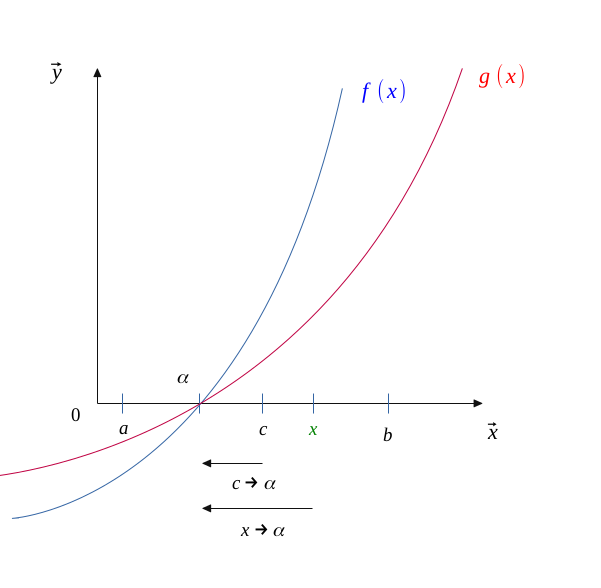
Therefore, if \( x \to \alpha \), then \( c \to x \) and we can rewrite \( (3) \) as \( (3') \) :
$$ \lim_{x \to \alpha} \enspace \frac{f'(x)}{g'(x)} = \lim_{x \to \alpha} \enspace \frac{f(x)}{g(x)} = l \qquad (3') $$And as a result,
$$ \forall x \in I \setminus \{\alpha\}, \enspace \forall \alpha \in \overline{\mathbb{R}}, \enspace g(x) \neq 0 \quad \text{and} \quad g'(x) \neq 0, $$$$ \left \{ \begin{gather*} \lim_{x \to \alpha} \ f(x) = 0, \\ \lim_{x \to \alpha} \ g(x) = 0 \\ \\ \lim_{x \to \alpha} \ \frac{f'(x)}{g'(x)} = l \end{gather*} \right \} \Longrightarrow \lim_{x \to \alpha} \enspace \frac{f(x)}{g(x)} = l \qquad \bigl(\text{L'Hôpital's rule} \bigr) $$-
Case 1 : removing indeterminacy
According to this rule, if: \( \lim_{x \to \alpha} \enspace f'(x) \neq 0 \) or even \( \lim_{x \to \alpha} \enspace g'(x) \neq 0 \), then, the limit of the quotient \( \frac{f}{g} \) can be easily obtained.
-
Case 2 : Still with indeterminacy
While we are still with an indeterminate form , we have to start the process again until the indeterminacy is removed.
-
Case 1 : removing indeterminacy
-
Indeterminate form of type [infinite/infinite]\(: \left[ \frac{\pm \infty}{\pm \infty} \right]\)
In the same way, it can be shown that it also works when instead of \( (H)\) we do have a new hypothesis \( (H')\), such as:
$$ \Biggl \{ \begin{gather*} \lim_{x \to \alpha} \enspace f(x) = \pm \infty \\ \lim_{x \to \alpha} \enspace g(x) = \pm \infty \end{gather*} \qquad (H') $$Applying the limit, we then again have an indeterminate form :
$$ \lim_{x \to \alpha} \enspace \frac{f(x)}{g(x)} = \left[ \frac{\pm \infty}{\pm \infty} \right] $$Let us rewrite \( (1) \) previously found:
$$ \forall x \in I, \enspace \exists c \in \hspace{0.04em} ]\alpha, x[, \enspace \frac{f'(c)}{g'(c)} = \frac{f(x) - f(\alpha)}{g(x) - g(\alpha)} \qquad (1) $$Now, applying the limit when \( x \to \alpha \):
$$ \forall x \in I, \enspace \exists c \in \hspace{0.04em} ]\alpha, x[, \ \lim_{x \to \alpha} \enspace \frac{f'(c)}{g'(c)} = \lim_{x \to \alpha} \enspace \frac{f(x) - f(\alpha)}{g(x) - g(\alpha)}= l \qquad (4)$$As \( f(\alpha) \) and \( g(\alpha) \) are both constants and knowing \( (H') \), we can write that:
$$ \lim_{x \to \alpha} \enspace \frac{f(x) - f(\alpha)}{g(x) - g(\alpha)} = \lim_{x \to \alpha} \ \frac{f(x)}{g(x)} = l \qquad (4') $$So, thanks to \( (4) \) and \( (4') \) mixed together, we obtain \( (5)\):
$$ \forall x \in I, \enspace \exists c \in \hspace{0.04em} ]\alpha, x[, \ \lim_{x \to \alpha} \enspace \frac{f'(c)}{g'(c)} = \lim_{x \to \alpha} \enspace \frac{f(x)}{g(x)}= l \qquad (5)$$Finally, in the same as above, we do have a chain reaction when \(x \to a\), such as:
$$ x \to \alpha \Longrightarrow c \to \alpha \Longrightarrow c \to x $$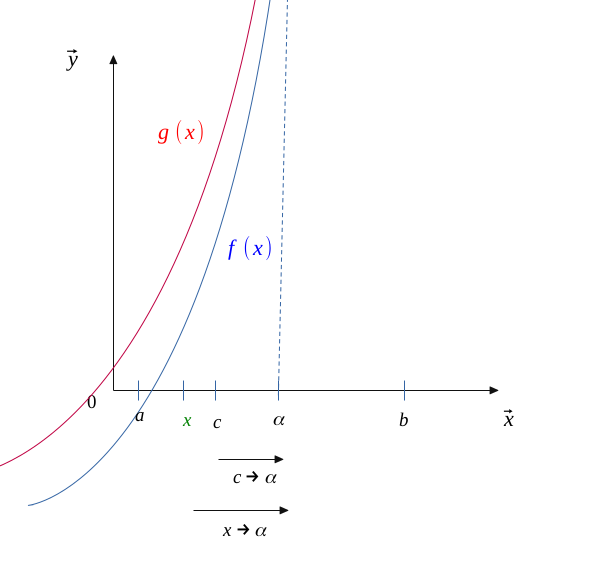
Therefore, if \( x \to \alpha \), then \( c \to x \) and we can rewrite \( (5) \) as \( (5') \) :
$$ \lim_{x \to \alpha} \enspace \frac{f'(x)}{g'(x)} = \lim_{x \to \alpha} \enspace \frac{f(x)}{g(x)} = l \qquad (5') $$And as a result,
$$ \forall x \in I \setminus \{\alpha\}, \enspace \forall \alpha \in \overline{\mathbb{R}}, \enspace g(x) \neq 0 \quad \text{and} \quad g'(x) \neq 0, $$$$ \left \{ \begin{gather*} \lim_{x \to \alpha} \ f(x) = \pm \infty, \\ \lim_{x \to \alpha} \ g(x) = \pm \infty \\ \\ \lim_{x \to \alpha} \ \frac{f'(x)}{g'(x)} = l \end{gather*} \right \} \Longrightarrow \lim_{x \to \alpha} \enspace \frac{f(x)}{g(x)} = l \qquad \bigl(\text{L'Hôpital's rule} \bigr)^* $$ -
Indeterminate form of type [zero times infinite]\(: \bigl[ 0 \times \pm \infty \bigr]\)
At last, with a product \( fg \) having an indeterminate form of type \( [0] \times {[ \pm \infty]}\) applying the limit on \( \alpha\), such as:
$$ \lim_{x \to \alpha} \enspace f(x) g(x) = \bigl[ 0 \times \pm \infty \bigr]$$$$ \text{with } \Biggl \{ \begin{gather*} \lim_{x \to \alpha} \enspace f(x) = 0 \\ \lim_{x \to \alpha} \enspace g(x) = \pm \infty \end{gather*} $$We can rather considerate the product as a quotient, to be able to apply the rule, so that:
$$ \lim_{x \to \alpha} \enspace f(x) g(x) = \lim_{x \to \alpha} \enspace \frac{f(x)}{\frac{1}{g(x)}}$$ -
Conclusion
$$ \forall x \in I \setminus \{\alpha\}, \enspace \forall \alpha \in \overline{\mathbb{R}}, \enspace g(x) \neq 0 \quad \text{and} \quad g'(x) \neq 0, $$$$ \left \{ \begin{gather*} \lim_{x \to \alpha} \ f(x) = 0 \text{ ou }\pm \infty, \\ \lim_{x \to \alpha} \ g(x) = 0 \text{ ou }\pm \infty \\ \\ \lim_{x \to \alpha} \ \frac{f'(x)}{g'(x)} = l \end{gather*} \right \} \Longrightarrow \lim_{x \to \alpha} \enspace \frac{f(x)}{g(x)} = l \qquad \qquad \bigl(\text{L'Hôpital's rule} \bigr) $$
Examples
-
Example 1
$$ \lim_{x \to 0^+} \enspace \frac{\sin(x)}{x} = \left[ \frac{0^+}{0^+} \right] $$We are facing an indeterminate form of type \( \left[ \frac{0}{0} \right]\).
Applying the rule, we do have:
$$ \lim_{x \to 0^+} \enspace \frac{\sin(x)}{x} = \lim_{x \to 0} \enspace \frac{\cos(x)}{1}= 1 $$ -
Example 2
$$ \lim_{x \to +\infty} \enspace \frac{e^x}{x^n} = \left[ \frac{+ \infty}{+ \infty} \right] $$Applying the rule in chain, the numerator will remain fixed, but the denominator will become a constant over the \(n\)-th derivation :
$$ \lim_{x \to +\infty} \enspace \frac{e^x}{x^n} = \lim_{x \to +\infty} \enspace \frac{e^x}{nx^{n-1}} $$$$ \lim_{x \to +\infty} \enspace \frac{e^x}{x^n} = \lim_{x \to +\infty} \enspace \frac{e^x}{n(n-1)x^{n-2}} $$$$ \lim_{x \to +\infty} \enspace \frac{e^x}{x^n} \enspace = \enspace... \enspace = \enspace \lim_{x \to +\infty} \enspace \frac{e^x}{n!} = + \infty $$ -
Example 3
$$ \lim_{x \to 0^+} \ x^n \ln(x) = \bigl[ 0^+ \times - \infty \bigr] $$$$ \text{with } \Biggl \{ \begin{gather*} \lim_{x \to 0^+} \ x^n = \ 0^+ \\ \lim_{x \to 0^+} \ \ln(x) = - \infty \end{gather*} $$To apply the rule, let us considerate a quotient to calculate the limit:
$$ \lim_{x \to 0^+} \ x^n \ln(x) = \lim_{x \to 0^+} \ \frac{\ln(x)}{x^{-n}} $$At this stage, applying the rule we do have:
$$ \lim_{x \to 0^+} \ x^n \ln(x) = \lim_{x \to 0^+} \ \frac{\frac{1}{x}}{-nx^{-n-1}} $$$$ \lim_{x \to 0^+} \ x^n \ln(x) = \lim_{x \to 0^+} \ \frac{1}{-nx^{-n}} $$$$ \lim_{x \to 0^+} \ x^n \ln(x) = \lim_{x \to 0^+} \ - \frac{x^{n}}{n} = \ 0^+ $$ -
Example 4
$$ \lim_{x \to 0^+} \ \frac{\ln(1 + x)}{x} = \left[ \frac{0^+}{0^+} \right] $$$$ \lim_{x \to 0^+} \ \frac{\ln(1 + x)}{x} = \lim_{x \to 0^+} \ \frac{\frac{1}{1 + x}}{1} = 1 $$ -
Example 5
$$ \lim_{x \to 0^+} \ \frac{e^x - 1}{x} = \left[ \frac{0^+}{0^+} \right] $$$$ \lim_{x \to 0^+} \ \frac{e^x - 1}{x} = \lim_{x \to 0^+} \ \frac{e^x}{1} = 1 $$
 Back to top