





 Index
Index
The Pythagorean theorem tells us that:
In a right-angle triangle, the square of the hypotenuse is equal to the sum of the square on the sides of the right angle.
Let us take any triangle \(\{a, b, c\}\), right-angled between \( a\) and \( b\) such as the following figure:
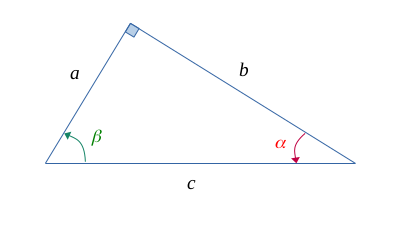
We do have the following equation:
Its reciprocal tells us on the other hand:
In any triangle \(\{a, b, c\}\):
Both previous implications then form the following equivalence:
The Pythagorean theorem
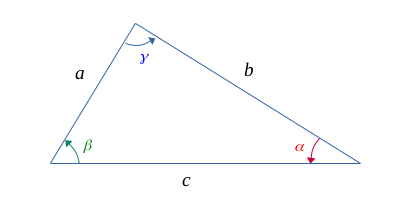
Let be a triangle \(\{a, b, c\}\), right-angled between \( a\) and \( b\) such as the following figure:
Why \(c\) is necessarily the longest side ?
By definition, the orthogonality condition implies that this triangle possesses a right angle measuring \(90^\circ\).
In Euclidean geometry, the sum of the angles of a non-degenerate triangle is strictly \(180^\circ\). The existence of a \(90^\circ\) angle dictates that the sum of the other two acute angles must equal \(90^\circ\).
Which means that the right angle is the largest angle in the triangle.
Now, we know from Euclid's theorem on the triangle inequality between angles and sides that:
In any triangle, the longest side is always opposite the largest angle.
Since the right angle is the absolute maximum among the angles of this triangle, the opposite side \(c\) (the hypotenuse) is necessarily the longest side.
-
The classical demonstration
To proove the truthfulness of the theorem, we projected a height \( h_c\) on the hypotenuse \( c\).
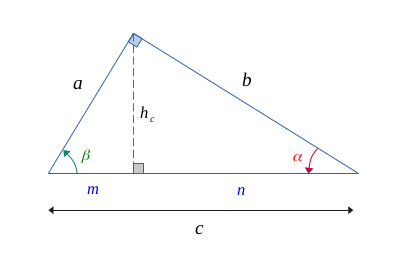
We know that the sum of the angles of a triangle is equal to \(\pi \enspace (180°)\) .
In the main triangle formed by \(\{a, b, c\}\), we notice that \(\alpha + \beta + \frac{\pi}{2} = \pi\).
This general relation will allow us to deduce other angles.
Now, in the triangle formed by \(\{m, \; h_c, \; a\}\), we do have a right angle and the angle \(\beta\). Therefore, the third angle is \(\alpha\).
Finally, in the last triangle formed by \(\{h_c, \; n, \; b\}\), we do have a right angle and the angle \(\alpha\). Thus, the third angle is \(\beta\).
We added them to the following figure:
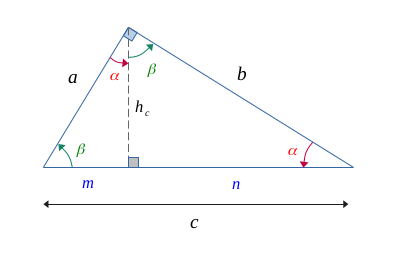
A property of the similar triangles tells us that when two triangles have two-by-two the same angles, they are similar , and will then have two-by-two similar sides forming the same ratio.
In this case, pn has the following relations:
$$ \frac{a}{c} = \frac{m}{a} = \frac{h_c}{b} $$$$ \frac{a}{c} = \frac{m}{a} \qquad (1)$$$$ \frac{b}{c} = \frac{n}{b} = \frac{h_c}{a} $$$$ \frac{b}{c} = \frac{n}{b} \qquad (2)$$Thanks to both expressions \((1)\) and \((2)\), we then have:
$$ \Biggl \{ \begin{gather*} a^2 = cm \qquad (3) \\ b^2 = cn \qquad (4) \end{gather*} $$Now, additionning \((3) \) and \((4)\), we do obtain:
$$ a^2 + b^2 = cm + cn$$$$ a^2 + b^2 = c(m + n) $$But \( (m + n = c) \), so as a result,
$$ a \perp b \Longrightarrow a^2 + b^2 = c^2 \qquad \bigl(\text{Pythagorean theorem} \bigr) $$ -
Einstein's excellent intuition
As in the previous demonstration, Einstein had noted that when the height projected onto the hypotenuse is drawn, it forms three similar triangles .
Now, such right-angled similar triangles , the areas of each triangle were proportional to the square of their respective hypotenuse.
Indeed, if we start from any triangle \(\{a ,\ b, \ c\}\) which is rectangle between \( a\) and \( b\), if we do apply a proportionnality coefficient \(k\) to obtain a second triangle \(\{a', \; b', \; c'\}\), then:
$$ \left \{ \begin{gather*} a' = ka \\ b' = kb \\ c' = kc \end{gather*} \right \} $$And the respective areas of the two triangles also undergo the transformation:
$$ A = \frac{ab}{2} \longmapsto A' = \frac{ka \times kb}{2} $$$$ A' = k^2 \times \frac{ab}{2} $$$$ A' = k^2 \times A $$
Since the two internal triangles are simply reductions of the large triangle, we can define the following two coefficients:
$$ \left \{ \begin{gather*} \text{Little triangle} : k_1 = \frac{a}{c} \\ \\ \text{Middle triangle} : k_2 = \frac{b}{c} \end{gather*} \right \} $$As well as their respective areas depending on \(A\):
$$ \left \{ \begin{gather*} \text{Little triangle} : A_1 = k_1 \times A \\ \\ \text{Middle triangle} : A_2 = k_2 \times A \end{gather*} \right \} $$By substituting, we obtain:
$$ \left \{ \begin{gather*} \text{Little triangle} : A_1 = \left( \frac{a}{c} \right)^2 \times A \\ \\ \text{Middle triangle} : A_2 = \left( \frac{b}{c} \right)^2 \times A \end{gather*} \right \} $$And \since areas add up:
$$ A = A_1 + A_2 $$$$ A = \left( \frac{a}{c} \right)^2 \times A + \left( \frac{b}{c} \right)^2 \times A $$$$ A = A \left[ \left( \frac{a}{c} \right)^2 + \left( \frac{b}{c} \right)^2 \right] $$Finally, we can deduce that:
$$ \left( \frac{a}{c} \right)^2 + \left( \frac{b}{c} \right)^2 = 1 $$$$ \frac{a^2 + b^2}{c^2} = 1 $$
And finally, that,
$$ a \perp b \Longrightarrow a^2 + b^2 = c^2 \qquad \bigl(\text{Pythagorean theorem} \bigr) $$ -
Garfield's demonstration
A demonstration with a more pronounced geometric aspect.
If we draw two identical right triangles \(\{a ,\ b, \ c\}\), one flattened on \(b\) and the other flattened on \(a\) as shown in the following figure:
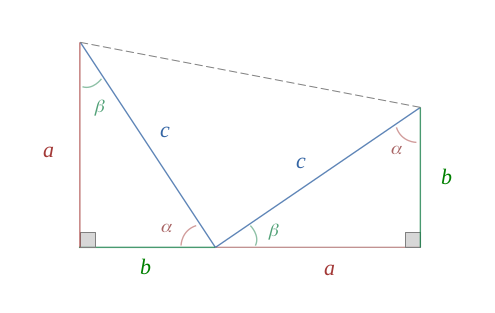
So, the two hypotenuse \(c\) are adjacents.
Furthermore, \since the sum of the angles in a triangle is constant and the third angle is a right angle, we have:
$$ \alpha + \beta = \frac{\pi}{2} $$However, a flat angle is worth \(\pi\), e angle formed by the two hypotenuses \(c\) are necessarily worth \(\frac{\pi}{2}\). Therefore, a right angle is added to the figure:
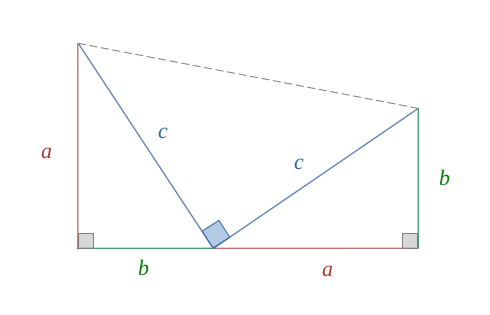
We now have a trapezoid whose area we can calculate:
$$ A = (a + b) \times \frac{(a + b)}{2} $$$$ A = \frac{(a + b)^2}{2} $$Developping the expression we do obtain this:
$$ A = \frac{a^2 + 2ab + b^2}{2} $$$$ A = \frac{a^2 + b^2}{2} + 2 \times \frac{ab}{2} $$The areas of the two right-angle triangles \(\{a ,\ b, \ c\}\) are identified:
$$ \left \{ \begin{gather*} 2 \times \frac{ab}{2} : \text{Area of two right-angle triangles } \{a ,\ b, \ c\} \end{gather*} \right \} $$And by addition, the other is necessarily worth:
$$ \left \{ \begin{gather*} \frac{a^2 + b^2}{2} : \text{Area of the half square of side } c \end{gather*} \right \} $$But this area of the half-square is also, by definition, equal to \(\frac{c^2}{2}\), thus:
$$ \frac{a^2 + b^2}{2} = \frac{c^2}{2} $$
And finally, we find it all,
$$ a \perp b \Longrightarrow a^2 + b^2 = c^2 \qquad \bigl(\text{Pythagorean theorem} \bigr) $$
The Pythagorean theorem reciprocal
To proove now the truthfulness of the theorem reciprocal, we start from a triangle, a priori right-angled, but let start from the only hypothesis that:
Why \(c\) is necessarily the longest side
Since the length \(b\) is strictly positive, its square is also strictly positive (\(b^2 > 0\)). Consequently, we can establish the following strict inequality:
In the exact same manner, since the length \(a\) is strictly positive (\(a^2 > 0\)), we obtain:
This leads to the following system of strict inequalities:
Since the square root function is strictly increasing on the interval \([0, +\infty[\), it rigorously preserves the direction of inequalities for positive values. Taking the square root of each side, we immediately conclude that:
Algebra thus proves that the length \(c\) is strictly greater than both lengths \(a\) and \(b\). Side \(c\) is therefore **necessarily the longest side of the triangle**, even before geometrically confirming that the shape is a right-angled triangle.
-
By calculating the angle \(\gamma\), a priori right-angled
Let us project the height \( h_c \) intersecting the side \( c \) at right-angle, and splitting the angle \( \gamma \) in two differents angles \( \gamma_a \) and \( \gamma_b \):
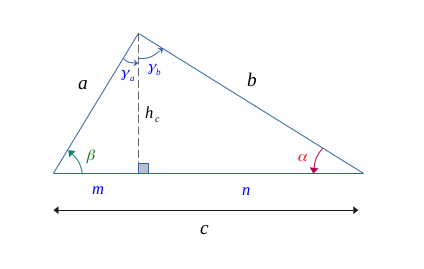
If \(\gamma\) is a right angle, then \(\cos(\gamma) = 0\).
We know from the trigonometric addition formulas that:
$$ \forall (\alpha, \beta) \in \hspace{0.04em} \mathbb{R}^2, $$$$ \cos(\alpha + \beta) = \cos(\alpha) \cos(\beta) - \sin(\alpha) \sin(\beta) $$So in our case,
$$ \cos(\gamma) = \cos(\gamma_a + \gamma_b) = \cos(\gamma_a) \cos(\gamma_b) - \sin(\gamma_a) \sin(\gamma_b) $$$$ \cos(\gamma) = \frac{h_c}{a} . \frac{h_c}{b} - \frac{m}{a} . \frac{n}{b} $$$$ \cos(\gamma) = \frac{h_c^2 - mn}{ab} \qquad (5) $$With the following equations which can be noticed on the above figure,
$$ \left \{ \begin{gather*} a^2 = m^2 + h_c^2 \\ b^2 = n^2 + h_c^2 \\ c^2 = (m+n)^2 = m^2 + 2mn + n^2 \end{gather*} \right \} $$we see that our hypothesis:
$$ a^2 + b^2 = c^2 $$becomes:
$$ \underbrace{ m^2 + h_c^2 } _{ a^2 } \enspace + \enspace \underbrace{ n^2 + h_c^2} _{ b^2 } \enspace = \enspace \underbrace{ m^2 + 2mn + n^2 } _{ c^2 }$$$$ 2h_c^2 + m^2 + n^2 = 2mn + m^2 + n^2 $$$$ h_c^2 = mn $$And then,
$$ h_c^2 - mn = 0 \qquad (6) $$Now, injecting \( (6) \) into \( (5) \) we do obtain:
$$ \cos(\gamma) = 0 \Longleftrightarrow \Biggl \{ \gamma = \frac{\pi}{2} \ ou \ \gamma = -\frac{\pi}{2} \Biggr \} $$That definitely means that the angle \( \gamma \) is a right angle, and as a consequence of it the triangle \(\{a, b, c\}\) is right-angled between \(a\) and \(b\).
$$ a^2 + b^2 = c^2 \Longrightarrow a \perp b \qquad \bigl(\text{Pythagorean theorem (reciprocal)} \bigr) $$ -
By comparing areas
Let us project again the height \( h_c \) intersecting the side \( c \) at right angle.
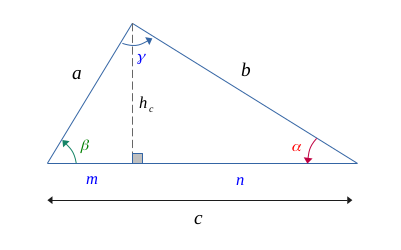
We know that the triangle area is worth:
$$ S_{triangle} = \frac{\text{base} \times \text{height}}{2} \qquad (7) $$But, the area of such triangle is worth:
$$ S_{triangle} = \frac{1}{2} \sin(\gamma) \times a b \qquad (8) $$And combining \((7)\) and \((8)\) :
$$ \frac{c.h_c}{2} = \frac{\sin(\gamma) \times a b}{2} \Longleftrightarrow c.h_c = \sin(\gamma) \times a b $$We now want to show that \(\sin(\gamma) = 1\) such as the triangle is definitely a right-angled triangle.
To do this, let us start from our initial hypothesis:
$$ a^2 + b^2 = c^2 $$And,
$$ a^2 + b^2 = (m + n)^2 \qquad (9) $$We now know from the Pythagorean theorem that in the inner triangle \(\{a, m, h_c\}\):
$$ a^2 = m^2 + h_c^2 $$So that:
$$ m^2 = a^2 - h_c^2 $$$$ m = \sqrt{ a^2 - h_c^2} \qquad (10) $$As well as the other inner triangle:
$$ n = \sqrt{ b^2 - h_c^2} \qquad (11) $$Now injecting \( (10) \) and \( (11) \) into \( (9) \), we do have:
$$ a^2 + b^2 = \left(\sqrt{ a^2 - h_c^2 } + \sqrt{ b^2 - h_c^2} \right)^2 $$Distributing it, we obtain:
$$ a^2 + b^2 = a^2 - h_c^2 + 2\sqrt{ (a^2 - h_c^2)( b^2 - h_c^2)} + b^2 - h_c^2 $$Let us remove the member \( (a^2 + b^2) \) which is present on both sides oh the equation:
$$ 0 = -2h_c^2 + 2\sqrt{ (a^2 - h_c^2)( b^2 - h_c^2)} $$$$ 2h_c^2 = 2\sqrt{a^2b^2 -a^2h_c^2 - b^2h_c^2 + h_c^4} $$$$ h_c^2 = \sqrt{a^2b^2 -a^2h_c^2 - b^2h_c^2 + h_c^4} $$Then, let us apply the square to get rid of the square root:
$$ \left(h_c^2 \right)^2 = \left(\sqrt{a^2b^2 -a^2h_c^2 - b^2h_c^2 + h_c^4}\right)^2 $$$$ h_c^4 = a^2b^2 -a^2h_c^2 - b^2h_c^2 + h_c^4 $$We can remove \( h_c^4 \) present on both sides.
$$ a^2b^2 = a^2h_c^2 + b^2h_c^2 $$We factorize it:
$$ a^2b^2 = h_c^2 (a^2 + b^2) $$But, our initial hypothesis was that:
$$ a^2 + b^2 = c^2 $$Thus,
$$ a^2 \ b^2 = h_c^2 \ c^2 $$$$ \sqrt{a^2 \ b^2} = \sqrt{h_c^2 \ c^2 } $$$$ c \ h_c = a \ b $$However, we previous had this result :
$$c \ h_c = \sin(\gamma) \times a \ b $$That automatically implies taht \(\sin(\gamma)= 1\), and that the angle \(\gamma\) is a right angle.
We definitely showed that the triangle \(\{a, b, c\}\) is right-angled between \(a \) and \( b \). Hence:
$$ a^2 + b^2 = c^2 \Longrightarrow a \perp b \qquad \bigl(\text{Pythagorean theorem (reciprocal)} \bigr) $$
The Pythagorean theorem equivalence
Two implications makes an equivalence.
Thus, having our two implications \((I_1)\) et \((I_2)\):
We can gather them to build the following equivalence:
Example
The Pythagorean theorem allows us to measure lengths on both plane and space.
-
Calculate a length in the plane
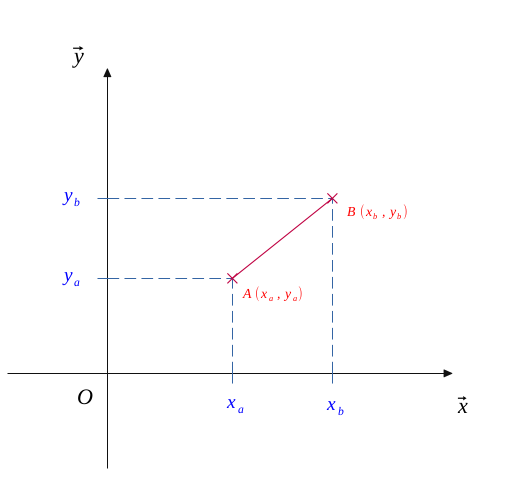
We start from a plane \((\vec{x}, \ \vec{y}) \) in which it exists two points \( A(x_a; \ y_a )\) and \(B(x_b; \ y_b )\).
Joining on the abscissa axis \( x_a \) and \( x_b\), as well as on the ordinate axis \( y_b \) and \( y_a\), we obtain a third point \( C\) and as a consequence of it a right-angled triangle \(ABC \), right-angled in \(C \).
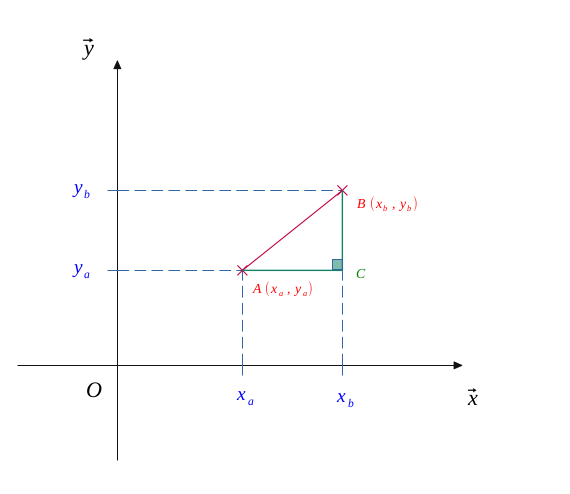
Thus, we can apply the Pythagorean theorem on it:
$$AB^2 = AC^2 + BC^2$$$$AB^2 = (x_b - x_a)^2 + (y_b - y_a)^2 $$$$AB = \sqrt{ (x_b - x_a)^2 + (y_b - y_a)^2} $$Thus, the distance \( AB\) in a two-dimensional space is worth:
$$\forall (A, B) \in \hspace{0.04em} (O, \vec{x}, \vec{y})^2, $$$$AB = \sqrt{ (x_b - x_a)^2 + (y_b - y_a)^2} $$ -
Calculate a length in space
We want now to calculate a length \(AB \) in space.
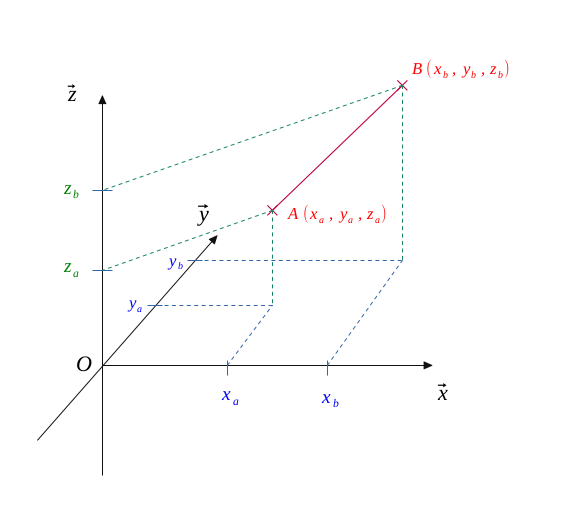
We previously found out that the length \(AC \), on this new figure, is worth:
$$AC = \sqrt{ (x_b - x_a)^2 + (y_b - y_a)^2} $$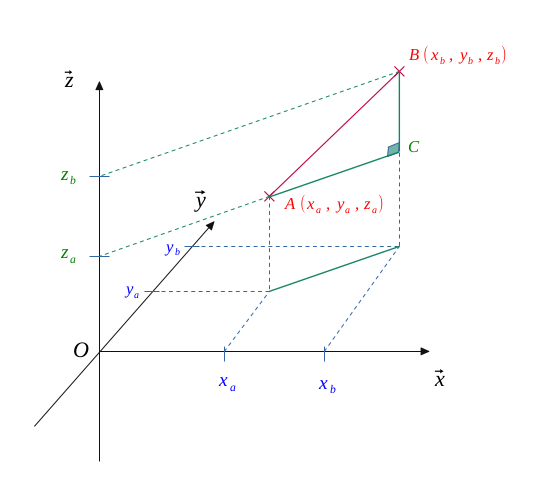
Consequently, we do apply again the Pythagorean theorem on the triangle \(ABC \):
$$AB^2 = AC^2 + BC^2$$$$AB^2 = (x_b - x_a)^2 + (y_b - y_a)^2 + (z_b - z_a)^2 $$$$AB = \sqrt{(x_b - x_a)^2 + (y_b - y_a)^2 + (z_b - z_a)^2 } $$Thus, the distance \( AB\) in a three-dimensional space is worth:
$$\forall (A, B) \in \hspace{0.04em} (O, \vec{x}, \vec{y}, \vec{z})^2, $$$$AB =\sqrt{(x_b - x_a)^2 + (y_b - y_a)^2 + (z_b - z_a)^2 }$$
 Back to top