





 Index
Index
Let be \(f\) a continous function on an interval \(I = \bigl[a, b \bigr]\).
From a definite integral, it is possible to determine an antiderivative \(S \) of \(f\).
This antiderivative will be the antiderivative of \(f\) which vanishes at point \(a\):
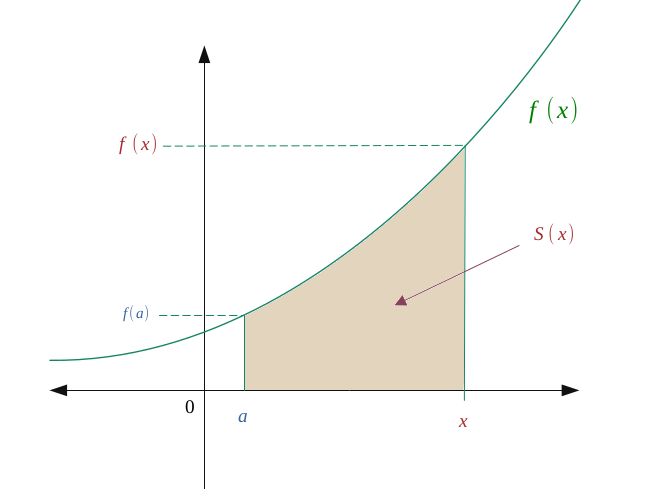
We can then define a primitive using this integral:
Conversely, from an antiderivative \(F\) of function \(f\), it is possible to determine the integral between two bounds \(a\) and \(x\).
Or more precisely, for two fixed bounds \(a\) and \(b\) :
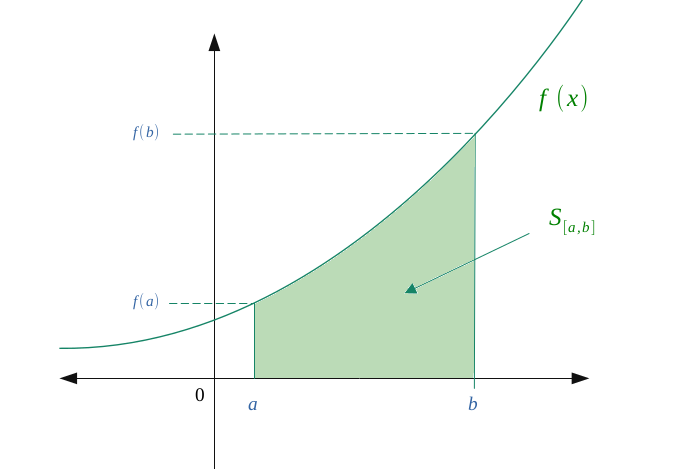
Let be \(f : x \longmapsto f(x) \) a continuous function, positive and increasing on an interval \(I = \bigl[a, b \bigr]\).
As well, let be \( n \in \mathbb{N}\) a natural number.
Fundamental theorem of calculus
-
Analytical Proof
Let \(F\) be an antiderivative of the function \(f\) on the interval \(I = \bigl[a, b \bigr]\), such that \(F\) is differentiable and for all \(x \in I\), \(F'(x) = f(x)\).
Let's partition this interval into a series of \(n\) sub-intervals using the following points: \(\bigl \{x_0, \ x_1, \ \dots,\ x_i, \ x_{i+1}, \ \dots, \ x_{n - 1}, \ x_{n} \bigr \} \) (where \(x_0 = a\) and \(x_n = b\)), as illustrated in the figure below: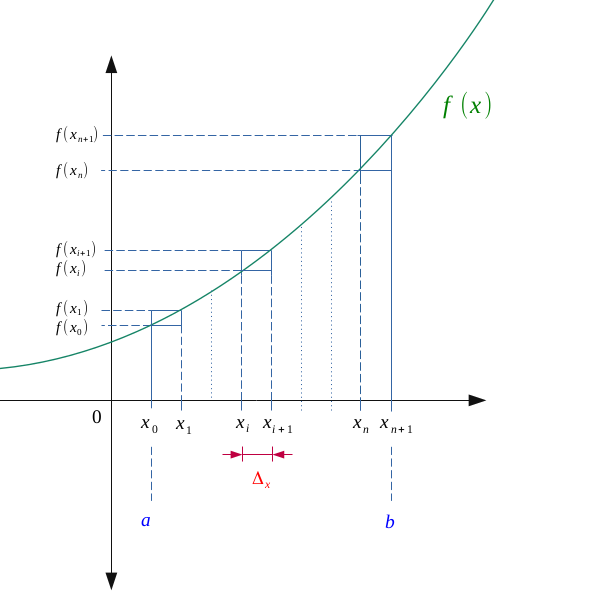
We then define \(\Delta_{x} \), the constant mesh size (width) of our partition between two consecutive points:
$$ \forall i \in [\![0, n-1 ]\!], \ \Delta_{x} = x_{i+1}- x_{i} $$The Mean Value Theorem (MVT) applied to the function \(F\) states that:
$$ F \text{ is continuous on } \bigl[a,b \bigr] \text{ and differentiable on } \bigl ]a,b \bigr[ \ \Longrightarrow \ \exists c \in \bigl ]a,b \bigr[, \ F'(c) = \frac{ F(b) - F(a)}{b-a} $$Since, by hypothesis, our function \(f = F'\) is continuous and strictly increasing (hence injective), this point \(c\) is unique. Thus, we can write:
$$ \exists ! c \in \bigl ]a,b \bigr[, \ f(c) = \frac{ F(b) - F(a)}{b-a}$$Because the antiderivative \(F\) is differentiable on each sub-interval \(\bigl[x_i, x_{i+1}\bigr]\), we can apply the theorem locally to each slice:
$$\forall i \in [\![0, n-1 ]\!], \ \exists ! \alpha_i \in \hspace{0.04em} \bigl]x_i, x_{i+1}\bigr[, \ F'(\alpha_i) = \frac{ F(x_{i+1}) - F(x_i)}{x_{i+1}-x_{i}}$$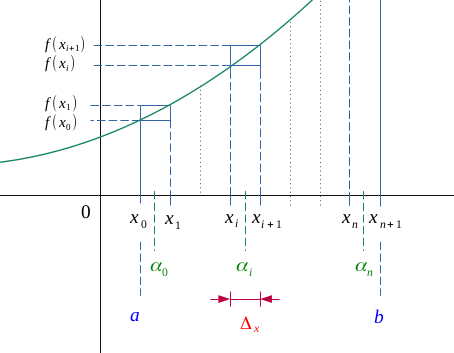
Since \(F' = f\), cross-multiplying yields:
$$f(\alpha_i) \Delta_{x} = F(x_{i+1}) - F(x_i)$$Summing up the areas of all these elementary rectangles across the entire interval \(\bigl[a,b \bigr]\), we get:
$$ \sum_{i=0}^{n - 1} f(\alpha_i) \Delta_{x} = \sum_{i=0}^{n - 1} \Bigl[ F(x_{i+1}) - F(x_i) \Bigr] $$We know that summing a series of consecutive differences results in a telescoping sum.
$$\sum_{k=0}^{n-1} \bigl [ a_{k+1} - a_k \bigr] = a_{n} - a_0 $$Applied to our current situation:
$$ \sum_{i=0}^{n - 1} \Bigl[ F(x_{i+1}) - F(x_i) \Bigr] = F(x_{n}) - F(x_0) $$Therefore, recalling that \(x_0 = a\) and \(x_n = b\):
$$ \sum_{i=0}^{n - 1} f(\alpha_i) \Delta_{x} = F(b) - F(a) $$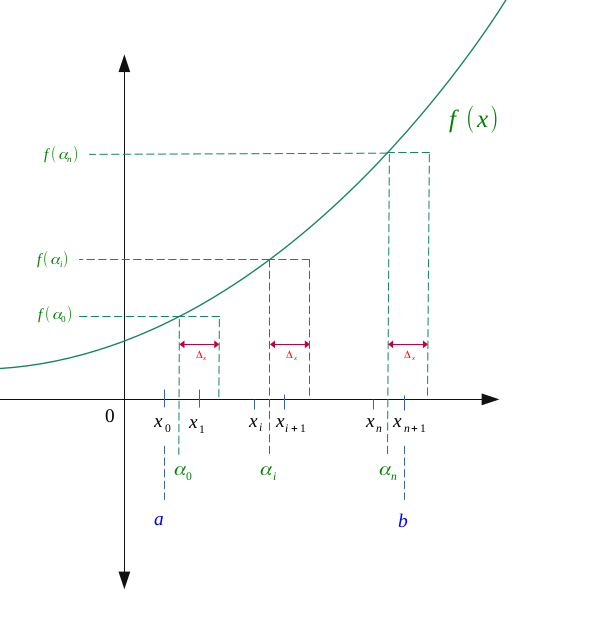
Taking the limit as \(n \to \infty\) (which means infinitely many sub-intervals, forcing the step size \(\Delta_{x} \to dx\)), the right-hand side remains constant, giving:
$$ \lim_{n \to \infty} \ \sum_{i=0}^{n - 1} f(\alpha_i) \Delta_{x} = F(b) - F(a) $$By definition, the left-hand side corresponds to the definite integral of the function \(f\) from \(a\) to \(b\).
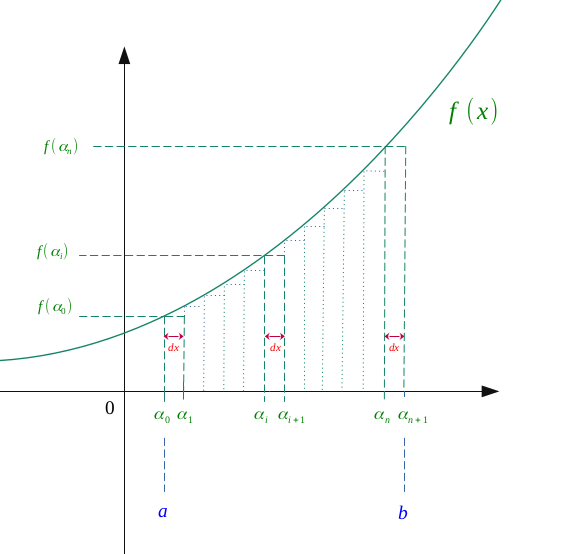
Furthermore, we can analytically and graphically observe the convergence of our partition points:
$$ \forall i \in [\![0, n-1 ]\!], \ n \to \infty \Longrightarrow \Biggl \{ \begin{gather*} \alpha_i \to x_i \Longrightarrow (\alpha_0 \to a, \enspace \alpha_{n-1} \to b)\\ f(\alpha_i) \to f(x_i) \Longrightarrow \Bigl(f(\alpha_0) \to f(a), \enspace f(\alpha_{n-1} \to b)\Bigr) \end{gather*}$$This yields the exact geometric area bounded by the x-axis and the curve of \(f\) over the interval \(\bigl[a,b \bigr]\).
We formalize this definite integral of the function \( f \) on the interval \(\bigl[a, b \bigr]\) through the fundamental relation:
$$ S_{a,b}= \int_a^b \ f(t) dt = F(b) - F(a) $$The historical symbol \( \int \) represents an elongated "S" for sum, establishing the ultimate connection between the area under a curve and antiderivatives.
This is why, by extension of notation, a family of antiderivatives (all equal up to a real constant) is referred to as an indefinite integral, denoted as:
$$ \int^x \ f(t) dt $$ -
Variable upper bound
Now let us consider a variable upper bound \(x\).
To avoid any confusion between \(x\), the function f variable of \(f(x)\), and \(x\) the variable representing the variable upper bound of the integral, it is preferable to introduce a new variable \(t\) inside the integrand, we will then have:
$$ S(x)= \int_a^x \ f(t) dt $$
This function of \(x\) is therefore the antiderivative of \(f\) which vanishes at point \(a\).
The parameter \(t\) being a dummy variable, which will disappear after integration. Furthermore, we can use \(t\) or any other variable, all these writings are equivalent:
$$ S(x)= \int_a^x \ f(t) \ dt = \int_a^x \ f(u) \ du = \int_a^x \ f(\phi) \ d \phi \ ... etc. $$With what was seen above, we then have for a definite integral:
$$ \int_a^x \ f(t) dt = F(x) - F(a) $$We can then define an antiderivative with this integral which vanishes at \(a\):
$$ F(x) = \int_a^x \ f(t) dt + F(a) $$ -
Conclusion
If we know how to calculate the definite integral of a function \(f\) continuous on an interval \([a, x]\), we do know how to find an antiderivative of \(f\).
Conversely, by finding an antiderivative of \(f\), we know how to calculate the definite integral over any interval \([a, x]\).
Although in practice, it is easier to find an antiderivative and then calculate its integral than the opposite.
Example
-
Determining a definite integral from an antiderivative
In this sense, it is enough to determine an antiderivative of the function under study, and its definite integral is:
$$ \int_a^x \ f(t) \ dt = F(x) - F(a) $$ -
Determining an antiderivative by calculating the definite integral
We will calculate integrals by the Riemann sum method .
One way to do this is to calculate a sum from the left.
The Riemann sum method by calculating from the left tells us that:
For any function \(f\) and \(n \in \mathbb{N}\) a natural number, which the number of subdivisions of the interval \((x-a)\). We then have:
$$ I_n(x)= \biggl(\frac{x-a}{n} \biggr) \sum_{k=0}^{n-1} \Biggl[ f\biggl(a + k \Bigl(\frac{x-a}{n} \Bigr) \biggr) \Biggr] $$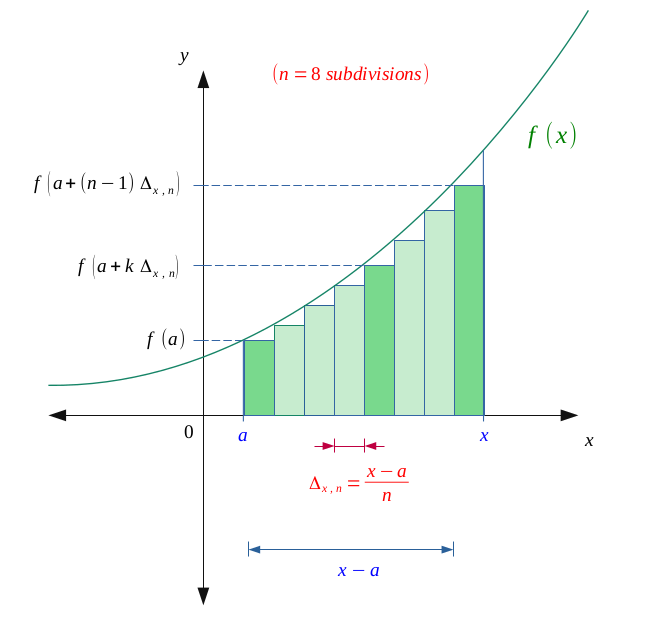
For the sake of simplicity, we set a new variable down representing the step \(\Delta_{x, n}\):
$$ \Delta_{x, n} = \frac{x-a}{n} $$Which gives us:
$$ I_n(x)= \Delta_{x, n} \sum_{k=0}^{n-1} \Biggl[ f\bigl(a + k \Delta_{x, n} \bigr) \Biggr] $$From there, we can reduce the step in a infinitesimal way, by making tend \(n \to +\infty\).
$$ \int_a^x \ f(t)\ dt = \lim_{n \to +\infty} I_n(x) $$-
Computation of the primitive of \(f(x) = x^2\)
Thus, let's calculate in our case:
$$ \int_a^x \ t^2 \ dt = \lim_{n \to +\infty} S_n(x) $$Where \(S_n(x)\) is worth:
$$ S_n(x) = \Delta_{x, n} \sum_{k=0}^{n-1} \Biggl[ \bigl(a + k \Delta_{x, n} \bigr)^2 \Biggr] $$$$ S_n(x) = \Delta_{x, n} \Biggl[ a^2 + a^2 + 2a \Delta_{x, n} + \Delta_{x, n}^2 + a^2 + 4a \Delta_{x, n} + 4\Delta_{x, n}^2 \hspace{0.2em} + \ ... \ + \hspace{0.2em} a^2 + 2(n-1)a \Delta_{x, n} + (n-1)^2 \Delta_{x, n}^2 \Biggr] $$By putting a little order, we do have:
$$ S_n(x) = \Delta_{x, n} \Biggl[ (n-1)a^2 + 2a \Delta_{x, n} + 4a \Delta_{x, n} + \ ... \ + \hspace{0.2em} 2(n-1)a \Delta_{x, n} + \Delta_{x, n}^2 + 2^2\Delta_{x, n}^2 + \ ... \ + \hspace{0.2em} (n-1)^2 \Delta_{x, n}^2 \Biggr] $$$$ S_n(x) = \Delta_{x, n} \Biggl[ (n-1)a^2 + 2a \Delta_{x, n} \Bigl(1 + 2 + + \ ... \ + \hspace{0.2em} (n-1)\Bigr ) + \Delta_{x, n}^2 \Bigl(1 + 2^2 + \ ... \ + \hspace{0.2em} + (n-1)^2 \Bigr) \Biggr] $$We notice the presence of the sum of natural numbers and the sum of natural squares from \(0\) to \((n-1)\).
$$ S_n(x) = \Delta_{x, n} \Biggl[ (n-1)a^2 + 2a \Delta_{x, n} \Biggl[ \sum_{k=0}^{n-1} k \Biggr] + \Delta_{x, n}^2 \Biggl[ \sum_{k=0}^{n-1} k^2 \Biggr] \Biggr] \qquad (4) $$We will have to adapt these two sums .
The sum of natural numbers from \(0\) until \(n\) is worth:
$$ \sum_{k = 0}^n k = \frac{n(n+1)}{2} $$Then, from \(0\) to \((n-1)\) it is worth now,
$$ \sum_{k = 0}^{n-1} k = \frac{(n-1)n}{2} \qquad (5) $$In the same way, we will adapt the sum of natural squares :
$$ \sum_{k = 0}^n k^2 = \frac{n(n+1)(2n+1)}{6} $$Now, from \(0\) to \((n-1)\),
$$ \sum_{k = 0}^{n-1} k^2 = \frac{(n-1)n(2n)}{6} \qquad (6) $$Let us inject \( (5) \) and \( (6) \) into \( (4) \):
$$ S_n(x) = \Delta_{x, n} \Biggl[ (n-1)a^2 + 2a \Delta_{x, n} \frac{(n-1)n}{2} + \Delta_{x, n}^2 \frac{(n-1)n(2n)}{6} \Biggr] $$Which is worth, under a developped form:
$$ S_n(x) = \Delta_{x, n}(n-1)a^2 + 2a \Delta_{x, n}^2 \frac{(n-1)n}{2} + \Delta_{x, n}^3 \frac{(n-1)n(2n)}{6} $$$$ S_n(x) = \Delta_{x, n}(n-1)a^2 + 2a \Delta_{x, n}^2 \frac{(n^2 -n)}{2} + \Delta_{x, n}^3 \frac{(2n^3 - n^2)}{6} $$Now, let us replace \( \Delta_{x, n} \) by its value.
$$ S_n(x) = \frac{x-a}{n}(n-1)a^2 + 2a \biggl( \frac{x-a}{n}\biggr)^2 \frac{(n^2 -n)}{2} + \biggl( \frac{x-a}{n} \biggr)^3 \frac{(2n^3 - n^2)}{6} $$$$ S_n(x) = a^2(x-a) \biggl[ \frac{n-1}{n} \biggr] + a(x-a)^2\biggl[ \frac{n^2 -n}{n^2} \biggr] + \frac{1}{6}(x-a)^3 \biggl[ \frac{2n^3 - n^3}{n^3} \biggr] $$By stydying the limit when \(n \to +\infty\):
$$ S(x)= \int_a^x \ t^2 \ dt = \lim_{n \to +\infty} \ S_n(x) $$$$ S(x)= a^2(x-a) + a(x-a)^2+ \frac{1}{3}(x-a)^3 $$$$ S(x)= a^2x - a^3 + a(x^2 - 2ax + a^2)+ \frac{1}{3}(x^3 - 3x^2 a + 3 xa^2 -a^3) $$$$ S(x)= a^2x - a^3 + ax^2 - 2a^2x + a^3+ \frac{x^3}{3} -x^2 a + xa^2 - \frac{a^3}{3} $$$$ S(x)= \frac{x^3}{3} - \frac{a^3}{3} + \hspace{0.2em} \underbrace { a^2x + xa^2 - 2a^2x } _{ = 0 } \hspace{0.2em} + \hspace{0.2em} \underbrace { a^3 - a^3 } _{ = 0 } \hspace{0.2em} + \hspace{0.2em} \underbrace { ax^2 + -x^2 a } _{ = 0 } $$$$ S(x)= \int_a^x \ t^2 \ dt = \frac{x^3}{3} - \frac{a^3}{3} $$As we were searching for a general antiderivative \(F\) starting from this expression:
$$ S(x)= \int_a^x \ t^2 \ dt = F(x) - F(a)$$Therefore, we have determined this primitive \(F\) of the function \(f\), and the latter is worth:
$$ F(x) = \int^x \ t^2 \ dt = \frac{x^3}{3} $$ -
Computation of the primitive of \(g(x) = \cos(x)\)
Let's now find a primitive:
$$ \int_a^x \ \cos(t) \ dt = \lim_{n \to +\infty} T_n(x) $$Where \(S_n(x)\) is worth:
$$ T_n(x) = \Delta_{x, n} \sum_{k=0}^{n-1} \Biggl[ \cos(a + k \Delta_{x, n} \bigr) \Biggr] $$We know from addition trigonometric formulas that:
$$ \forall (\alpha, \beta) \in \hspace{0.04em} \mathbb{R}^2, $$$$ \cos(\alpha + \beta) = \cos(\alpha) \cos(\beta) - \sin(\alpha) \sin(\beta) $$$$ T_n(x) = \Delta_{x, n} \Biggl[ \Bigl(\cos(a)\cos(0) - \sin(a)\sin(0)\Bigr) + \Bigl(\cos(a)\cos(\Delta_{x, n}) - \sin(a)\sin(\Delta_{x, n})\Bigr) + \ ... \ + \hspace{0.2em} \biggl(\cos(n-1)\cos\Bigl((n-1)\Delta_{x, n}\Bigr) - \sin(n-1)\sin\Bigl((n-1)\Delta_{x, n}\Bigr) \biggr) \Biggr] $$Then, by factorizing terms together,
$$ T_n(x) = \Delta_{x, n} \Biggl[ \cos(a)\Bigl( \cos(0) + \cos(\Delta_{x, n}) + \ ... \ + \hspace{0.2em} \cos(n\Delta_{x, n}) \Bigr) - \sin(a)\Bigl( \cos(0) + \sin(\Delta_{x, n}) + \ ... \ + \hspace{0.2em} \sin((n-1)\Delta_{x, n}) \Bigr) \Biggr] $$$$ T_n(x) = \Delta_{x, n} \Biggl[ \cos(a) \sum_{k = 0}^{n - 1} \cos(k \Delta_{x, n}) - \sin(a)\sum_{k = 0}^{n - 1} \sin(k \Delta_{x, n}) \Biggr] $$Now, using trigonometric sums , we do have both relations:
$$\forall n \in \mathbb{N}, $$$$ \sum_{k = 0}^n \cos(k \theta) = \cos\left(\frac{n\theta}{2}\right) \times \frac{\sin\left(\frac{(n + 1) \theta}{2}\right)}{\sin\left(\frac{\theta}{2}\right)} $$$$ \sum_{k = 0}^n \sin(k \theta) = \sin\left(\frac{n\theta}{2}\right) \times \frac{\sin\left(\frac{(n + 1) \theta}{2}\right)}{\sin\left(\frac{\theta}{2}\right)} $$So, applying it to our case, that is to say to stop at the \((n - 1)\)-th term of the sum :
$$ T_n(x) = \Delta_{x, n} \left[ \cos(a) \left( \cos\left(\frac{(n - 1)\Delta_{x, n}}{2}\right) \times \frac{\sin\left(\frac{n \Delta_{x, n}}{2}\right)}{\sin\left(\frac{\Delta_{x, n}}{2}\right)} \right) - \sin(a) \left( \sin\left(\frac{(n - 1)\Delta_{x, n}}{2}\right) \times \frac{\sin\left(\frac{n \Delta_{x, n}}{2}\right)}{\sin\left(\frac{\Delta_{x, n}}{2}\right)} \right) \right] $$$$ T_n(x) = \frac{x - a}{n} \left[ \cos(a) \times \cos\left(\frac{(n-1)(x - a)}{2n}\right) \times \frac{\sin\left(\frac{x - a}{2}\right)}{\sin\left(\frac{(x - a)}{2n}\right)} - \sin(a) \times \sin\left(\frac{(n-1)(x - a)}{2n}\right) \times \frac{\sin\left(\frac{x - a}{2}\right)}{\sin\left(\frac{(x - a)}{2n}\right)} \right] $$Let us use again the addition trigonometric formulas :
$$ T_n(x) = \frac{x - a}{n} \left[ \frac{\sin\left(\frac{x - a}{2}\right)}{\sin\left(\frac{(x - a)}{2n}\right)} \times \cos\left(a + \frac{(n-1)(x - a)}{2n}\right) \right] $$Now, we are ready to make\(n\) tend to infinity.
.$$ T(x)= \int_a^x \ \cos(t) \ dt = \lim_{n \to +\infty} \ T_n(x) $$As the quotient \( \frac{(x - a)}{2n} \) tends towards \(0\), then the quotient \(\sin\left(\frac{(x - a)}{2n}\right)\) tends towards \(\frac{(x - a)}{2n}\). For the right part, both terms of the same order \(n\) will vanish.
$$ T(x) = \frac{x - a}{n} \times \left( \sim 2n\frac{\sin\left(\frac{x - a}{2}\right)}{x - a} \right) \times \left( \sim \cos\left(a + \frac{x - a}{2}\right) \right) $$$$ T(x) = \frac{x - a}{n} \times 2n\frac{\sin\left(\frac{x - a}{2}\right)}{x - a} \times \cos\left(\frac{2a + x - a}{2}\right) $$$$ T(x) = \frac{\cancel{x - a}}{\cancel{n}} \times 2\cancel{n}\frac{\sin\left(\frac{x - a}{2}\right)}{\cancel{x - a}} \times \cos\left(\frac{a + x}{2}\right) $$$$ T(x) = 2sin\left(\frac{x - a}{2}\right) \times \cos\left(\frac{a + x}{2}\right) $$Finally, still thanks to the addition trigonometric formulas :
$$ \forall (p, q) \in \hspace{0.04em} \mathbb{R}^2, $$$$ \sin(p ) - \sin(q) = 2 \cos\left(\frac{p+q}{2}\right) \sin\left(\frac{p-q}{2}\right) $$Si, in our case, this leads to it:
$$ T(x) = \sin(x) - \sin(a) $$As we were searching for a general antiderivative \(G\) starting from this expression:
$$ T(x)= \int_a^x \ \cos(t) \ dt = G(x) - G(a)$$Therefore, we have determined this primitive \(G\) of the function \(g\), and the latter is worth:
$$ G(x) = \int^x \ \cos(t)\ dt = \sin(t) $$
-
 Back to top