





 Index
Index
Let \((a,n) \in \hspace{0.04em} \mathbb{N}^2\) be two natural numbers.
-
The first terms
The sum of the \( (n + 1) \) first natural numbers, that is to say from \(0\) to \(n\), is worth:
$$ \forall n \in \mathbb{N}, $$$$ \sum_{k = 0}^n k = \frac{n(n+1)}{2} $$ -
Generalization: sum from a to n
In the general way, this sum going from \((k = a) \) until \(n\) is worth:
$$ \forall (a,n) \in \hspace{0.04em} \mathbb{N}^2, $$$$ \sum_{k =a}^{n} k = \frac{(n + a)(n+1- a)}{2} $$
-
The first terms
The sum of the \( (n + 1) \) first natural squares, that is to say from \(0\) to \(n\), is worth:
$$ \forall n \in \mathbb{N}, $$$$ \sum_{k = 0}^n k^2 = \frac{n(n+1)(2n+1)}{6} $$ -
Generalization: sum from a to n
In the general way, this sum going from \((k = a) \) until \(n\) is worth:
$$ \forall (a,n) \in \hspace{0.04em} \mathbb{N}^2, $$$$ \sum_{k =a}^{n} k^2 = \frac{1}{6} \Bigl( n+1-a\Bigr) \biggl( 2n^2 + 2a^2 + 2an + n - a \biggr) $$
-
The first terms
The sum of the \( (n + 1) \) first natural cubes, that is to say from \(0\) to \(n\), is worth:
$$ \forall n \in \mathbb{N}, $$$$ \sum_{k = 0}^n k^3 = \frac{n^2 (n+1)^2 }{4} $$Moreover,
$$ \forall n \in \mathbb{N}, $$$$ \sum_{k = 0}^n k^3 = \Biggl( \hspace{0.1em} \sum_{k = 0}^n k \hspace{0.1em} \Biggr)^2$$ -
Generalization: sum from a to n
In the general way, this sum going from \((k = a) \) until \(n\) is worth:
$$ \forall (a,n) \in \hspace{0.04em} \mathbb{N}^2, $$$$ \sum_{k=a}^n k^3 = \frac{1}{4}\bigl(n+1-a\bigr)\bigl(n+a\bigr)\bigl(n^2 + a^2 + n - a\bigr)$$
-
The first terms
The sum of the \( (n + 1) \) first odd numbers, that is to say from \(0\) to \(n\), is worth:
$$ \forall n \in \mathbb{N}, $$$$ \sum_{k = 0}^n (2k +1) = (n+1)^2 $$ -
Generalization: sum from a to n
In the general way, this sum going from \((k = a) \) until \(n\) is worth:
$$ \forall (a,n) \in \hspace{0.04em} \mathbb{N}^2, $$$$ \sum_{k =a}^{n} (2k +1) = (n + 1+ a)(n+1- a) $$
-
The first terms
The sum of the \( (n + 1) \) first even numbers, that is to say from \(0\) to \(n\), is worth:
$$ \forall n \in \mathbb{N}, $$$$ \sum_{k = 0}^n (2k) = n(n+1) $$ -
Generalization: sum from a to n
In the general way, this sum going from \((k = a) \) until \(n\) is worth:
$$ \forall (a,n) \in \hspace{0.04em} \mathbb{N}^2, $$$$ \sum_{k =a}^{n} (2k) = (n + a)(n+1- a) $$
-
The first terms
The sum of the \( (n + 1) \) first terms of an arithmetical sequence, that is to say from \(0\) to \(n\), is worth:
$$ \forall n \in \mathbb{N}, \enspace \forall (u_0, r) \in \hspace{0.04em} \mathbb{R}^2, $$$$ \sum_{k = 0}^n (u_0 + kr) = \Bigl(n + 1 \Bigr) \Biggl( \frac{u_0 + u_n}{2} \Biggr)$$$$ (\text{with } u_n = u_0 + nr) $$ -
Generalization: sum from a to n
In the general way, this sum going from \((k = a) \) until \(n\) is worth:
$$ \forall (a,n) \in \hspace{0.04em} \mathbb{N}^2, $$$$ \sum_{k = a}^n (u_0 + kr) = \Bigl(n + 1 - a\Bigr) \Bigg( \frac{u_0 + u_{n+a}}{2} \Biggr)$$$$ (\text{with } u_n = u_0 + nr) $$
-
The first terms
The sum of the \( (n + 1) \) first natural powers of a real number, that is to say from \(0\) to \(n\), is worth:
$$ \forall n \in \mathbb{N}, \enspace \forall q \in \hspace{0.04em} \Bigl[ \mathbb{R} \ \backslash \ \bigl \{0,1 \bigr \} \Bigr] , $$$$ \sum_{k = 0}^n q^k = \frac{q^{n+1} - 1}{q-1} $$ -
Generalization: sum from a to n
In the general way, this sum going from \((k = a) \) until \(n\) is worth:
$$ \forall (a,n) \in \hspace{0.04em} \mathbb{N}^2, \enspace \forall q \in \hspace{0.04em} \Bigl[ \mathbb{R} \ \backslash \ \bigl \{0,1 \bigr \} \Bigr] , $$$$ \sum_{k =a}^{n} q^k = \frac{q^{n+1} - q^{a}}{q-1} $$
-
The first terms
The sum of the \( (n + 1) \) first terms of a geometrical sequence, that is to say from \(0\) to \(n\), is worth:
$$ \forall n \in \mathbb{N}, \enspace \forall v_0 \in \hspace{0.04em} \mathbb{R}, \ \forall q \in \hspace{0.04em} \Bigl[ \mathbb{R} \ \backslash \ \bigl \{0,1 \bigr \} \Bigr] , $$$$ \sum_{k = 0}^n (v_0.q^k ) = v_0.\frac{q^{n+1} - 1}{q-1} $$ -
Generalization: sum from a to n
In the general way, this sum going from \((k = a) \) until \(n\) is worth:
$$ \forall (a,n) \in \hspace{0.04em} \mathbb{N}^2, \enspace \forall v_0 \in \hspace{0.04em} \mathbb{R}, \ \forall q \in \hspace{0.04em} \Bigl[ \mathbb{R} \ \backslash \ \bigl \{0,1 \bigr \} \Bigr] , $$$$ \sum_{k =a}^{n} v_0.q^k = v_0.\frac{q^{n+1} - q^{a}}{q-1} $$
-
Horizontal sum from 0 to n$$\forall n \in \mathbb{N}, $$$$ \sum_{p = 0}^n \binom{n}{p} = \hspace{0.2em} 2^n $$
-
Vertical sum from r to n$$\forall (r, n) \in \hspace{0.04em}\mathbb{N}^2, \enspace r \leqslant n, $$$$ \sum_{k=r}^n \binom{k}{r} = \binom{n+1}{r +1} $$
Hence, as:
Thus:
Let \((a,n) \in \hspace{0.04em} \mathbb{N}^2\) be two natural numbers.
The sum of natural numbers\( : \sum k\)
-
The first terms
We want to calculate the sum of the first natural numbers from \( 0\) to \( n\):
$$ \sum_{k = 0}^n k = \enspace \underbrace{0 + 1 + 2 \ + \ ... \ + \ (n-1) + n} _\text{(n+1) terms} $$-
By the Gauss method
By definition, this sum is worth:
$$ \sum_{k = 0}^n k = \enspace \underbrace{0 + 1 + 2 \ + \ ... \ + \ (n-1) + n} _\text{(n+1) terms} $$Let us rewrite this sum in reverse:
$$ \sum_{k = 0}^n k = n + (n-1) \enspace + \ ... \ + \enspace 2 + 1 + 0 $$Additionning both equations by matching the terms one by one, we do have:
$$ \sum_{k = 0}^n k + \sum_{k = 0}^n k = \enspace \underbrace{(0 + n) + (1 + n - 1) \ + \ ... \ + \ (n - 1 + 1) + (n + 0)} _\text{(n+1) terms} $$All these terms are worth \( n \):
$$ 2\sum_{k = 0}^n k = \enspace \underbrace{ n + n \ + \ ... \ + \ n + n} _\text{(n+1) terms} $$Thus,
$$ 2\sum_{k = 0}^n k = n(n+1) $$And as a result,
$$ \forall n \in \mathbb{N}, $$$$ \sum_{k = 0}^n k = \frac{n(n+1)}{2} $$ -
By telescoping terms
We know from remarkable identities that:
$$ (k + 1)^2 = k^2 + 2k + 1$$$$ (k + 1)^2 - k^2 - 1= 2k $$Let us do the sum of each terms of both members of the equation, from \( (k =0) \) to \(n\).
$$ \sum_{k=0}^n \Bigl[ (k + 1)^2 - k^2 \Bigr] - \sum_{k=0}^n 1= \sum_{k=0}^n 2k $$Now, we know that a telescoping of terms is going to happen, and it will remain only:
$$\sum_{k=0}^n \bigl [ a_{k+1} - a_k \bigr] = a_{n+1} - a_0 $$So in our case:
$$\sum_{k=0}^n \Bigl[(k+1)^2 - k^2 \Bigr] = (n + 1)^2 - \ 0^2 $$Which leads us to:
$$ (n + 1)^2 -(n+1) = 2\sum_{k=0}^n k $$$$ (n+1)(n+1 - 1) = 2\sum_{k=0}^n k $$$$ \frac{n(n+1)}{2} = \sum_{k = 0}^n k$$And as a result,
$$ \forall n \in \mathbb{N}, $$$$ \sum_{k = 0}^n k = \frac{n(n+1)}{2} $$
-
-
Generalization: sum from a to n
Let us do the same reasoning as before, but now from \((k = a) \) until \(n\):
$$ \sum_{k = a}^n k = \enspace \underbrace{a + (a + 1) + (a + 2) \ + \ ... \ + \ (n-1) + n} _\text{(n+1) terms} $$-
By telescoping terms
$$ (k + 1)^2 = k^2 + 2k + 1$$$$ (k + 1)^2 - k^2 - 1= 2k $$$$ \sum_{k=a}^n \Bigl[ (k + 1)^2 - k^2 \Bigr] - \sum_{k=a}^n 1= \sum_{k=a}^n 2k $$$$ (n + 1)^2 - a^2 - (n+1 -a )= 2\sum_{k=a}^n k $$Factorizing the two first members of left part, we do have:
$$ (n + 1 - a)(n+1+a) - (n+1 -a )= 2\sum_{k=a}^n k $$Factorizing now all the left part we do obtain:
$$ (n + 1 - a)(n+a)= 2\sum_{k=a}^n k $$$$ \frac{(n + 1 - a)(n+a)}{2}= \sum_{k=a}^n k $$Finally we do have,
$$ \forall (a,n) \in \hspace{0.04em} \mathbb{N}^2, $$$$ \sum_{k =a}^{n} k = \frac{(n + a)(n+1- a)}{2} $$
-
The sum of natural squares\( : \sum k^2\)
-
The first terms
We want to calculate the sum of the first natural squares from \( 0\) to \( n\):
$$ \sum_{k = 0}^n k^2 = \enspace \underbrace{0 + 1 + 4 + 9 \ + \ ... \ + \ (n-1)^2 + n^2} _\text{(n+1) terms} $$Thanks to the Newton's binomial , we know that:
$$\forall k \in \hspace{0.04em} \mathbb{R},$$$$ (k + 1)^3 = \binom{3}{0} k^3 + \binom{3}{1}k^2 + \binom{3}{2}k + \binom{3}{3}$$So,
$$ (k + 1)^3 = k^3 + 3k^2 + 3k + 1$$$$ (k + 1)^3 - k^3 - 3k -1 = 3k^2 $$Let us do the sum of each terms of both members of the equation, from \( (k =0) \) to \(n\).
Now, we know that a telescoping of terms is going to happen, and it will remain only:
$$\sum_{k=0}^n \bigl [ a_{k+1} - a_k \bigr] = a_{n+1} - a_{0} $$So in our case:
$$\sum_{k=0}^n \Bigl[(k+1)^3 -k^3 \Bigr] = (n + 1)^3 - 0 $$Which leads us to:
$$ (n + 1)^3 -(n+1) -3\sum_{k=0}^n k = 3\sum_{k=0}^n k^2 $$The sum of the first natural numbers had been calculated above. Let us replace it.
$$ (n + 1)^3 -(n+1) -3 \Biggl[ \frac{n(n+1)}{2} \Biggr] = 3\sum_{k=0}^n k^2 $$$$ (n+1)\Bigl((n + 1)^2 -1 - \frac{3n}{2} \Bigr) = 3\sum_{k=0}^n k^2 $$$$ \frac{1}{2}(n+1)\Bigl(2n^2 +4n - 3n\Bigr) = 3\sum_{k=0}^n k^2 $$$$ \frac{1}{6}(n+1)\Bigl(2n^2 +n\Bigr) = \sum_{k=0}^n k^2 $$$$ \frac{n(n+1)(2n+1)}{6} = \sum_{k=0}^n k^2 $$And as a result,
$$ \forall n \in \mathbb{N}, $$$$ \sum_{k = 0}^n k^2 = \frac{n(n+1)(2n+1)}{6} $$ -
Generalization: sum from a to n
Let us do the same reasoning as before, but now from \((k = a) \) until \(n\):
$$ \sum_{k = a}^n k^2 = \enspace \underbrace{a^2 + (a + 1)^2 + (a + 2)^2 \ + \ ... \ + \ (n-1)^2 + n^2} _\text{(n+1) terms} $$-
By telescoping terms
$$ (k + 1)^3 = k^3 + 3k^2 + 3k + 1$$$$ (k + 1)^3 - k^3 -3 k - 1 = 3k^2 $$$$ \sum_{k=a}^n \Bigl[(k + 1)^3 - k^3 \Bigr] -\sum_{k=a}^n 3 k -\sum_{k=a}^n 1 = \sum_{k=a}^n 3k^2 $$Let us replace all sums by its value:
$$ (n+1)^3 - a^3 - 3\frac{(n + a)(n+1- a)}{2} -(n+1-a) = 3\sum_{k=a}^n k^2 $$We know from the Bernoulli's formula (or geometrical identity) that:
$$ \forall (a,b) \in \hspace{0.04em} \mathbb{R}^2, \enspace \forall n \in \hspace{0.04em} \mathbb{N}, $$$$a^n - b^n = (a-b) \sum_{k=0}^{n-1} a^{n-k-1}b^k $$So in our case:
$$(n+1)^3 - a^3 = (n+1-a) \sum_{k=0}^{2} (n+1)^{2-k}a^k $$$$(n+1)^3 - a^3 = (n+1-a) \Bigl[ (n+1)^2 + a(n+1) +a^2 \Bigr]$$Which leads us to:
$$ (n+1-a) \Bigl[ (n+1)^2 + a(n+1) +a^2 \Bigr] - 3\frac{(n + a)(n+1- a)}{2} -(n+1-a) = 3\sum_{k=a}^n k^2 $$We can now factorize it by \((n+1-a)\):
$$ (n+1-a) \Bigl[(n+1)^2 + a(n+1) +a^2 - 3\frac{(n + a)}{2} -1 \Bigr] = 3\sum_{k=a}^n k^2 $$$$ (n+1-a) \Bigl[n^2 + 2n + 1 + an + a + a^2 - 3\frac{(n + a)}{2} -1 \Bigr] = 3\sum_{k=a}^n k^2 $$Let us multiply the entire expression inside the parentheses by \(2\) (while adjusting the other factor) to clear the denominator:
$$ \frac{ (n+1-a)}{2} \Bigl[2n^2 + 4n + 2 + 2an + 2a + 2a^2 - 3n - 3a -2 \Bigr] = 3\sum_{k=a}^n k^2 $$$$ \frac{ (n+1-a)}{2} \Bigl[2n^2 + \underbrace{4n-3n} _{n} + 2an + \underbrace{2 -2} _{0} + \underbrace{2a -3a} _{-a} + 2a^2 \Bigr] = 3\sum_{k=a}^n k^2 $$$$ \frac{ (n+1-a)}{2} \Bigl[2n^2 + n + 2an + 2a^2 - a \Bigr] = 3\sum_{k=a}^n k^2 $$And finally we obtain,
$$ \forall (a,n) \in \hspace{0.04em} \mathbb{N}^2, $$$$ \sum_{k =a}^{n} k^2 = \frac{1}{6} \Bigl( n+1-a\Bigr) \biggl( 2n^2 + 2a^2 + 2an + n - a \biggr) $$
-
The sum of natural cubes\( : \sum k^3\)
-
The first terms
We want to calculate the sm of the first natural cubes from \( 0\) to \( n\):
$$ \sum_{k = 0}^n k^3 = \enspace \underbrace{0 + 1 + 8 + 27 \ + \ ... \ + \ (n-1)^3 + n^3} _\text{(n+1) terms} $$We know from the Newton's binomial that:
$$\forall k \in \hspace{0.04em} \mathbb{R},$$So,
$$ (k + 1)^4 = \binom{4}{0} k^4 + \binom{4}{1}k^3 + \binom{4}{2}k^2 + \binom{4}{3}k + 1$$And,
$$ (k + 1)^4 = k^4 + 4k^3 + 6k^2 + 4k + 1$$$$ (k + 1)^4 - k^4 - 6k^2 -4k -1 = 4k^3 $$Let us do the sum of each terms of both members of the equation, from \( (k =0) \) to \(n\).
Now, we know that a telescoping of terms is going to happen, and it will remain only:
$$\sum_{k=0}^n \bigl [ a_{k+1} - a_k \bigr] = a_{n+1} - a_{0} $$So in our case:
$$\sum_{k=0}^n \Bigl[(k+1)^4 -k^4 \Bigr] = (n + 1)^4 - 0 $$Which leads us to:
$$ (n + 1)^4 -(n+1) -6\sum_{k=0}^n k^2 -4\sum_{k=0}^n k = 4\sum_{k=0}^n k^3 $$The sum of the first natural numbers and also the sum of the first natural squares had already been calculated. Let us replace both of it by their respective value.
$$ (n + 1)^4 -(n+1) -6 \Biggl[\frac{n(n+1)(2n+1)}{6} \Biggr] -4 \Biggl[\frac{n(n+1)}{2} \Biggr] = 4\sum_{k=0}^n k^2 $$$$ (n+1)\Bigl((n + 1)^3 -1 -n(2n+1) -2n \Bigr) = 4\sum_{k=0}^n k^2 $$$$ (n+1)\Bigl(n^3 +3n^2 + 3n +1 -1 -2n^2 -n -2n^2 -2n \Bigr) = 4\sum_{k=0}^n k^2 $$$$ (n+1)(n^3+ n^2) = 4\sum_{k=0}^n k^2 $$And finally,
$$ \forall n \in \mathbb{N}, $$$$ \sum_{k = 0}^n k^3 = \frac{n^2 (n+1)^2 }{4} $$Furthermore, we can notice that:
$$ \sum_{k = 0}^n k^3 = \frac{n^2 (n+1)^2 }{4} = \Biggl(\frac{n(n+1)}{2} \Biggr)^2 $$So,
$$ \forall n \in \mathbb{N}, $$$$ \sum_{k = 0}^n k^3 = \Biggl( \hspace{0.1em} \sum_{k = 0}^n k \hspace{0.1em} \Biggr)^2$$ -
Generalization: sum from a to n
Let us do the same reasoning as before, but now from \((k = a) \) until \(n\):
$$ \sum_{k = a}^n k^3 = \enspace \underbrace{a^3 + (a + 1)^3 + (a + 2)^3 \ + \ ... \ + \ (n-1)^3 + n^3} _\text{(n+1) terms} $$-
By telescoping terms
$$ (k + 1)^4 = k^4 + 4k^3 + 6k^2 + 4k + 1$$$$ (k + 1)^4 - k^4 -6k^2 - 4k - 1 = 4k^3 $$Let us do the sum of each terms of both members of the equation, from \( (k =0) \) to \(n\).
$$ \sum_{k=a}^n \Bigl[(k + 1)^3 - k^4 \Bigr] - \sum_{k=a}^n 6 k^2 - \sum_{k=a}^n 4k - \sum_{k=a}^n 1 = \sum_{k=a}^n 4k^3 $$We already calculated both sums \(\sum k^2\) and \(\sum k\). Let us replace it by their respective value.
$$ (n+1)^4 - a^4 - 6 \times \frac{1}{6} \Bigl( n+1-a\Bigr) \biggl( n(2n+1) + a(2n +2a -1)\biggr) -4 \frac{(n + a)(n+1- a)}{2} -(n+1-a) = 4\sum_{k=a}^n k^3 $$We use again the Bernoulli's formula , in our case it will be:
$$(n+1)^4 - a^4 = (n+1-a) \sum_{k=0}^{3} (n+1)^{3-k}a^k $$$$(n+1)^4 - a^4 = (n+1-a) \Bigl[ (n+1)^3 + (n+1)^2 a + a^2(n+1) + a^3 \Bigr]$$Which leads us to:
$$(n+1-a) \Bigl[ (n+1)^3 + (n+1)^2 a + a^2(n+1) + a^3 \Bigr] - (n+1-a) \Bigl[ n(2n+1) + a(2n +2a -1)\Bigr] -2 (n + a)(n+1- a) -(n+1-a) = 4\sum_{k=a}^n k^3 $$We can now factorize by \((n+1-a)\) and concentrate on the inside:
$$(n+1-a) \Biggl[ (n+1)^3 + (n+1)^2 a + a^2(n+1) + a^3 - \biggl[ n(2n+1) + a(2n +2a -1)\biggr] -2(n + a) -1 \Biggr] = 4\sum_{k=a}^n k^3 $$$$(n+1-a) \Bigl[ n^3 + 3n^2 + 3n + 1 + an^2 + 2an + a + a^2n + a^2 + a^3 -2n^2 -n -2an - 2a^2 +a -2n - 2a - 1 \Bigr] = 4\sum_{k=a}^n k^3 $$Tidying things up a bit:
$$(n+1-a) \Bigl[ n^3 + \underbrace{3n^2 -2n^2} _{n^2} + \underbrace{3n -2n -n} _{0} + \underbrace{1 - 1} _{0} + a^3 + an^2 + \underbrace{2an -2an} _{0} + \underbrace{a + a - 2a} _{0} + a^2n + \underbrace{a^2 - 2a^2} _{-a^2} \Bigr] = 4\sum_{k=a}^n k^3 $$$$(n+1-a) \Bigl[ n^3 + an^2 + a^2n + a^3 + n^2 -a^2 \Bigr] = 4\sum_{k=a}^n k^3 $$At last, we factorize by \((n+a)\):
$$(n+1-a) \Bigl[ n^2(n+a) + a^2(n+a) + (n+a)(n-a) \Bigr] = 4\sum_{k=a}^n k^3 $$$$(n+1-a)\Bigl[(n+a)(n^2 + a^2 + n - a)\Bigr] = 4\sum_{k=a}^n k^3 $$And as a result,
$$ \forall (a,n) \in \hspace{0.04em} \mathbb{N}^2, $$$$ \sum_{k=a}^n k^3 = \frac{1}{4}\bigl(n+1-a\bigr)\bigl(n+a\bigr)\bigl(n^2 + a^2 + n - a\bigr)$$
-
The sum of odd numbers\( : \sum (2k +1) \)
An odd number \( O \) can be formulated as:
-
The first terms
We want to calculate the first odd number from \( 0\) to \( n\):
$$ \sum_{k = 0}^n (2k +1) = \enspace \underbrace{1 + 3 \hspace{0.1em} + \hspace{0.1em} ... \hspace{0.1em} + \hspace{0.1em} (2n+1) } _\text{(n+1) terms} $$We can split this sum into two differents:
$$ \sum_{k = 0}^n (2k +1) = \sum_{k = 0}^n (2k) + \sum_{k = 0}^n 1 $$$$ \sum_{k = 0}^n (2k +1) = 2\sum_{k = 0}^n k + \sum_{k = 0}^n 1 $$The sum of the first natural numbers had been calculated above, let inject it:
$$ \sum_{k = 0}^n (2k +1) = n(n+1) + (n+1) $$$$ \sum_{k = 0}^n (2k +1) = (n+1)(n+1) $$And as a result,
$$ \forall n \in \mathbb{N}, $$$$ \sum_{k = 0}^n (2k +1) = (n+1)^2 $$ -
Generalization: sum from a to n
Let us do the same reasoning as before, but now from \((k = a) \) until \(n\):
$$ \sum_{k = a}^n (2k +1) = \enspace \underbrace{ (2a+1) + \Bigl[2(a+1) +1 \Bigr] \hspace{0.1em} + \hspace{0.1em} ... \hspace{0.1em} + \hspace{0.1em} (2n+1) } _\text{(n+1 -a) terms} $$$$ \sum_{k = a}^n (2k +1) = \sum_{k = a}^n (2k) + \sum_{k = a}^n 1 $$$$ \sum_{k = a}^n (2k +1) = 2\sum_{k = a}^n k + \sum_{k = a}^n 1 $$$$ \sum_{k = a}^n (2k +1) = (n + a)(n+1- a) + (n+1- a) $$$$ \sum_{k = a}^n (2k +1) = (n+1- a) (n + 1 +a) $$And finally,
$$ \forall (a,n) \in \hspace{0.04em} \mathbb{N}^2, $$$$ \sum_{k =a}^{n} (2k +1) = (n + 1 + a)(n+1- a) $$
The sum of even numbers\( : \sum (2k) \)
An even number \( E \) can be formulated as:
-
The first terms
We want to calculate the sum of the first even numbers from \( 0\) to \( n\).
$$ \sum_{k = 0}^n 2k = \enspace \underbrace{2 +4 \hspace{0.1em} + \hspace{0.1em} ... \hspace{0.1em} + \hspace{0.1em} 2n } _\text{(n+1) terms} $$$$ \sum_{k = 0}^n 2k = 2\sum_{k = 0}^n k $$The sum of the first natural numbers had been calculated above, let inject it:
$$ \sum_{k = 0}^n 2k = n(n+1) $$And finally,
$$ \forall n \in \mathbb{N}, $$$$ \sum_{k = 0}^n 2k= n(n+1) $$ -
Generalization: sum from a to n
Let us do the same reasoning as before, but now from \((k = a) \) until \(n\):
$$ \sum_{k = a}^n 2k = \enspace \underbrace{2a +4a \hspace{0.1em} + \hspace{0.1em} ... \hspace{0.1em} + \hspace{0.1em} 2n } _\text{(n+1) terms} $$$$ \sum_{k = a}^n 2k = 2\sum_{k = a}^n k = (n + a)(n+1- a) $$And finally,
$$ \forall (a,n) \in \hspace{0.04em} \mathbb{N}^2, $$$$ \sum_{k =a}^{n} (2k) = (n + a)(n+1- a) $$
The sum of the terms of an arithmetical sequence\( : \sum (u_0 + kr) \)
Let \( (u_n)_{n \in \mathbb{N}}\) be an arithmetical sequence with a reason \( r \in \mathbb{R}\) and its first term \( u_0\in \mathbb{R}\).
-
The first terms
We want to calculate the sum of the terms of this sequence from \( 0\) to \( n\):
$$ \sum_{k = 0}^n (u_0 + kr) = u_0 + (u_0 + r) + (u_0 + 2r) \enspace + \enspace ... \enspace + \enspace \Bigl[u_0 + (n -1)r \Bigr] + (u_0 + nr) $$So,
$$ \sum_{k = 0}^n (u_0 + kr) = u_0(n + 1) + r \bigl(1 + 2 \enspace + \enspace ... \enspace + \enspace (n -1) + n \bigr) $$$$ \sum_{k = 0}^n (u_0 + kr) = u_0(n + 1) + r \Biggl[ \sum_{k = 0}^n k \Biggr] $$The sum of the first natural numbers had been calculated above, let inject it:
$$ \sum_{k = 0}^n (u_0 + kr) = u_0(n + 1) + r\Biggl[\frac{n(n + 1)}{2}\Biggr]$$$$ \sum_{k = 0}^n (u_0 + kr) = u_0(n + 1) + \Biggl(\frac{nr(n + 1)}{2}\Biggr)$$Now, factorizing by \( (n + 1) \) we obtain:
$$ \sum_{k = 0}^n (u_0 + kr) = \Bigl(n + 1 \Bigr) \Biggl(u_0 + \frac{ nr}{2}\Biggr) $$$$ \sum_{k = 0}^n (u_0 + kr) = \Bigl(n + 1 \Bigr) \Biggl(\frac{ 2 u_0 + nr}{2}\Biggr) $$$$ \sum_{k = 0}^n (u_0 + kr) = \Bigl(n + 1 \Bigr) \Biggl(\frac{ u_0 + u_n}{2}\Biggr) $$And finally,
$$ \forall n \in \mathbb{N}, \enspace \forall (u_0, r) \in \hspace{0.04em} \mathbb{R}^2, $$$$ \sum_{k = 0}^n (u_0 + kr) = \Bigl(n + 1 \Bigr) \Biggl( \frac{u_0 + u_n}{2} \Biggr)$$$$ (\text{with } u_n = u_0 + nr) $$ -
Generalization: sum from a to n
Let us do the same reasoning as before, but now from \((k = a) \) until \(n\):
$$ \sum_{k = a}^n (u_0 + kr) = (u_0 + ar) + \Bigl[u_0 + (a+1)r \Bigl] \enspace + \enspace... \enspace + \enspace \Bigl[u_0 + (n -1)r \Bigl] + (u_0 + nr) $$So,
$$ \sum_{k = a}^n (u_0 + kr) = u_0(n + 1-a) + r \Bigl[a + (a+1) \enspace + \enspace ... \enspace + \enspace (n -1) + n \Bigr] $$$$ \sum_{k = a}^n (u_0 + kr) = u_0(n + 1-a) + r \Biggl[ \sum_{k = a}^n k \Biggr] $$$$ \sum_{k = a}^n (u_0 + kr) = u_0(n + 1-a) + r \Biggl(\frac{ (n + a)(n+1- a)}{2}\Biggr) $$$$ \sum_{k = a}^n (u_0 + kr) = \Bigl(n + 1 - a\Bigr) \Biggl( u_0 + \frac{ (n+a)r}{2}\Biggr) $$$$ \sum_{k = a}^n (u_0 + kr) = \Bigl(n + 1 - a\Bigr) \Biggl( \frac{ 2u_0 + (n+a)r}{2}\Biggr) $$$$ \sum_{k = a}^n (u_0 + kr) = \Bigl(n + 1 - a\Bigr) \Biggl( \frac{ u_0 + u_{n+a}}{2}\Biggr) $$So finally,
$$ \forall (a,n) \in \hspace{0.04em} \mathbb{N}^2, $$$$ \sum_{k =a}^n (u_0 + kr) = \Bigl(n + 1 - a\Bigr) \Bigg( \frac{u_0 + u_{n+a}}{2} \Biggr)$$$$ (\text{with } u_n = u_0 + nr) $$
The sum of the natural powers of a real number\( : \sum q^k\)
Let \( q \in \hspace{0.04em} \Bigl[ \mathbb{R} \ \backslash \ \bigl \{0,1 \bigr \} \Bigr] , \) be a real number.
-
The first terms
We want to calculate the sum of the first natural powers of a real \(q\) from \( 0\) to \( n\):
$$ \sum_{k = 0}^n q^k = \enspace \underbrace{1 + q + q^2 \enspace + ... + \enspace q^{n-1} + q^n} _\text{(n+1) terms} \qquad (1) $$Multuplying all by \( q \) we obtain:
$$ q.\left[\sum_{k = 0}^n q^k \right] = q.(1 + q + q^2 \enspace + ... + \enspace q^{n-1} + q^n) $$We now develop the right member:
$$ q.\left[\sum_{k = 0}^n q^k \right] = q + q^2 + q^3 \enspace + ... + \enspace q^n + q^{n+1} \qquad (2) $$By substracting \( (1) \) from \( (2) \), we realize that a telescoping of terms occurs:
$$ q.\left[\sum_{k = 0}^n q^k \right] - \left[\sum_{k = 0}^{n} q^k \right] = q^{n+1} - 1 $$Finally, we factorize by \( \sum q^k \) and:
$$ (q - 1).\left[\sum_{k = 0}^n q^k \right] = q^{n+1} - 1 $$As a result we do have,
$$ \forall n \in \mathbb{N}, \enspace \forall q \in \hspace{0.04em} \Bigl[ \mathbb{R} \ \backslash \ \bigl \{0,1 \bigr \} \Bigr] , $$$$ \sum_{k = 0}^n q^k = \frac{q^{n+1} - 1}{q-1} $$ -
Generalization: sum from a to n
Let us do the same reasoning as before, but now from \((k = a) \) until \(n\):
$$ \sum_{k = a}^n q^k = \enspace \underbrace{q^a + q^{a+1} + q^{a+2} \enspace + ... + \enspace q^{n-1} + q^n} _\text{(n+1- a) terms} $$$$ q \Biggl[ \sum_{k = a}^n q^k \Biggr] = q(q^a + q^{a+1} + q^{a+2} \enspace + ... + \enspace q^{n-1} + q^n) $$$$ q \Biggl[ \sum_{k = a}^n q^k \Biggr] = q^{a+1} + q^{a+2} + q^{a+3} \enspace + ... + \enspace q^{n} + q^{n+1} $$$$ q.\left[\sum_{k = a}^n q^k \right] - \left[\sum_{k = a}^{n} q^k \right] = q^{n+1} - q^a $$$$ \sum_{k = a}^n q^k = \frac{q^{n+1} - q^a }{q-1} $$And finally,
$$ \forall (a,n) \in \hspace{0.04em} \mathbb{N}^2, \enspace \forall q \in \hspace{0.04em} \Bigl[ \mathbb{R} \ \backslash \ \bigl \{0,1 \bigr \} \Bigr] , $$$$ \sum_{k =a}^{n} q^k = \frac{q^{n+1} - q^{a}}{q-1} $$
The sum of the terms of a geometrical sequence\( : \sum (v_0 . q^k) \)
Let \( (v_n)_{n \in \mathbb{N}}\) be a geometrical sequence with a reason \( q \in \hspace{0.04em} \Bigl[ \mathbb{R} \ \backslash \ \bigl \{0,1 \bigr \} \Bigr] \) and its first term \( v_0\in \mathbb{R}\).
-
The first terms
We want to calculate the sum of the terms of this sequence from \( 0\) to \( n\):
$$ \sum_{k = 0}^n (v_0.q^k ) = v_0 + v_0.q + v_0.q^2 \enspace + ... + \enspace + v_0.q^{n - 1} + v_0.q^n $$So,
$$ \sum_{k = 0}^n (v_0.q^k ) = v_0.\Biggl[ \sum_{k = 0}^n q^k \Biggr] $$The sum of the first natural powers of a real number has already been calculated, let us inject it:
$$ \sum_{k = 0}^n (v_0.q^k ) = v_0.\frac{q^{n+1} - 1}{q-1} $$And finally,
$$ \forall n \in \mathbb{N}, \enspace \forall v_0 \in \hspace{0.04em} \mathbb{R}, \ \forall q \in \hspace{0.04em} \Bigl[ \mathbb{R} \ \backslash \ \bigl \{0,1 \bigr \} \Bigr] , $$$$ \sum_{k = 0}^n (v_0.q^k ) = v_0.\frac{q^{n+1} - 1}{q-1} $$ -
Generalization: sum from a to n
Let us do the same reasoning as before, but now from \((k = a) \) until \(n\):
$$ \sum_{k = a}^n (v_0.q^k ) = v_0q^a + v_0.q^{a+1} + v_0.q^{a+2} \enspace + ... + \enspace + v_0.q^{n - 1} + v_0.q^n $$$$ \sum_{k = a}^n (v_0.q^k ) = v_0.\Biggl[ \sum_{k = a}^n q^k \Biggr] $$$$ \sum_{k = 0}^n (v_0.q^k ) = v_0.\frac{q^{n+1} - q^{a}}{q-1}$$And finally,
$$ \forall (a,n) \in \hspace{0.04em} \mathbb{N}^2, \enspace \forall v_0 \in \hspace{0.04em} \mathbb{R}, \ \forall q \in \hspace{0.04em} \Bigl[ \mathbb{R} \ \backslash \ \bigl \{0,1 \bigr \} \Bigr] , $$$$ \sum_{k =a}^{n} v_0.q^k = v_0.\frac{q^{n+1} - q^{a}}{q-1} $$
Sum of a binomial \( : \sum \binom{n}{p} \)
The demonstration of these formulas on the page dedicated to binomial formulas :
Trigonometric sums \( : \sum \bigl[\cos(k \theta) + i \sin(kx)\bigr] \)
Let us start from the fact that:
So, let's calculate the sum \(\sum e^{ik\theta}\) and then let us separate the real and imaginary parts, thus obtaining the respective sums of \(\sum \cos(k \theta)\) and \(\sum \sin(kx)\).
We do know that the sum of natural powers of a real number from \(0\) to \(n\) is worth:
Therefore, in our specific cas, that leads us to it:
Let us now mutliply both numerator and denominator by \(\textcolor{rgb(157 171 234)}{e^{-\frac{i \theta}{2}}}\) to balance each floor.
At the denominator, we recognize one of the two Euler's trigonometric formulas :
We then replace the denominator and rearrange the numerator to prepare for a new factorization:
And, we factorize it
At the numerator this time, we again recognize the same Euler's trigonometric formulas , which we replace.
Thus, we recover the real and imaginary parts for the respective sums and:
And as a result,
The infinite sum of the inverse of natural squares \( : \sum \frac{1}{k^2} \)
This problem, solved by Leonhard Euler , is also known as the Basel problem .
We start from infinite series of the \(\sin(x)\) function:
We factorize the all expression by \(x\):
Then divide all by \(x\),
Then, if we assume that the roots of the \(\frac{\sin(x)}{x}\) function are all multiples of \(\pi\) (except \(0\)), then we can write that:
Thanks to the previous expression \((1)\), we easily deduce that \((\alpha = 1)\), so that:
Then we assemble them symmetrically between respective conjugates:
And we bring into play the third remarkable identity :
By developing all the factors step by step, we will try to highlight the second degree terms :
Gradually, we realize that:
Now, if we put together \((1)\) and \((2)\):
Therefore, we can deduce that the second degree coefficients are equal, that is:
The nubber \(\pi\) being constant, we can take it out of the sum, and finally:
Equivalent of the sum of square roots \( : \sum \sqrt{k} \)
We try to determine an equivalent for :
Let us find a frame for this expression:
Since the function \((x \longmapsto \sqrt{x})\) is increasing onto \(\mathbb{R}^+\), by applying integral-series comparison , we obtain:
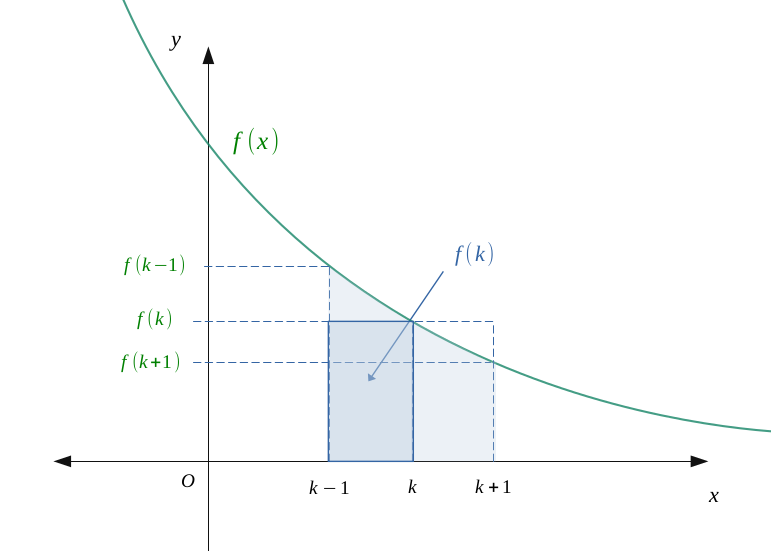
Making the sum of these elements from \((k = 1)\) until \((k = n)\), we do have that:
If we know divide each member by \(\frac{2}{3}n^{\frac{3}{2}}\), we obtain this:
Finally, let us make tend \((n \to +\infty)\) to obtain:
Thanks to the squeeze theorem , we finally find that:
And as a result,
Recap table of usual sums
Examples
-
Calculate a sum of natural numbers
Let us calculate the following sum \(S\):
$$ S = \sum_{k =5}^{20} k = 5 + 6 + 7 \hspace{0.1em} + \hspace{0.1em} ... \hspace{0.1em} + \hspace{0.1em} 20 $$-
Calculate the sum from \(0\) to \(20\) et remove the sum from \(0\) to \(4\)$$ \sum_{k =0}^{n} k = \frac{n(n+1)}{2} $$
So,
$$ S = \Biggl[\sum_{k =0}^{20} k\Biggr] - \Biggl[\sum_{k =0}^{4} k \Biggr]$$$$ S = \frac{20 \times 21 }{2} - \frac{4 \times 5 }{2} $$$$ S = 210- 10 = 200 $$ -
Calculate directly the sum from \(5\) to \(20\)
At this stage, we will use the general formula:
$$ \sum_{k =a}^{n} k = \frac{(n + a)(n+1- a)}{2} $$So,
$$ S = \sum_{k =5}^{20} k = \frac{(20 + 5)(20+1- 5)}{2} $$$$ S = \sum_{k =5}^{20} k = \frac{25 \times 16}{2} = 200$$
-
-
Calculate a sum of natural cubes
Let us calculate the following sum \(S'\):
$$ S' = \sum_{k =7}^{11} k^3 = \ 7^{3} + \ 8^{3} + \ 9^3 + \ 10^3 + \ 11^3 $$-
Calculate the sum from \(0\) to \(11\) et remove the sum from \(0\) to \(6\)
$$\sum_{k = 0}^n k^3 = \frac{n^2 (n+1)^2 }{4} $$So,
$$ S' = \Biggl[\sum_{k = 0}^{11} k^3 \Biggr] - \Biggl[\sum_{k = 0}^6 k^3 \Biggr]$$$$ S' = \frac{11^2 (11+1)^2 }{4}- \frac{6^2 (6+1)^2 }{4}$$$$ S' = \frac{121 \times 144}{4}- \frac{ 36 \times 49 }{4} = 3915$$ -
Calculate directly the sum from \(7\) to \(11\)
$$ \sum_{k=a}^n k^3 = \frac{1}{4}\bigl(n+1-a\bigr)\bigl(n+a\bigr)\bigl(n^2 + a^2 + n - a\bigr) $$So,
$$ S' = \sum_{k =7}^{11} k^3 = \frac{1}{4} \times (11 + 1 - 7)(11 + 7)(11^2 + 7^2 + 11 - 7) $$$$ S' = \sum_{k =7}^{11} k^3 = \frac{1}{4} \times 5 \times 18 \times (121 + 49 + 4) $$$$ S' = \sum_{k =7}^{11} k^3 = \frac{1}{4} \times 5 \times 18 \times 174 = 3915 $$
-
 Back to top