





 Index
Index
In an triangle, The Thales' theorem implies proportionality ratios between sides length.
Let be an ordinary triangle, in which we have drew a parallel of one of the sides, and such as the following figure:
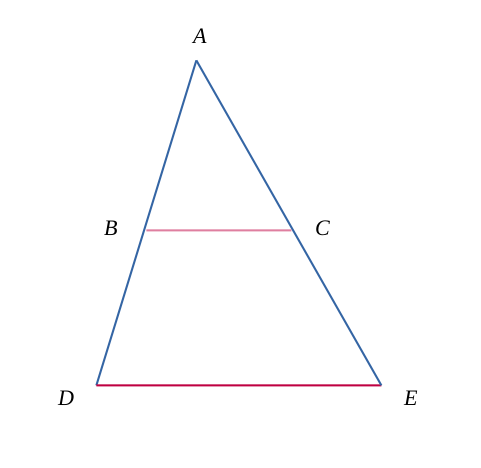
The Thales' theorem tells us that, in a triangle \(ADE\), if it exists any straight line \(BC\) intersecting \(AD\) and \(AE\) respectively on \(B\) and \(C\) such as \(BC \parallel DE\), then it implies lengths ratios between sides:
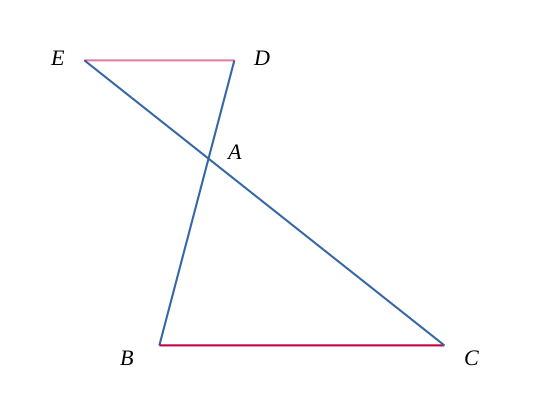
As well, it is possible to apply it in a reversed triangle, such as the following figure:
-
Extension of the theorem
Finally, by extension of the Thales theorem , if we have established these following equalities between ratios:
$$ \frac{AB}{AD} = \frac{AB'}{AD'} = \frac{BB'}{DD'} $$These ratios will apply for all projections (not necessarily orthogonal) on the side \( DD' \).
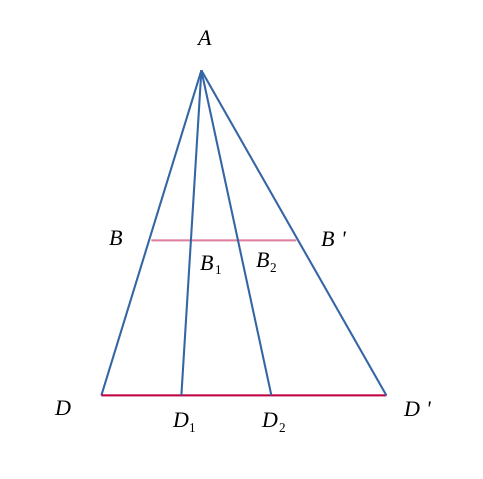 $$ \frac{AB}{AD} = \frac{AB_1}{AD_1} = \frac{AB_2}{AD_2}= \frac{AB'}{AD'} $$
The Thales' theorem reciprocal tells us that if in any triangle \( ADE \), with any straight line \( BC \) intersecting \( AD \) and \( AE \) respectively on \( B \) and \( C \), such as the following figure:
Then, it implies a parallelism relation:
Moreover, only one of these three equalities can be sufficient if both lengths start from a commun summit:
Both previous implications then form the following equivalence:
Let be an ordinary triangle, in which we added a straight line \(BC\) intersecting \(AD\) and \(AE\) respectively on \(B\) and \(C\).
The Thales' theorem
Let us start from the hypothesis that:
To proove the truthfulness of the theorem, let us add to this triangle an height \( AG \) intesecting \( BC \) and \( DE \), respectively on \( F \) and \( G \).
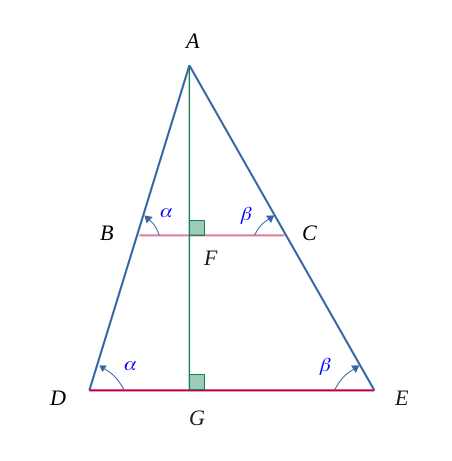
We can now apply the laws of trigonometry in it.
-
Trigonometry relations in the left part of the triangle
We introduce the angle \(\alpha\) as:
$$ \alpha = \widehat{GDA} = \widehat{FBA} $$For both triangles \( ADG \) and \( ABF \), we do have:
$$ \cos(\alpha) = \frac{DG}{DA} = \frac{BF}{BA} $$Then, we can say that:
$$ \frac{DG}{DA} = \frac{BF}{BA} $$And also:
$$ \frac{AB}{AD} = \frac{BF}{DG} \qquad (1) $$
As well,
$$ \sin(\alpha) = \frac{AG}{AD} = \frac{AF}{AB} $$$$ \frac{AG}{AD} = \frac{AF}{AB} $$$$ \frac{AB}{AD} = \frac{AF}{AG} \qquad (2) $$Now, we notice a commun term \( \frac{AB}{AD} \) in both equations \( (1) \) and \( (2) \), that gives us a triple equality:
$$ \frac{AB}{AD} = \frac{BF}{DG} = \textcolor{rgb(93 183 129)}{\frac{AF}{AG}} \qquad (3) $$Let us now do the same thing in the right part of the triangle.
-
Trigonometry relations in the right part of the triangle
Repeating the same process as before, we find out a new triple equality:
$$ \frac{AC}{AE} = \frac{FC}{GE} = \textcolor{rgb(93 183 129)}{\frac{AF}{AG}} \qquad (4) $$ -
General equality between ratios
Now, we notice that in both expressions \( (3) \) and \( (4) \), there is a common term \( \frac{AF}{AG} \), thus all these ratios are equals:
$$ \frac{AB}{AD} = \frac{AC}{AE} = \frac{BF}{DG} = \frac{FC}{GE} = \textcolor{rgb(93 183 129)}{\frac{AF}{AG}} \qquad (5) $$So far, we prooved that:
$$ \frac{AB}{AD} = \frac{AC}{AE} $$
It remains to be prooved that these two ratios are also equals to the third: \( \frac{BC}{DE} \).
We know from the property of addition of numerators and denominators of a fraction that:
$$ \forall (a, c) \in \hspace{0.04em} \mathbb{R}^2, \enspace (b, d) \in \hspace{0.04em} \bigl(\mathbb{R}^* \bigr)^2, \enspace \ \Bigl \{ (b+d) \Bigr \} \ \neq 0, $$$$ \frac{a}{b} = \frac{c}{d} = \frac{a+c}{b+d} $$.In our case, the previous property allows us to say that:
$$ \frac{BF}{DG} = \frac{FC}{GE} = \frac{BF +FC}{DG + DE} $$And by the way:
$$ \frac{BF}{DG} = \textcolor{rgb(93 183 129)}{\frac{FC}{GE}} = \frac{BC}{DE} \qquad (6) $$As with the group of equalities \( (5) \), we had:
$$ \frac{AB}{AD} = \frac{AC}{AE} = \frac{BF}{DG} = \textcolor{rgb(93 183 129)}{\frac{FC}{GE}} = \frac{AF}{AG} \qquad (5) $$The group of equalities \( (5) \) and \( (6) \) having at least one common term which is \( \frac{FC}{GE} \), then the ratio \( \frac{BC}{DE} \) is also equal to the others, and:
$$ \frac{AB}{AD} = \frac{AC}{AE} = \frac{BF}{DG} = \frac{FC}{GE} = \frac{AF}{AG} = \frac{BC}{DE} \qquad (5') $$We thus prooved that:
$$ \frac{AB}{AD} = \frac{AC}{AE} = \frac{BC}{DE} $$And as a result,
$$ BC \parallel DE \Longrightarrow \Biggl( \frac{AB}{AD} = \frac{AC}{AE} = \frac{BC}{DE} \Biggr) \bigl(\text{The Thales' theorem} \bigr) $$
-
Extension of the theorem
Finally, by extension of the Thales theorem , if we subdivide our main triangle, such as the following figure :
These ratios will apply for all projections (not necessarily orthogonal) on the side \( DD' \):
$$ \frac{AB}{AD} = \frac{AB_1}{AD_1} = \frac{AB_2}{AD_2}= \frac{AB'}{AD'} $$
The Thales' theorem reciprocal
To now proove the veracity of the theorem reciprocal, let us start from three different hypotheses:
-
\( \frac{AB}{AD} = \frac{AC}{AE} \qquad (H_2) \)
-
\( \frac{AB}{AD} = \frac{BC}{DE} \qquad (H_2') \)
-
\( \frac{AC}{AE} = \frac{BC}{DE} \qquad (H_2'') \)
-
Using the similarity of two triangles
We know from the following property of the similarity of two triangles that:
Two triangles are similar if their three respective sides are proportional .
As a consequence of it, with the three hypotheses \((H_2)\), \((H_2')\) and \((H_2'')\) we will always have similar triangles . And these two triangles being nested in one another, it is obvious to conclude that in any case:
$$ BC \parallel DE $$ -
Conclusion
We showed that one over three ratio equality was enough to imply parallelism, and:
$$ \left( \frac{AB}{AD} = \frac{AC}{AE} = \frac{BC}{DE} \right) \Longrightarrow BC \parallel DE \qquad \bigl(\text{The Thales' theorem (reciprocal)} \bigr) $$
Moreover, only one of these three equalities can be sufficient if both lengths start from a commun summit:
We know from the following property of the similarity of two triangles that:
Two triangles are similar if they have a common angle and their two respective lengths are proportional .
$$ \left( \frac{AB}{AD} = \frac{AC}{AE} \right) \Longrightarrow BC \parallel DE \qquad \bigl(\text{The Thales' theorem (reciprocal)} \bigr)^* $$
The Thales' theorem equivalence
Two implications makes an equivalence.
Thus, having our two implications \((I_1)\) et \((I_2)\):
We can gather them to build the following equivalence:
 Back to top