





 Index
Index
Let \( \vec{u}\) and \( \vec{v}\) be two vectors.
We represent \(||\vec{u}|| \) and \(||\vec{v}|| \) as the respective magnitudes of \( \vec{u}\) and \( \vec{v}\), and \( (\vec{u} , \vec{v})\) the forming angle by these two vectors.
We call the scalar product \( \vec{u}\cdot\vec{v} \), the real number resulting from:
This is the magnitude of the orthogonal projection of the vector \( \vec{u}\) onto the vector \( \vec{v}\), multiplied by the magnitude of the vector \( \vec{v}\).
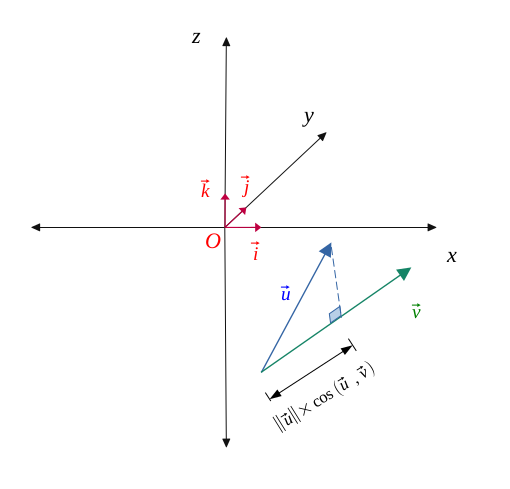
Furthermore, performing the scalar product \( (\lambda\vec{u})\cdot(\mu\vec{v})\), we do obtain:
And also the distributive law to the left:
These are the same formulas as remarkable identities .
The vectorial projection of \(\vec{u}\) onto \(\vec{v}\) is worth:
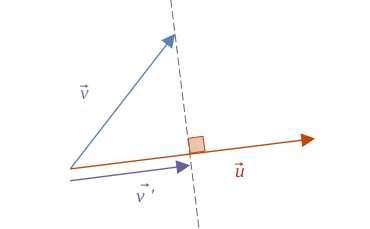
Click on the title to access to the recap table.
Commutative law
Let \(\vec{u} \) and \(\vec{v} \) be two vectors.
Performing both scalar products \( \vec{u}\cdot\vec{v} \) and \( \vec{u}\cdot\vec{u} \), we do have:
Let us call \(\alpha \) = \( (\vec{u}, \vec{v}) \), the forming angle by \( \vec{u} \) and \(\vec{v} \), then:
But, the cosine function is pair and: \( \forall \alpha \in \mathbb{R}, \ \cos(\alpha ) = \cos(-\alpha ) \).
From this we can deduce that: \( \cos(\vec{u}, \vec{v}) = \cos(\vec{v}, \vec{u}) \).
And finally,
Orthogonal vectors
Let \(\vec{u} \) and \(\vec{v} \) be two vectors, different from the zero vector.
-
From left to right implication
Let us assume that \(\vec{u} \) and \(\vec{v} \) are orthogonal.
Then, by the definition of the scalar product,
$$ \vec{u}\cdot\vec{v} = ||\vec{u}|| \times ||\vec{v}|| \times \cos(\vec{u}, \vec{v}) $$But, if \(\vec{u} \) ans \(\vec{v} \) are orhtogonal, then \(\cos(\vec{u}, \vec{v}) = \cos \left(\frac{\pi}{2}\right) = 0 \).
Thus, their scalar product will be zero, and:
$$ \forall (\vec{u}, \vec{v}) \neq \vec{0},$$$$ \vec{u} \text{ and } \vec{v} \text{ orthogonal vectors }\Longrightarrow \vec{u}\cdot \vec{v} = 0 $$ -
Reciprocal
Reciprocally, being said that the two vectors \(\vec{u} \) and \(\vec{v} \) are non-zero vectors, so:
$$ \vec{u}\cdot \vec{v} = 0 \Longrightarrow \cos(\vec{u}, \vec{v}) = 0 $$And,
$$ \forall k \in \mathbb{N}, \ \cos(\vec{u}, \vec{v}) = 0 \Longrightarrow \Biggl\{ (\vec{u}, \vec{v}) = \frac{k\pi}{2} \Biggr \} $$And as a result, \(\vec{u} \) and \(\vec{v} \) are necessarily orthogonal vectors.
$$\vec{u}\cdot \vec{v} = 0 \Longrightarrow \vec{u} \text{ and } \vec{v} \text{ orthogonal vectors }$$ -
Conclusion
$$ \forall (\vec{u}, \vec{v}) \neq \vec{0},$$$$ \vec{u} \text{ and } \vec{v} \text{ orthogonal vectors }\Longleftrightarrow \vec{u}\cdot \vec{v} = 0 $$
Squared vector
Let \(\vec{u} \) be a vector.
Then, by the definition of the scalar product,
But \(\cos(\vec{u}, \vec{u}) = \cos \left(0\right) = 1 \).
Thus, only magnitudes remains in the product.
And finally:
Scalar product by the vectors coordinates
Let \(\vec{u}\begin{pmatrix} x\\ y\\z \end{pmatrix}\) and \(\vec{v}\begin{pmatrix} x'\\ y'\\z' \end{pmatrix}\) be two vectors represented in an orthonormal coordinate system \( (O, \vec{i}, \vec{j}, \vec{k})\) and such as the following figure:
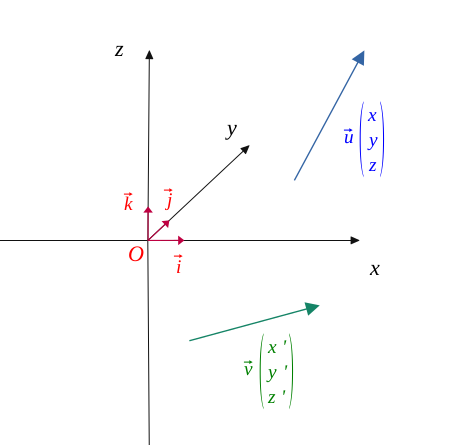
So, we can express \(\vec{u} \) and \(\vec{v} \) in the following formula:
Then, the scalar product \(\vec{u}\cdot\vec{v} \) is worth:
The three vectors \(\vec{i} \cdot \vec{j}, \vec{k} \) are by hypothesis our unit vectors, then:
Furthermore, being in an orthognal reference frame, the three vectors \(\vec{i} \cdot \vec{j}, \vec{k} \) are orthogonal , so their scalar product is zero:
And by the commutative law of the scalar product , we do also have:
Now, rewriting \((1) \),
Et finalement,
Bilinearity
Let \((\lambda, \mu) \in \hspace{0.04em} \mathbb{R}^2\) be two real numbers, and \(\vec{u}\begin{pmatrix} x\\ y\\z \end{pmatrix}, \ \vec{v}\begin{pmatrix} x'\\ y'\\z' \end{pmatrix}\) two vectors.
Performing the scalar product \( (\lambda\vec{u})\cdot\vec{v}\), we do have:
Using the coordinates expression, we do have this:
But, in the same time:
And we then obtain bilinearity:
Furthermore, performing the scalar product \( (\lambda\vec{u})\cdot(\mu\vec{v})\), we do obtain:
Distributive law in relation to the addition
Let \(\vec{u}\), \(\vec{v}\) and \(\vec{w}\) be three vectors, also expressed \(\overrightarrow{AB}\), \(\overrightarrow{AC}\) and \(\overrightarrow{CD}\) such as the following figure:
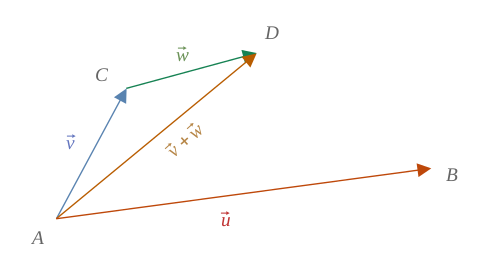
We also note in this figure the sum \((\vec{v} + \vec{w})\) giving \(\overrightarrow{AD}\).
-
Right-hand distributivity
So the scalar product \(\vec{u}\cdot( \vec{v} + \vec{w}) \) is worth :
$$ \vec{u}\cdot( \vec{v} + \vec{w}) = || u || \times || v + w || \times \cos(\vec{u}, \vec{v} + \vec{w})$$$$ \vec{u}\cdot( \vec{v} + \vec{w}) = || \overrightarrow{AB} || \times || \overrightarrow{AD} || \times \cos(\overrightarrow{AB}, \overrightarrow{AD}) \qquad (1) $$Let us now calculate what the scalar products are independently worth \(\vec{u}\cdot\vec{v}\) and \(\vec{u}\cdot\vec{w}\):
$$ \left \{ \begin{gather*} \vec{u}.\vec{v} = || \overrightarrow{AB} || \times || \overrightarrow{AC} || \times \cos(\overrightarrow{AB}, \overrightarrow{AC}) \\ \vec{u} \cdot \vec{w} = || \overrightarrow{AB} || \times || \overrightarrow{CD} || \times \cos(\overrightarrow{AB}, \overrightarrow{CD}) \end{gather*} \right \} $$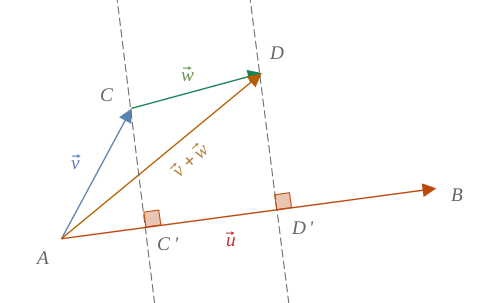
But \(\left[|| \overrightarrow{AC} || \times \cos(\overrightarrow{AB}, \overrightarrow{AC})\right]\) and \(\left[|| \overrightarrow{CD} || \times \cos(\overrightarrow{AC}, \overrightarrow{CD})\right]\) are the respective orthogonal projections of vectors \(\overrightarrow{AC}\) and \(\overrightarrow{CD}\) on vector \(\overrightarrow{AB}\).
$$ \left \{ \begin{gather*} \vec{u}.\vec{v} = || \overrightarrow{AB} || \times || \overrightarrow{AC'} || \qquad(2) \\ \vec{u} \cdot \vec{w} = || \overrightarrow{AB} || \times || \overrightarrow{C'D'} || \qquad(3) \end{gather*} \right \} $$So, the sum of the two expressions \((2)\) and \((3)\) is worth:
$$ \vec{u}\cdot\vec{v} + \vec{u} \cdot \vec{w} = || \overrightarrow{AB} || \times || \overrightarrow{AC'} || + || \overrightarrow{AB} || \times || \overrightarrow{C'D'} || $$$$ \vec{u}\cdot\vec{v} + \vec{u} \cdot \vec{w} = || \overrightarrow{AB} || \times \left[ || \overrightarrow{AC'} || + || \overrightarrow{C'D'} || \right] $$Moreover, both vectors \(|| \overrightarrow{AC'} ||\) and \(|| \overrightarrow{C'D'} ||\) being aligned, we have:
$$ \vec{u}\cdot\vec{v} + \vec{u} \cdot \vec{w} = || \overrightarrow{AB} || \times || \overrightarrow{AD'} || $$And \(|| \overrightarrow{AD'} ||\) being the orthogonal projection of the vector \(\overrightarrow{AD}\) on \(\overrightarrow{AB}\), we now have:
$$ \vec{u}\cdot\vec{v} + \vec{u} \cdot \vec{w} = || \overrightarrow{AB} || \times || \overrightarrow{AD} || \times \cos(\overrightarrow{AB}, \overrightarrow{AD}) $$So, thanks to the previous expression \((1)\), we finally have that:
$$ \forall (\vec{u}, \vec{v}, \vec{w}), $$$$ \vec{u}\cdot( \vec{v} + \vec{w}) = \vec{u}.\vec{v} + \vec{u} \cdot \vec{w} $$ -
Left-handed distributive law
And thanks to the commutative law of the scalar product , we do have the same thing to the left:
$$ (\vec{u} + \vec{v}) \cdot \vec{w} = \vec{w} . (\vec{u} + \vec{v}) $$Devlopping the expression with the right-handed distributive law:
$$ (\vec{u} + \vec{v}) \cdot \vec{w} = \vec{w}.\vec{u} + \vec{w} \cdot \vec{v} $$And still with the commutative law :
$$ (\vec{u} + \vec{v}) \cdot \vec{w} = \vec{u} \cdot \vec{w} + \vec{v} \cdot \vec{w} $$And finally,
$$ \forall (\vec{u}, \vec{v}, \vec{w}), $$$$ (\vec{u} + \vec{v}) \cdot \vec{w} = \vec{u} \cdot \vec{w} + \vec{v} \cdot \vec{w} $$
Remarkable identities
We saw above that the scalar product is distributive , that is the property that will be used in this part.
-
Calculation of \( (\vec{u} + \vec{v})^2 \)
$$ (\vec{u} + \vec{v})^2 = (\vec{u} + \vec{v})\cdot(\vec{u} + \vec{v}) $$$$ (\vec{u} + \vec{v})^2 =\vec{u}\cdot \vec{u} + \vec{u}.\vec{v} + \vec{u} \cdot \vec{v} - \vec{v}. \vec{v} $$$$ (\vec{u} + \vec{v})^2 = {|| \vec{u} ||}^2 + 2 \vec{u}\cdot\vec{v} + {|| \vec{v} ||}^2 $$ -
Calculation of \( (\vec{u} - \vec{v})^2 \)
This is the same calculation but with a \((-)\) sign in the double product.
$$ (\vec{u} - \vec{v})^2 = (\vec{u} - \vec{v})\cdot(\vec{u} - \vec{v}) $$$$ (\vec{u} - \vec{v})^2 =\vec{u}\cdot \vec{u} - \vec{u}.\vec{v} - \vec{u} \cdot \vec{v} - \vec{v}. \vec{v} $$$$ (\vec{u} - \vec{v})^2 = {|| \vec{u} ||}^2 - 2 \vec{u}\cdot\vec{v} + {|| \vec{v} ||}^2 $$ -
Calculation of \( (\vec{u} + \vec{v})\cdot (\vec{u} - \vec{v}) \)
$$ (\vec{u} + \vec{v})\cdot (\vec{u} - \vec{v}) = \vec{u}. \vec{u} - \vec{u} \cdot \vec{v} + \vec{v}. \vec{u} - \vec{v}. \vec{v} $$We saw above that the scalar product is commutative , so \( \vec{u}\cdot \vec{v} = \vec{v}. \vec{u} \), and:
$$ (\vec{u} + \vec{v}). (\vec{u} - \vec{v}) = {|| \vec{u} ||}^2 \hspace{0.1em} \underbrace{ - \ \vec{u} \cdot \vec{v} + \vec{u} \cdot \vec{v} } _{ = \hspace{0.1em} 0 } \hspace{0.1em} - {|| \vec{v} ||}^2$$$$ {|| \vec{u} ||}^2 - {|| \vec{v} ||}^2= (\vec{u} + \vec{v}) \cdot (\vec{u} - \vec{v}) $$
As a result, we obtain the same formulas as the classical remarkable identities .
Expression depending on norms
We saw above that:
Working with the expression \( (4) \), we do have:
But thanks to the squared vectors property , we do know that:
Then \( (4) \) becomes now:
And finally,
In the same way, working with the expression \( (5) \):
Projection of a vector onto a vector
The scalar projection of \(\vec{v}\) onto \(\vec{u}\) is worth:
Thus, having its standard we can attribute to it the direction and the sens of \(\vec{u}\) via the operation:
And with the above, we have:
The vectorial projection of \(\vec{u}\) onto \(\vec{v}\) is worth:
Recap table of the properties of the scalar product
Examples
-
Calculate a distance from a point to a plane
Let \((\mathcal{P})\) be a plane in space, passing through a point \(A\bigl(x_0; y_0; z_0\bigr)\) and orthogonal to a vector \(\vec{n}\begin{pmatrix} a\\ b \\c \end{pmatrix}\)(with \(a, b, c \) all three non-zero).
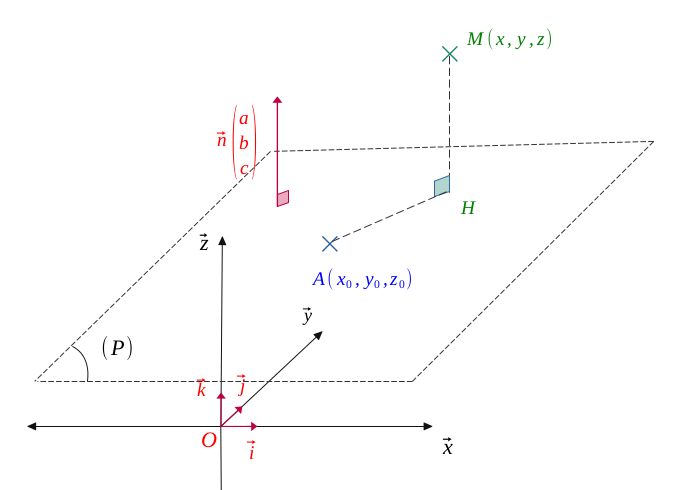
We need to determine the distance \([HM]\) from point \(M\bigl(x; y; z \bigr)\) to the plane \((\mathcal{P})\).
As both vectors \(\vec{n}\) and \(\overrightarrow{HA}\) are orthogonal , we do have:
$$ \vec{n} \ \cdot \ \overrightarrow{HA} = 0$$$$ \vec{n} \ \cdot \ (\overrightarrow{HM} + \ \overrightarrow{MA}) = 0$$$$ \vec{n} \ \cdot \ \overrightarrow{HM} + \ \vec{n} \ . \ \overrightarrow{MA} = 0$$$$ || \vec{n} || \times || \overrightarrow{HM} || + \vec{n} \ \cdot \ \overrightarrow{MA} = 0$$$$ || \overrightarrow{HM} || = \frac{\vec{n} \ \cdot \ \overrightarrow{AM}}{ || \vec{n} ||} $$$$ HM = \left | \frac{\vec{n} \ \cdot \ \overrightarrow{AM}}{ || \vec{n} ||} \right| $$Therefore, knowing the coordinates of point \(M\), we can apply the scalar product calculation by the coordinates product :
$$ HM = \left | \frac{a(x -x_0) + b(y-y_0) + c(z-z_0) }{ \sqrt{a^2 + b^2 + c^2}} \right| $$
 Back to top