




 Index
Index
If a point \( O\) is the intersection between two ropes \( (AB )\) and \( (CD )\) of a circle inside it, and such as the following figure:
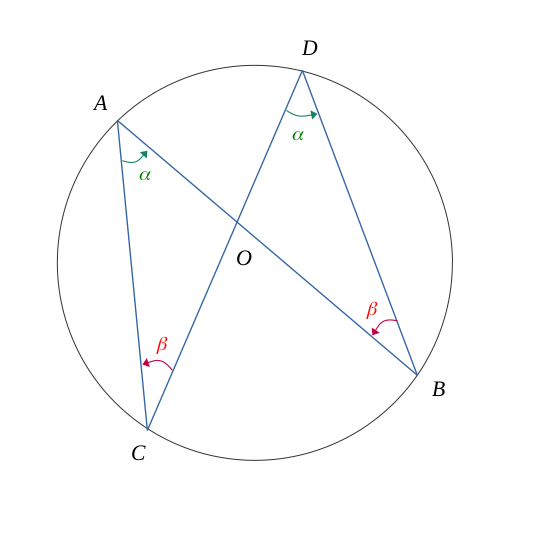
So, the two triangles \( AOC \) and \( DOB \) are similar , and the product between the lengths respectively proportional starting from the point \(O\) is worth:
If a point \( O\) is the intersection between two ropes \( (AC )\) and \( (DB )\) of a circle outside it, and such as the following figure:
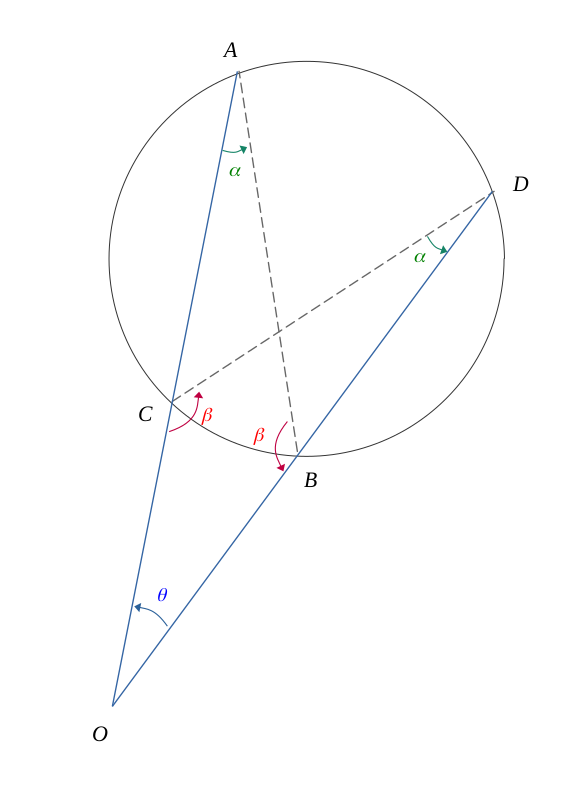
So, the two triangles \( ABO \) and \( DCO \) are similar , and the product between the lengths respectively proportional starting from the point \(O\) is worth:
If a point \( O\) is the intersection between a rope \( (AC )\) of a circle and a tangent to the same circle passing through \( T\), and such as the following figure:
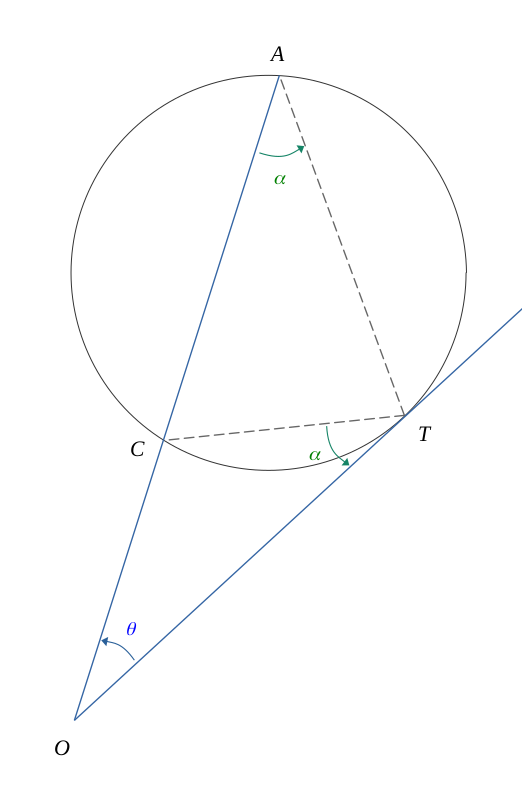
So, the two triangles \( OAT \) and \( CTO \) are similar , and the product between the lengths respectively proportional starting from the point \(O\) is worth:
If a point \( O\) is the intersection between two tangents to the circle passing respectively through \( T\) and \( T'\), and such as the following figure:
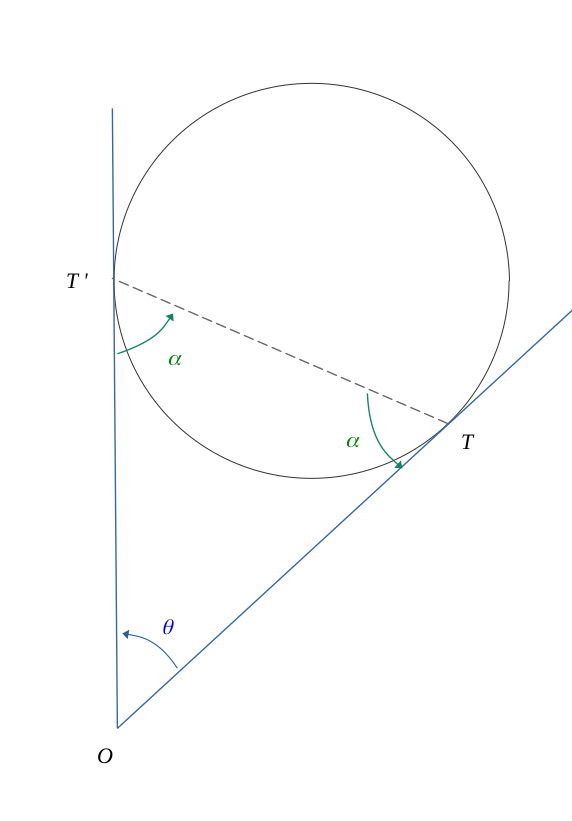
So, the triangle \( OTT' \) is an isosceles triangle, and in this case:
Case 1: Internal point of a circle
Let us consider a circle and two ropes \(AB\) and \(CD\) such as the following figure:
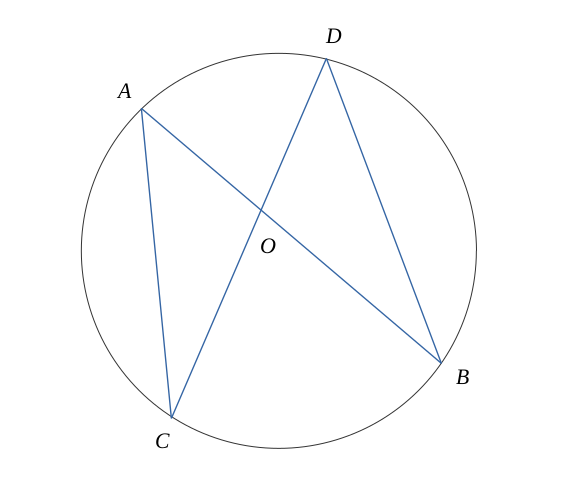
Point \(O\) is the point of intersection between the lines \((AB)\) and \((CD)\) inside the circle.
Angles \( \widehat{BAC}\) and \( \widehat{BDC}\) intercept the same arc \( \overset{\frown}{BC}\) on the circle. They are therefore equal.
In the same way, the angles \( \widehat{ABD}\) and \( \widehat{ACD}\) intercept the same arc \( \overset{\frown}{AD}\) on the circle.
The two triangles \( AOC \) and \( DOB \) having two angles two by two respectively equal, they are similar .
We then have the following proportions:
And as a result,
Case 2: External point of a circle
Let us consider a circle and two ropes \(AB\) and \(CD\) such as the following figure:
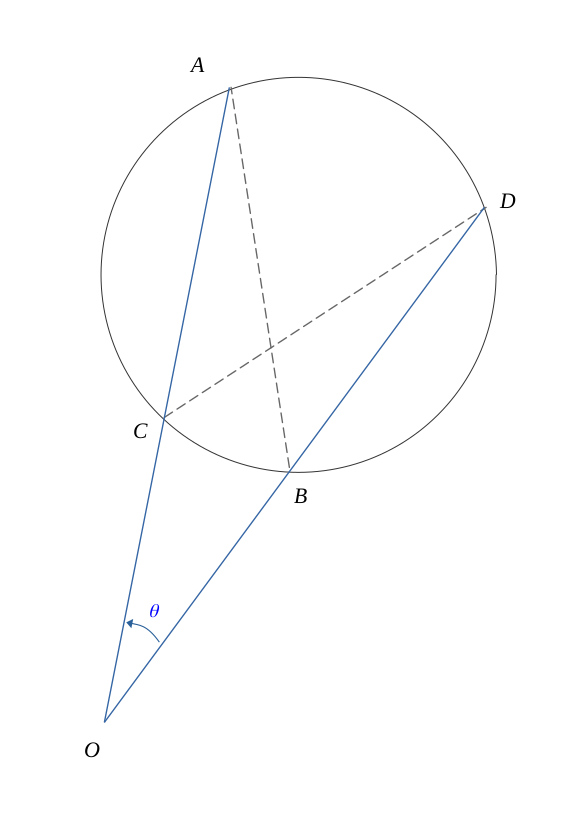
Point \(O\) is the point of intersection between the lines \((AB)\) and \((CD)\) outside the circle, this intersection forms an angle vertex \(\theta\).
Angles \( \widehat{BAC}\) and \( \widehat{BDC}\) intercept the same arc \( \overset{\frown}{BC}\) on the circle. They are therefore equal.
Consequently, the angle measures \( \widehat{ABO}\) and \( \widehat{DCO}\) are equals, being the third angle of the two respective triangles:
The two triangles \( ABO \) and \( DCO \) having two angles two by two respectively equal, they are similar .
We then have the following proportions:
And as a result,
Case 3: External point of a circle with one tangent
By returning to our previous figure by making tend the points \(B\) and \(D\) towards a new point \(T\), so that the straight line \((OT)\) be a tangent to the circle.
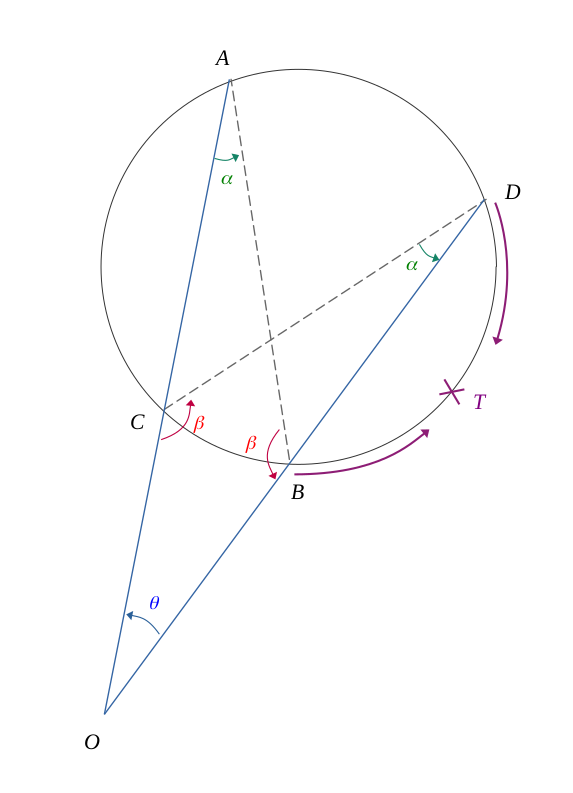
By constructing this new point \(T\), we retained the equivalence between the two angles \(\alpha\).
The two triangles \( OAT \) an \( CTO \) having two angles two by two respectively equal, they are similar .
We then have the following proportions:
And as a result,
Case 4: External point of a circle with two tangents
By returning to our previous figure and this time making points \(A\) and \(C\) tend toward a new point \(T'\), the line \((OT')\) becomes in turn tangent to the circle.
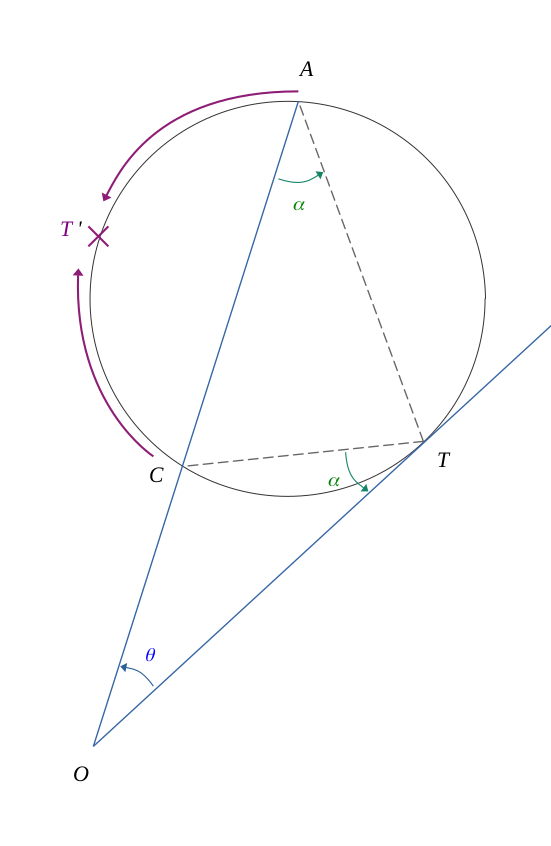
By constructing this new point \(T'\), we preserve the equivalence between the characteristic angles intersecting the circle.
This dual configuration allows us to apply the power of a point property proven previously to each of the two tangent lines.
By using the result established in Case 3, we can express the proportionality relation for each of the two tangent lines originating from point \(O\):
- For the first tangent intersecting the circle at \(T\), we have: \( \overline{OT}^2 = \overline{OA} \times \overline{OC} \)
- For the second tangent intersecting the circle at \(T'\), we have in the same manner: \( \overline{OT'}^2 = \overline{OA} \times \overline{OC} \)
By transitivity of algebraic equality, we immediately deduce:
Since lengths are strictly positive geometric quantities, the equality of squares implies the equality of distances. The triangle \( OTT' \) is therefore isosceles at \( O \):
 Back to top