






 Index
Index
This method consists in computing an approximate value of a real root of a function through successive iterations, starting from a well-chosen initial point.
Let \( f \) be a convex function (resp. concave) and strictly increasing (resp. decreasing) on an interval \( I \).
We denote by \( x_0 \in I \) the unique real number such that \( f(x_0) = 0 \).
To ensure the global and systematic convergence of the method toward this root without risking divergence, the choice of the starting point \(a_0\) must satisfy Fourier's conditions.
Fourier's Convergence Conditions
Formalized by Joseph Fourier, four strict criteria on the interval \(\bigl[a, b \bigr]\) guarantee the absolute convergence of Newton's sequence:
- \( f(a) \) and \( f(b) \) have opposite signs (existence of a root \( x_0 \) via the IVT).
- \( f'(x) \neq 0 \) across the entire interval (the function is strictly monotonic, ensuring both the uniqueness of the root and that no tangent is horizontal).
- \( f''(x) \) does not change sign (the function maintains a constant convexity or concavity, preventing slope fluctuations).
- The initial point \( a_0 \) satisfies: \( f(a_0) \times f''(a_0) > 0 \).
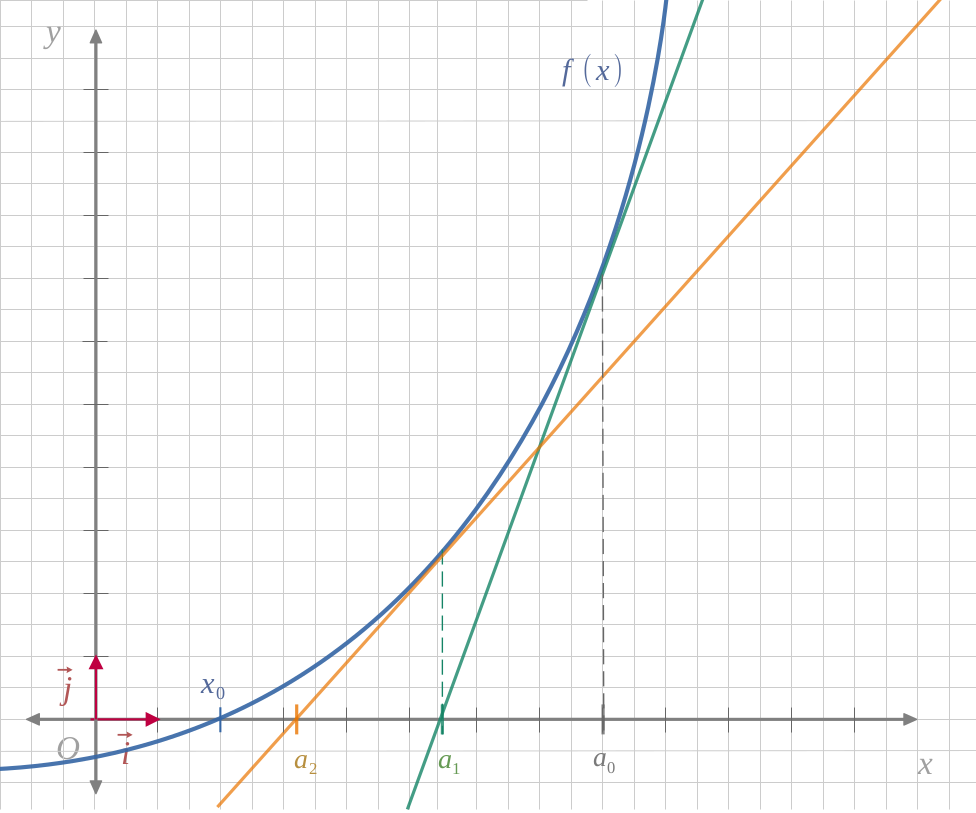
This target value \( x_0 \) is obtained as the limit of the Newton-Raphson sequence:
With \( (a_n)_{n \in \mathbb{N}} \) being the recurrence sequence defined by:
Let \( f \) be a convex function and strictly increasing on an interval \( I \).
We denote by \( x_0 \in I \) the unique real number such that \( f(x_0) = 0 \).
To ensure the global and systematic convergence of the method toward this root without risking divergence, the choice of the starting point \(a_0\) must satisfy Fourier's conditions.
Fourier's Convergence Conditions
Formalized by Joseph Fourier, four strict criteria on the interval \(\bigl[a, b \bigr]\) guarantee the absolute convergence of Newton's sequence:
- \( f(a) \) and \( f(b) \) have opposite signs (existence of a root \( x_0 \) via the IVT).
- \( f'(x) \neq 0 \) across the entire interval (the function is strictly monotonic, ensuring both the uniqueness of the root and that no tangent is horizontal).
- \( f''(x) \) does not change sign (the function maintains a constant convexity or concavity, preventing slope fluctuations).
- The initial point \( a_0 \) satisfies: \( f(a_0) \times f''(a_0) > 0 \).
This final condition requires starting from the side where the function and its concavity share the same sign. If \( f \) is convex (\( f'' > 0 \)), one must choose \( a_0 \) such that \( f(a_0) > 0 \) (to the right of the root) to build a stable and monotonic sequence of approximations.
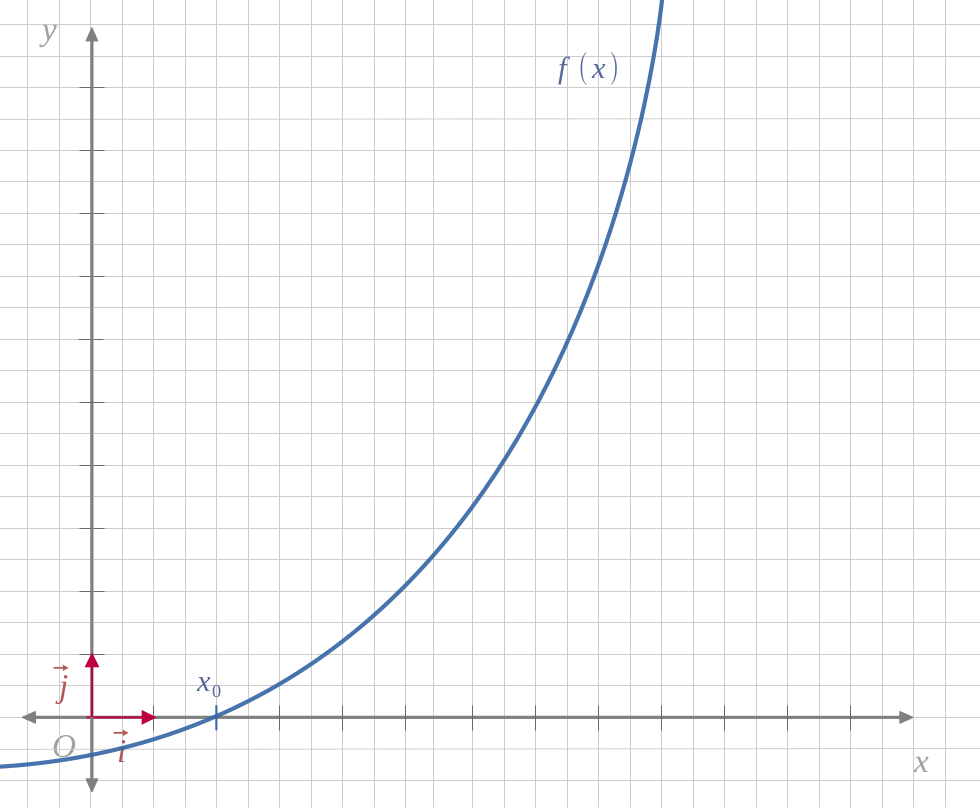
We know that this function will cancel at some point, but we don't know yet for what value \( x_0 \).
We have represented the tangent to this curve at point \( x = a_0 \), and corresponding to the following equation:
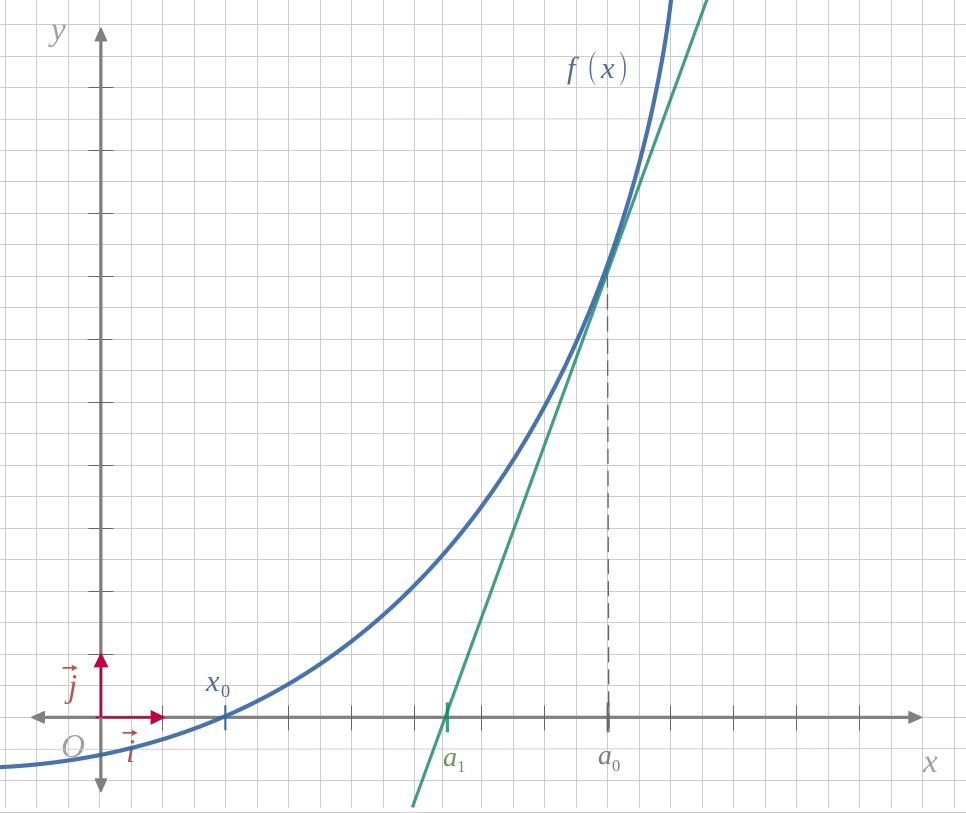
We will thus try to find out when this function will cancel itself. We do have:
At this stage, we know that \( f'(a_0) > 0 \), then we can divide by \( f'(a_0) \).
If we continue and do the same thing, this time not starting from \( a_1 \), we will obtain:
We then obtain a recurring sequence \( (a_n)_{n \in \mathbb{N}} \) such as:
The more successive iterations we establish, the more we will tend towards the desired value, namely:
With \( (a_n)_{n \in \mathbb{N}} \) a recurring sequence such as:
We can repeat this same reasoning for a concave and/or decreasing and/or negative function, and adapt a such process according to the case.
Example
We will try to find an approximate value of \( \sqrt{2} \) by this method.
Let \( f \) be a function such as \( x_0 = \sqrt{2}\) be a solution for\( f(x_0) = 0 \). Let's start from this hypothesis and try to determine this function.
We will then study the function \( f \) defined by:
And thus find an approximate value of \( x_0 \) for which \( f(x_0) = 0 \).
We are definitely in the case of a convex function and strictly increasing function, we can then apply the method.
This involves computing the different values of the following:
With \( f(x) = x^2 - 2 \) and its derivative function \( f'(x) = 2x \).
So,
Furthermore, by finding a common denominator, we recover the result of Heron's method:
Here are the results of the calculation with different value for \( a_0 \):
 Back to top