





 Index
Index
Newton's binomial tells us that :
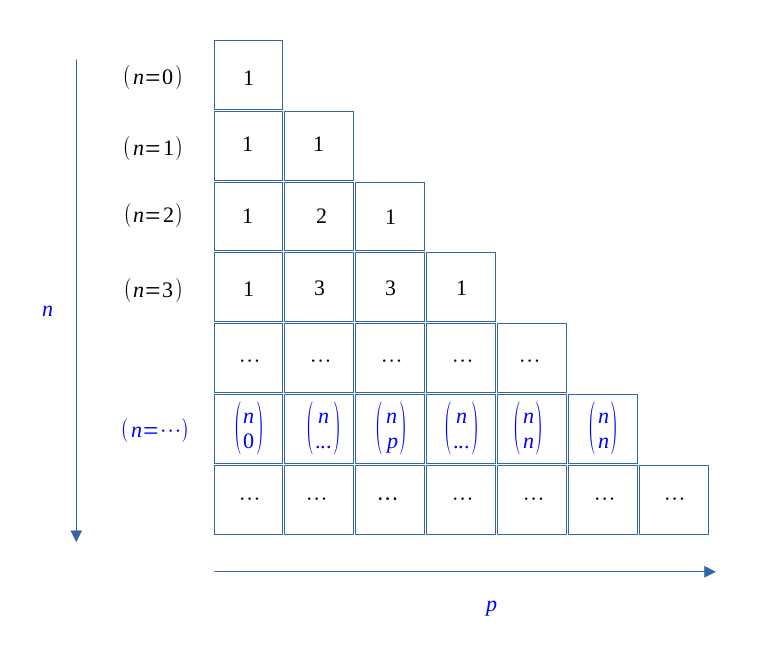
We can use the Pascal's triangle to find binomials coefficients \(\binom{n}{p}\).
Let show by a recurrence that the statement \((S_n)\) is true:
-
First term calculation
Let verify if this is the case for the first term, that is to say when \( n = 0 \).
$$ (a + b)^0 = 1 $$But,
$$ \sum_{p = 0}^0 \binom{0}{p} a^{0-p}b^p = a^{0 - 0}b^0 = 1 $$We definitely have:
$$ (a + b)^0 = \sum_{p = 0}^0 \binom{0}{p} a^{0-p}b^p = 1$$\((S_0)\) is true.
-
Inductive step
Let \( k \in \mathbb{N} \) be a natural number.
Let us assume that \((S_k)\) is true for all \( k \).
$$ (a + b)^{k} = \sum_{p = 0}^{k} \binom{k}{p} a^{k - p}b^p \qquad (S_{k}) $$And let verify if it is also the case for \((S_{k + 1})\).
$$ (a + b)^{k + 1} = \sum_{p = 0}^{k + 1} \binom{k + 1}{p} a^{k + 1 - p}b^p \qquad (S_{k + 1}) $$So that:
$$ (a + b)^{k + 1} = \binom{k + 1}{0}a^{k + 1} + \binom{k + 1}{1}a^{k}b + \binom{k + 1}{2}a^{k-1}b^2 \ + \ ... \ + \ \binom{k + 1}{k}ab^{k} + \binom{k + 1}{k + 1}b^{k + 1} \qquad (S_{k + 1}') $$Multiplying \(( S_{k} ) \) by \(( a + b) \), we do have:
$$ (a + b)^{k}(a + b) = (a + b) \times \sum_{p = 0}^k \binom{k}{p} a^{k-p}b^k $$$$ (a + b)^{k + 1} = (a + b) \times \left[ \binom{k}{0}a^k + \binom{k}{1}a^{k - 1}b + \binom{k}{2}a^{k - 2}b^2 \ + \ ... \ + \ \binom{k}{k - 1}ab^{k -1} + \binom{k}{k} b^k \right] $$$$ (a + b)^{k + 1} = \binom{k}{0} \left(a^{k + 1} + ba^k \right) + \binom{k}{1}\left(a^kb + a^{k - 1}b^2 \right) \ + \ ... \ + \ \binom{k}{k - 1}\left(a^2b^{k -1} + ab^k \right) + \binom{k}{k}\left(ab^k + b^{k + 1}\right) $$$$ (a + b)^{k + 1} = \textcolor{rgb(118 139 240)}{\binom{k}{0}} a^{k + 1} + \textcolor{rgb(93 183 129)}{\left[\binom{k}{0} + \binom{k}{1} \right]} ba^k + \textcolor{rgb(232 124 124)}{\left[\binom{k}{1} + \binom{k}{2} \right]} a^{k - 1}b^2 \ + \ ... \ + \ \textcolor{rgb(197 144 218)}{\left[\binom{k}{k -1} + \binom{k}{k} \right]}ab^k + \textcolor{rgb(118 139 240)}{\binom{k}{k}} b^{k +1} $$But we know thanks to the Pascal's formula that :
$$ \forall (p,n) \in \hspace{0.04em}\mathbb{N}^2, \enspace p \leqslant n -1, $$$$ \binom{n}{p} = \binom{n - 1}{p - 1} + \binom{n - 1}{p} \qquad \text{(Pascal's formula)} $$And as well:
$$ \binom{n + 1}{p + 1} = \binom{n}{p} + \binom{n}{p + 1} \qquad (\text{Pascal}^*) $$Consequently, thanks to \( (\text{Pascal}^*) \), we do have:
$$ (a + b)^{k + 1} = \textcolor{rgb(118 139 240)}{\binom{k}{0}} a^{k + 1} + \textcolor{rgb(93 183 129)}{\binom{k + 1}{1} } ba^k + \textcolor{rgb(232 124 124)}{\binom{k + 1}{2}} a^{k - 1}b^2 \ + \ ... \ + \ \textcolor{rgb(197 144 218)}{\binom{k + 1}{k}}ab^k + \textcolor{rgb(118 139 240)}{\binom{k}{k }} b^{k +1} $$Now, we notice that:
$$ \binom{k}{0} = \binom{k + 1}{0} $$And:
$$ \binom{k}{k} = \binom{k + 1}{k + 1} $$And finally we do have:
$$ (a + b)^{k + 1} = \binom{k + 1}{0} a^{k + 1} + \binom{k + 1}{1} ba^k + \binom{k + 1}{2} a^{k - 1}b^2 \ + \ ... \ + \ \binom{k + 1}{k}ab^k + \binom{k + 1}{k + 1 } b^{k +1} $$If we write it under another form, we do have the beginning statement \(( S_{k + 1} ) \):
$$ (a + b)^{k + 1} = \sum_{p = 0}^{k + 1} \binom{k + 1}{p} a^{k + 1 - p}b^p \qquad (S_{k + 1}) $$Thus, \((S_{k + 1})\) is true.
-
Conclusion
The statement \((S_n)\) is true for its first terme \(n_0 = 0\) and it is hereditary from terms to terms for all \(k \in \mathbb{N}\).
By the recurrence principle, that statement is true for all \(n \in \mathbb{N}\).
Nous venons de prouver par une récurrence que :
 Back to top