





 Index
Index
This theorem is a direct consequence of Rolle's theorem .
Let be \(f(x)\) a continuous function on an interval \(\bigl[a,b \bigr]\), and derivable on \(\bigl ]a,b \bigr[\).
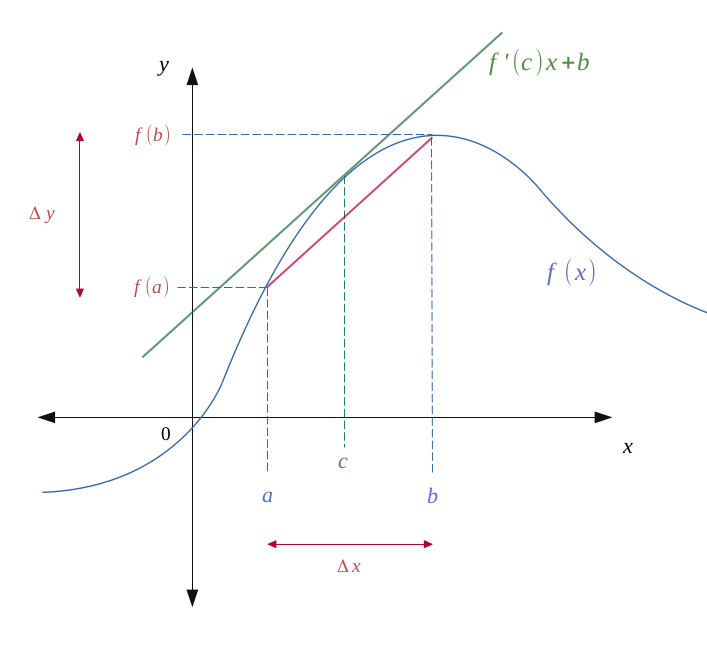
Let be \(f(x)\) a continuous function on an interval \(\bigl[a,b \bigr]\), and derivable on \(\bigl ]a,b \bigr[\).
Let us also consider an affine function \(g(x)\) secant to the curve of \(f\) at the boundary points \(A(a, \, f(a))\) and \(B(b, \, f(b))\).
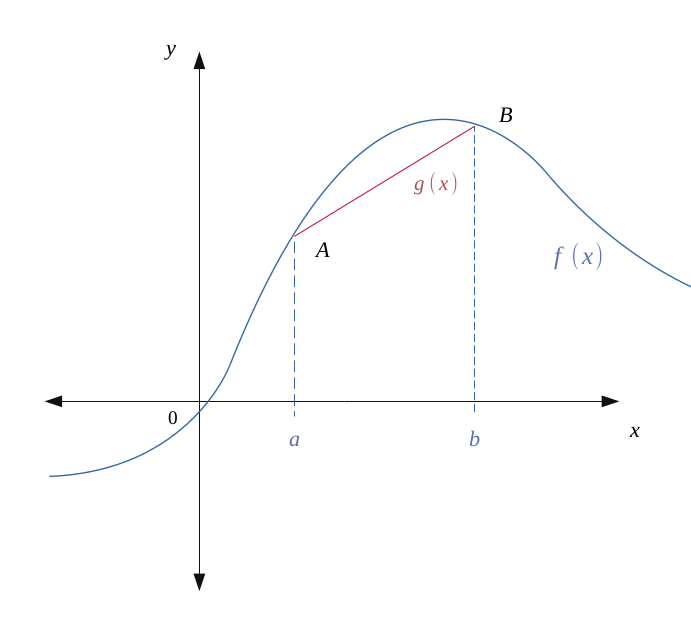
Points \(A\) and \(B\) represent the endpoints of the curve of \(f\) over the studied interval.
Let us now consider an auxiliary function \(\Phi\) also defined on \(\bigl[a,b \bigr]\) such as:
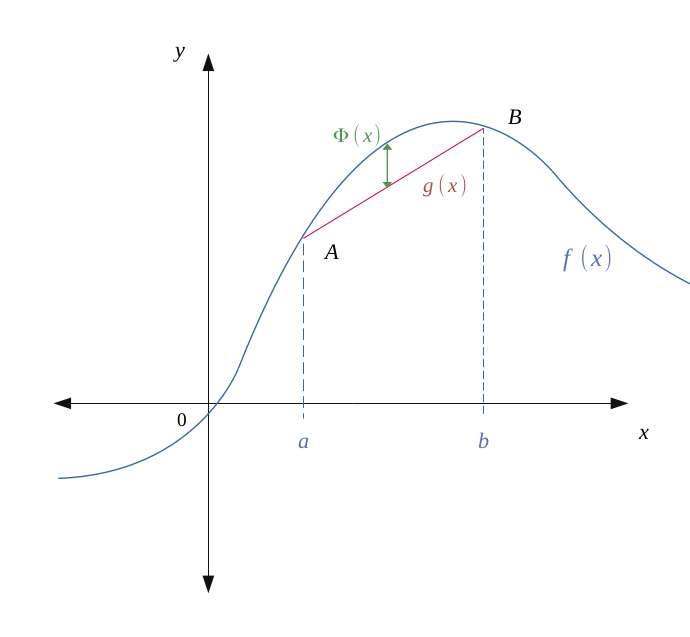
Since the slope between \(a\) and any point in \(x \in \bigl[a, b\bigr]\) is worth:
But,
So,
Thus, injecting \((g)\) in \((\Phi)\),
Functions \( f \) and \(g\) being derivable on \( \bigl ]a,b \bigr[ \), they are derivable on this same interval, it will be the same for their difference \(\Phi\).
Et comme :
Rolle's theorem may therefore apply.
Rolle's theorem tells us that:
For any a continuous function \(f(x)\) on an interval \(\bigl[a,b \bigr]\), and derivable on \(\bigl ]a,b \bigr[\):
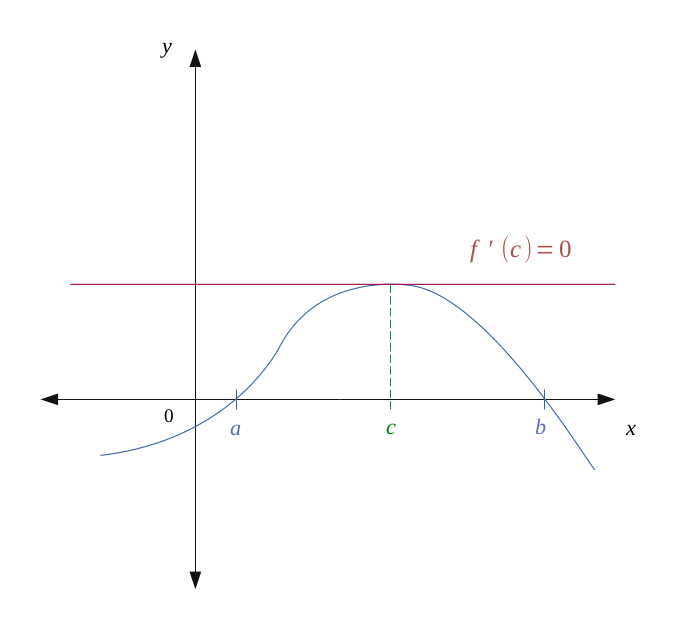
In our case,
And, by applying the derivative of \((\Phi^*)\) we obtain \(\Phi'\):
And thanks to both results \((1)\) and \((\Phi ')\), we obtain this:
Thus,
And as a result,
 Back to top