Proofs
Let \(a \in \mathbb{R}\) be a real number and \(f\) a function such as:
$$\forall x \in \mathbb{R}, \ f : x \longmapsto a^x$$
$$ \hspace{5.5em} \mathbb{R} \longmapsto \mathbb{R^+}$$
The origin oh the logarithm comes from the question of determining a function that returns the exponent \(x\) of a function \(f(x) = a^x\). Therefore, this function will be
the reciprocal function
of the function \(f\), because it returns identity \((f \circ f^{-1})\):
$$f^{-1} : a^x \longmapsto x $$
$$ \hspace{2.6em} \mathbb{R^+} \longmapsto \mathbb{R}$$
So,
$$ ( f^{-1} )'= \frac{1}{ ((a^x)'\circ f^{-1})} \qquad (1) $$
But, by
the definition of a derivative
:
$$ (a^x)' = \lim_{h \to 0 } \enspace \frac{a^{x + h} - a^x}{h} $$
$$ (a^x)' = \lim_{h \to 0 } \enspace \frac{a^x a^h - a^x}{h} $$
$$ (a^x)' = a^x \ \lim_{h \to 0 } \enspace \frac{a^h - 1}{h} $$
If we take the hypothesis that this limit exists, and we call it \(\alpha\), we then have:
$$ \forall x \in \hspace{0.04em} \mathbb{R}^*_+, \ (a^x)' = \alpha \ a^x \qquad (2) $$
Now injecting the expression \((2)\) into \((1)\), we obtain:
$$ ( f^{-1} )'= \frac{1}{ (\alpha \ a^x \circ f^{-1})} $$
$$ ( f^{-1} )'= \frac{1}{ \alpha ( a^x \circ f^{-1})} $$
But, \(a^x = f\), so:
$$ ( f^{-1} )'= \frac{1}{ \alpha x} $$
Now, taking the
antiderivative
on each side of the equation:
$$ \int^x ( f^{-1}(t) )' \ dt = \int^x \frac{1}{ \alpha t} \ dt $$
Furthermore, by the reciprocity relationship:
$$ f(0) = 1 \Longleftrightarrow f^{-1}(1) = 0 $$
We thus can define this function by an
integral
:
$$ \int^x_1 ( f^{-1}(t) )' \ dt = \int^x_1 \frac{1}{ \alpha t} \ dt $$
$$ f^{-1}(x) - \ \underbrace{ f^{-1}(1) } _{ = \ 0 } \ = \frac{1}{ \alpha } \int^x_1 \frac{1}{t} \ dt $$
$$ f^{-1}(x) = \frac{1}{ \alpha } \int^x_1 \frac{dt}{t} \qquad (3) $$
We no have a definition of what is the Napierian logarithm (or natural logarithm):
$$ \forall x \in \hspace{0.04em} \mathbb{R}^+, $$
$$ \ln(x) = \int^x_1 \frac{dt}{t} $$
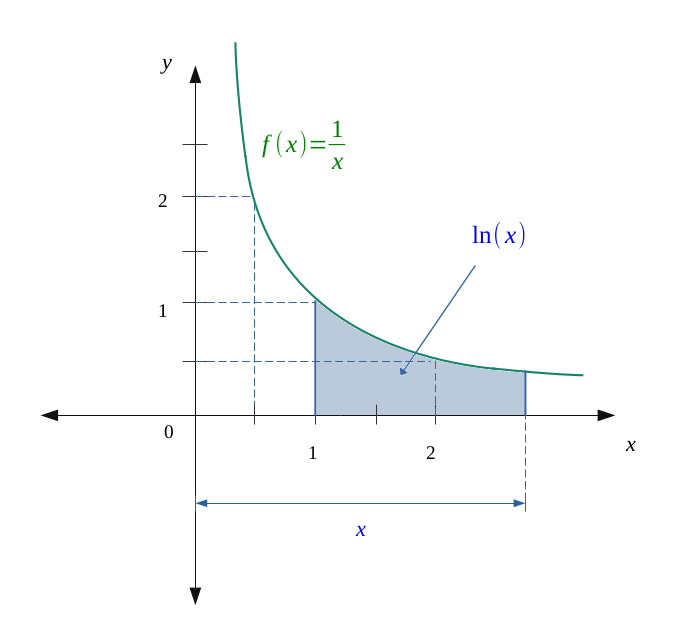
Consequently, we do also have:
$$ \ln(1) = \int^1_1 \frac{dt}{t} = 0$$
$$ \ln(1) = 0 $$
Moreover:
$$ \forall x \in \hspace{0.04em} \mathbb{R}^+, \ \ln(x)' = \ \left( \int^x_1 \frac{dt}{t} \right)' $$
$$ \ln(x)' = \frac{1}{x} $$
So,
$$ \forall x \in \hspace{0.04em} \mathbb{R}^+, $$
$$ \ln(x)' = \frac{1}{x} $$
In the end, with the expression \((3)\), and for all power of \(a\):
$$ \forall x \in \hspace{0.04em} \mathbb{R}^*_+, \ \log_a(x) = \frac{\ln(x) }{\alpha} \qquad (4) $$
with a certain parameter \(\alpha\) still
to determine
.
Both \(\log_a(x)\) and \(\ln(x)\) functions being defined as the same thing up to a coefficient \(\alpha\), the following properties will be true for both logarithmic functions.
Using the formula found previously, we have:
$$ \forall (a,b) \in \hspace{0.04em} \left[ \mathbb{R}^*_+ \right]^2, $$
$$ \ln(ab) = \int^{ab}_{1} \frac{dt}{t}$$
Now using
the Chasles relation applied to integrals
:
$$ \ln(ab) = \int^{a}_{1} \frac{dt}{t} + \int^{ab}_{a} \frac{dt}{t}$$
By setting down a variable change for the right integral:
$$ \Biggl \{ \begin{gather*} t = a \ u \\ dt = a \ du \end{gather*} $$
$$ \ln(ab) = \ln(a) + \int^{b}_{1} \frac{ a \ du }{a \ u } $$
$$ \ln(ab) = \ln(a) + \int^{b}_{1} \frac{ du }{ u } $$
And as a result,
$$ \forall (a,b) \in \hspace{0.04em} \left[ \mathbb{R}^*_+ \right]^2, $$
$$ \ln(ab) = \ln(a) + \ln(b) $$
$$ \forall a \in \hspace{0.04em} \mathbb{R}^*_+,$$
$$ \ln \left(\frac{1}{a} \right) = \int^{\frac{1}{a}}_{1} \frac{dt}{t}$$
By setting down a variable change for this integral:
$$ \Biggl \{ \begin{gather*} t = \frac{u}{a} \\ dt = \frac{du}{a} \end{gather*} $$
$$ \ln \left(\frac{1}{a} \right) = \int^{1}_{a} \frac{du}{a} \frac{a}{u}$$
$$ \ln \left(\frac{1}{a} \right) = \int^{1}_{a} \frac{du}{u} $$
$$ \ln \left(\frac{1}{a} \right) = -\int^{a}_{1} \frac{du}{u} $$
And finally,
$$ \forall a \in \hspace{0.04em} \mathbb{R}^*_+, $$
$$ \ln \left(\frac{1}{a} \right) = -\ln(a) $$
By simply taking the two previous properties, we have:
$$ \forall (a,b) \in \hspace{0.04em} \left[ \mathbb{R}^*_+ \right]^2, $$
$$ \ln \left(\frac{a}{b} \right) = \ln \left(a \times \frac{1}{b} \right) $$
$$ \ln \left(\frac{a}{b} \right) = \ln(a) - \ln \left(\frac{1}{b} \right) $$
And as a result,
$$ \forall (a,b) \in \hspace{0.04em} \left[ \mathbb{R}^*_+ \right]^2, $$
$$ \ln \left(\frac{a}{b} \right) = \ln(a) - \ln(b) $$
By retrieving the previous relation:
$$ \forall (a,b) \in \hspace{0.04em} \left[ \mathbb{R}^*_+ \right]^2,$$
$$ \ln(ab) = \ln(a) + \ln(b) $$
And replacing \(b\) by \(a\), we obtain:
$$ \forall a \in \hspace{0.04em} \mathbb{R}^*_+, $$
$$ \ln(a^2) = \ln(a) + \ln(a) $$
$$ \ln(a^2) = 2 \ \ln(a) $$
Now calculating \(\ln(a^3)\):
$$ \forall a \in \hspace{0.04em} \mathbb{R}^*_+,$$
$$ \ln(a^3) = \ln(a^2 \times a) $$
$$ \ln(a^3) = \ln(a^2)+ \ln(a) $$
$$ \ln(a^3) = 2 \ \ln(a) + \ln(a) $$
$$ \ln(a^3) = 3 \ \ln(a) $$
We see that by a direct recurrence, we obtain:
$$ \forall a \in \hspace{0.04em} \mathbb{R}^*_+, \ \forall n \in \hspace{0.04em} \mathbb{N}, $$
$$ \ln(a^n) = n \ \ln(a) $$
(idem moving backwards for \( n \in \hspace{0.04em} \mathbb{Z}\))
Furthermore, if we now take \( n \in \hspace{0.04em} \mathbb{R}\), we are forced to try with another method:
$$ \forall a \in \hspace{0.04em} \mathbb{R}^*_+, \ \forall n \in \hspace{0.04em} \mathbb{R}, $$
$$ \ln(a^n) = \int^{a^n}_{1} \frac{dt}{t}$$
By setting down the variable change:
$$ \Biggl \{ \begin{gather*} t = u^n \\ dt = n \times u^{n-1} \ du \end{gather*} $$
we then obtain:
$$ \ln(a^n) = \int^{a}_{1} \frac{ n \times u^{n-1} }{u^n} \ du $$
$$ \ln(a^n) = \int^{a}_{1} \frac{ n \times u^{n-1} }{u^{n-1} \times u} \ du $$
$$ \ln(a^n) = n \int^{a}_{1} \frac{du}{u} $$
And as a result,
$$ \forall a \in \hspace{0.04em} \mathbb{R}^*_+, \ \forall n \in \hspace{0.04em} \mathbb{R},$$
$$ \ln(a^n) = n \ \ln(a) $$
Retrieving the previous found expression:
$$ \forall x \in \hspace{0.04em} \mathbb{R}^*_+, \ \log_a(x) = \frac{\ln(x) }{\alpha} \qquad (4) $$
The logarithm to the base \(a\), which is the reciprocal function of the starting function \(a^x\), is defined up to a coefficient from the natural one. Let us study the behaviour og this function for \(x = a^n\):
$$ \log_a( a^n) = \frac{\ln( a^n) }{\alpha} \qquad (4) $$
$$ n = n \ \frac{\ln(a)}{\alpha} $$
$$ \alpha = \ln(a) $$
So, having found the coefficient between both logarithms:
$$ \forall a \in \hspace{0.04em} \Bigl[ \mathbb{R}^*_+ \hspace{0.2em} \backslash \ \{1\} \Bigr], \ \forall x \in \hspace{0.04em} \mathbb{R}^*_+, $$
$$ \log_a(x) = \frac{\ln(x) }{\ln(a)} $$
In the general case, for two logarithms respectively to the base \(a\) and \(b\), we study:
$$ \Biggl \{ \begin{gather*} \log_a(a^x) = x \\ \log_b(a^x) = x \ \log_b(a) \end{gather*} $$
Then, combining both expressions we do quickly find that:
$$\log_b(a^x) = \log_a(a^x) \ \log_b(a) $$
And as a result,
$$ \forall a \in \hspace{0.04em} \Bigl[ \mathbb{R}^*_+ \hspace{0.2em} \backslash \ \{1\} \Bigr], \ \forall b \in \hspace{0.04em} \mathbb{R}^*_+, \ \forall x \in \hspace{0.04em} \mathbb{R}^*_+, $$
$$ \log_a(x) = \frac{ \log_b(x) }{\log_b(a)} $$
And in this cas, its
derivative
is worth:
$$ \forall a \in \hspace{0.04em} \Bigl[ \mathbb{R}^*_+ \hspace{0.2em} \backslash \ \{1\} \Bigr], \ \forall x \in \hspace{0.04em} \mathbb{R}^*_+, $$
$$ \log_a(x)' = \left( \frac{\ln(x) }{\ln(a)}\right)' $$
$$ \log_a(x)' = \frac{\ln(x)'}{\ln(a)} $$
So,
$$ \forall a \in \hspace{0.04em} \Bigl[ \mathbb{R}^*_+ \hspace{0.2em} \backslash \ \{1\} \Bigr], \ \forall x \in \hspace{0.04em} \mathbb{R}^*_+, $$
$$ \log_a(x)' = \frac{1}{x \ \ln(a)} $$
Furthermore, the previous relation and its twin lead us to:
$$ \forall (a, b) \in \hspace{0.04em} \Bigl[ \mathbb{R}^*_+ \hspace{0.2em} \backslash \ \{1\} \Bigr]^2, \ \forall x \in \hspace{0.04em} \mathbb{R}^*_+, $$
$$ \log_a(x) = \frac{ \log_b(x) }{\log_b(a)} $$
$$ \log_b(x) = \frac{ \log_a(x) }{\log_a(b)} $$
$$ \Longleftrightarrow \frac{\log_a(x)}{\log_b(x)} = \frac{ 1}{\log_b(a)} $$
$$ \Longleftrightarrow \log_a(b) = \frac{\log_a(x)}{\log_b(x)} $$
So,
$$ \forall (a, b) \in \hspace{0.04em} \Bigl[ \mathbb{R}^*_+ \hspace{0.2em} \backslash \ \{1\} \Bigr]^2, $$
$$ \log_a(b) = \frac{1}{\log_b(a)} $$
Now consider the reciprocal function of the function \(g(x) = \ln(x)\).
If we take the formula for
the derivative of a reciprocal function
, we do have:
$$ \forall (g,g^{-1}) \in f^2, \enspace (g' \circ g^{-1}) \neq 0, $$
$$ ( g^{-1} )'= \frac{1}{ (g' \circ g^{-1})} $$
So,
$$ ( g^{-1} )'= \frac{1}{ (\ln(x)' \circ g^{-1})} $$
$$ ( g^{-1} )'= \frac{1}{ \frac{1}{g^{-1}} } $$
$$ ( g^{-1} )'= g^{-1} $$
This function has itself for derivative !
It is the exponentiel function which we will note \(e^x\) but sometimes \(exp(x)\). Indeed, we will later on that it has all
the properties of a power function of x
.
-
Using the reciprocal properties of the logarithm
Having said that \(g(x) = \ln(x)\) has the following property:
$$xy \longmapsto \ln(xy) = \ln(x) + \ln(y) $$
$$ \left(\left[ \mathbb{R^*_+} \right]^2 \longmapsto \hspace{0.04em} \mathbb{R}^2\right)$$
If we set down new variables:
$$ \Biggl \{ \begin{gather*} X = \ln(x) \Longleftrightarrow x = e^{X}\\ Y = \ln(y) \Longleftrightarrow y = e^{Y} \end{gather*} \qquad (5) $$
Then, the reciprocal function \(g^{-1} = e^x\) must have this property:
$$ \ln(xy) = X + Y \longmapsto xy = e^{X + Y} \qquad (6)$$
$$ \left(\mathbb{R}^2 \hspace{0.04em} \longmapsto \hspace{0.04em}\left[ \mathbb{R^*_+} \right]^2\right)$$
Both expressions \((5)\) and \((6)\) together show that:
$$ \forall (a, b) \in \hspace{0.04em} \mathbb{R}^2,$$
$$ e^a \ e^b = e^{a+b}$$
-
Using a Taylor expansion
We know that
the Taylor expansion of the exponential function at zero
is:
$$ \forall x \in \mathbb{R}, \ e^x = 1 + x + \frac{x^2}{2!} + \frac{x^3}{3!} + \ ... \ + \frac{x^n}{n!}$$
Moreover, using
the general formula of Taylor expansion
at \(a\) in the form:
$$ f(a + b) = f(a) + f'(a)b + \frac{f^{(2)}(a)}{2!}b^2 + \ ... \ + \hspace{0.2em} \frac{f^{(n)}(a)}{n!}b^n $$
But, in the case of the exponential function, we had this property:
$$ \forall x \in \mathbb{R}, \ (e^x)' = e^x $$
Which implies that,
$$ f(a) = f'(a) = f^{(2)}(a) = \ ... \ = f^{(n)}(a) $$
So now,
$$ f(a + b) = f(a) + f(a)b + \frac{f(a)}{2!}b^2 + \ ... \ + \hspace{0.2em} \frac{f(a)}{n!}b^n $$
$$ f(a + b) = f(a) \underbrace{ \left(1 + b + \frac{b^2}{2!} + \frac{b^3}{3!} + \ ... \ + \frac{b^n}{n!} \right) } _{ = \ f(b) }$$
$$ f(a + b) = f(a) f(b)$$
And as a result,
$$ \forall (a, b) \in \hspace{0.04em} \mathbb{R}^2,$$
$$ e^a \ e^b = e^{a+b}$$
Using the same logic as above,
$$ \frac{1}{y}\longmapsto \ln\left(\frac{1}{y}\right) = - \ln(y) $$
$$ \left(\mathbb{R^*_+} \longmapsto \hspace{0.04em} \mathbb{R}\right)$$
If we set down,
$$ Y = \ln(y) \Longleftrightarrow y = e^{Y} \qquad (5) $$
So,
$$ \ln \left(\frac{1}{y} \right) = - Y \longmapsto \frac{1}{y} = e^{- Y} \qquad (7)$$
$$ \left(\mathbb{R} \hspace{0.04em} \longmapsto \hspace{0.04em} \mathbb{R^*_+}\right)$$
Both expressions \((5)\) and \((7)\) together show that:
$$ \forall (a, b) \in \hspace{0.04em} \mathbb{R}^2,$$
$$ \frac{1}{e^b} = e^{- b}$$
Using the same logic as above,
$$ \frac{x}{y} \longmapsto \ln\left(\frac{x}{y}\right) = \ln(x) - \ln(y) $$
$$ \left(\left[ \mathbb{R^*_+} \right]^2 \longmapsto \hspace{0.04em} \mathbb{R}^2\right)$$
If we set down,
$$ \Biggl \{ \begin{gather*} X = \ln(x) \Longleftrightarrow x = e^{X}\\ Y = \ln(y) \Longleftrightarrow y = e^{Y} \end{gather*} \qquad (5) $$
So,
$$ \ln \left(\frac{x}{y} \right) = X - Y \longmapsto \frac{x}{y} = e^{X - Y} \qquad (8)$$
$$ \left(\mathbb{R}^2 \hspace{0.04em} \longmapsto \hspace{0.04em}\left[ \mathbb{R^*_+} \right]^2\right)$$
Both expressions \((5)\) and \((8)\) together show that:
$$ \forall (a, b) \in \hspace{0.04em} \mathbb{R}^2,$$
$$ \frac{e^a}{e^b} = e^{a - b}$$
Using the same logic as above,
$$ \forall n \ \mathbb{R}, \ x^n \longmapsto \ln\left(x^n \right) = n \ \ln(x) $$
$$ \left(\mathbb{R^*_+} \longmapsto \hspace{0.04em} \mathbb{R}\right)$$
If we set down,
$$ X = \ln(x) \Longleftrightarrow x = e^{X} \qquad (5) $$
So,
$$ \ln \left(x^n \right) = nX \longmapsto x^n = e^{nX} \qquad (9)$$
$$ \left(\mathbb{R} \hspace{0.04em} \longmapsto \hspace{0.04em} \mathbb{R^*_+}\right) $$
Both expressions \((5)\) and \((9)\) together show that:
$$ \forall (a, b) \in \hspace{0.04em} \mathbb{R}^2,$$
$$ (e^a)^b = e^{ab} $$
To determine an accurate value of the number \(e\), we can use
the Taylor expansion of the exponential function at zero
:
$$ \forall x \in \mathbb{R}, $$
$$ e^x = 1 + x + \frac{x^2}{2!} + \frac{x^3}{3!} + \ ... \ + \frac{x^n}{n!} + o(x^n)$$
$$ e^x = \sum_{k=0}^n \frac{x^k}{k!} + o(x^n)$$
Then, for \(x = 1\):
$$ e^1 = \sum_{k=0}^n \frac{1}{k!} + o(x^n) $$
This sum quickly converges towards \(2.7182818...etc\) (see table below).
$$ e \approx 2.7182818... $$
As well, we saw previously that:
$$ \forall a \in \hspace{0.04em} \Bigl[ \mathbb{R}^*_+ \hspace{0.2em} \backslash \ \{1\} \Bigr], \ \forall x \in \hspace{0.04em} \mathbb{R}^*_+, $$
$$ \log_a(x) = \frac{\ln(x) }{\ln(a)} $$
Now replacing \(x\) by \(a^x\), always strictly positive on \(\mathbb{R}\):
$$ \forall a \in \hspace{0.04em} \Bigl[ \mathbb{R}^*_+ \hspace{0.2em} \backslash \ \{1\} \Bigr], \ \forall x \in \hspace{0.04em} \mathbb{R}, $$
$$ \log_a(a^x) = \frac{\ln(a^x) }{\ln(a)} $$
$$ x \ \ln(a) = \ln(a^x) $$
Finally, applying the exponential function on each side,
$$ \forall a \in \hspace{0.04em} \Bigl[ \mathbb{R}^*_+ \hspace{0.2em} \backslash \ \{1\} \Bigr], \ \forall x \in \hspace{0.04em} \mathbb{R}, $$
$$ a^x = e^{x \ \ln(a)} $$
In the general case, to find the relationship between two
powers of x
, we retrieve the previous formula:
$$ \forall a \in \hspace{0.04em} \Bigl[ \mathbb{R}^*_+ \hspace{0.2em} \backslash \ \{1\} \Bigr], \ \forall b \in \hspace{0.04em} \mathbb{R}^*_+, \ \forall x \in \hspace{0.04em} \mathbb{R}^*_+, $$
$$ \log_a(x) = \frac{ \log_b(x) }{\log_b(a)} $$
Now replacing \(x\) by \(a^x\), always strictly positive on \(\mathbb{R}\):
$$ \forall a \in \hspace{0.04em} \Bigl[ \mathbb{R}^*_+ \hspace{0.2em} \backslash \ \{1\} \Bigr], \ \forall b \in \hspace{0.04em} \mathbb{R}^*_+, \ \forall x \in \hspace{0.04em} \mathbb{R}, $$
$$ \log_a(a^x) = \frac{ \log_b(a^x) }{\log_b(a)} $$
$$ \log_b(a^x) = x \ \log_b(a) $$
Finally, applying \(b^x\) on each side:
$$ b^{\log_b(a^x)} = b^{x \ \log_b(a)} $$
$$ a^x = b^{x \ \log_b(a)} $$
And finally,
$$ \forall (a,b) \in \hspace{0.04em} \left[ \mathbb{R}^*_+ \right]^2, \ \forall x \in \hspace{0.04em} \mathbb{R}, $$
$$ a^x = b^{x \ \log_b(a)} $$
With this result, we can deduce of it that
the derivative
of \(a^x\). Indeed, in the chapter upon
the determination of the origins of the logarithmic function
, we had found that:
$$ \forall x \in \hspace{0.04em} \mathbb{R}^*_+, \ (a^x)' = \alpha \ a^x \qquad (2) $$
And in the aftermath, establishing
a link between the logarithm of a base a and the natural logarithm
we determined that: \(\alpha = \ln(a)\).
So,
$$ \forall a \in \hspace{0.04em} \mathbb{R}^*_+, \ \forall x \in \hspace{0.04em} \mathbb{R}, $$
$$ (a^x)' = a^x \ \ln(a) $$
Finally, we can also notice that:
$$ \forall (a,b, n) \in \hspace{0.04em} \left[ \mathbb{R}^*_+ \right]^3, $$
$$ \left \{ \begin{gather*} a^{\log_n(b)} \\ b^{\log_n(a)} = \left(n^{\log_n(b)} \right)^{\log_n(a)} = n^{\log_n(b)\log_n(a)} = a^{\log_n(b)} \end{gather*} \right \} $$
$$ a^{\log_n(b)} = b^{\log_n(a)}$$
And especially for the exponential of the base \(e\),
$$ \forall (a,b) \in \hspace{0.04em} \left[ \mathbb{R}^*_+ \right]^2, $$
$$ a^{\ln(b)} = b^{\ln(a)} $$






 Index
Index
 Back to top