



 Index
Index
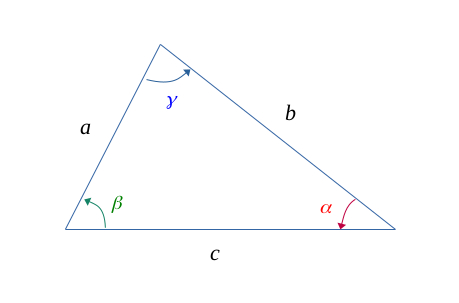
In the context of an unspecified triangle \(\{a, b, c\}\), with each angle in front of its respective length, such as:
And such as the following figure:
Héron's formula tells us that:
For any triplet of lengths \((a, b, c)\) of a triangle:
Relationships between lengths and angles
Law of \sines
To show it, let us project a height \( h_c \) upon the length \( c \), and such as the following figure:
Straightaway, the following relations come:
Dividing the equation \( (1) \) by \( a \), we do have:
In the same way, dividing \( (2) \) by \( b \):
We now notice that both right memebers of \( (3) \) and \( (4) \) are equals, it follows that:
By reproducing this operation on the two others lengths, we will have two new equations:
Equalities \( (5), (6), (7) \) having a common member from one to another, they are all equals.
And finally,
Al-Kashi's theorem
In all these demonstrations, we will demonstrate the theorem for only one of the three sides. Afterward the two other demonstrations are trivial.
-
With the Pythagorean theorem
-
Case of an acute triangle
To demonstrate the theorem, we have projected the height \( h_c \) on the side \( c \) to obtain the following figure:
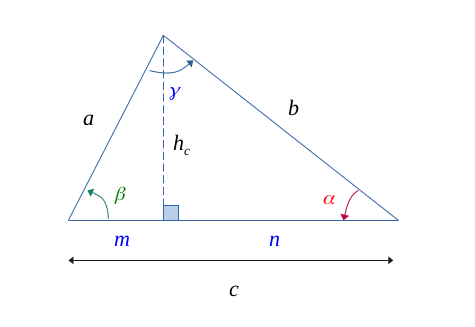
In the small triangle \(\{a, h_c, m\}\), the Pythagorean theorem gives us:
$$ a^2 = m^2 + h_c^2 $$$$ a^2 = (c-n)^2 + h_c^2 $$$$ a^2 = c^2 - 2cn + n^2 + h_c^2 \qquad (1) $$Now, in the other triangle \(\{b, h_c, n\}\),
$$ n^2 + h_c^2 = b^2 \qquad (2) $$But also,
$$ \cos(\alpha) = \frac{n}{b} \Longleftrightarrow n = b.\cos(\alpha) \qquad (3) $$Injecting \((2)\) and \((3)\) into \((1)\), we do have now:
$$ a^2 = c^2 - 2cb.\cos(\alpha) + b^2 $$And finally,
$$\forall (a, b, c) \in \hspace{0.04em} \mathbb{R}^3, \enspace \forall \alpha \in \mathbb{R}, $$$$ a^2 = b^2 + c^2 - 2bc \cdot \cos(\alpha) \qquad (Al-Kashi) $$ -
Case of an obtuse triangle
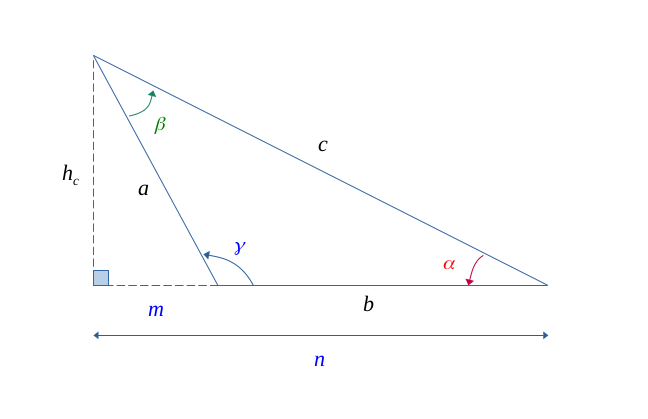
In the same way, in the small triangle \(\{a, h_c, m\}\), the Pythagorean theorem gives us that:
$$ a^2 = m^2 + h_c^2 $$$$ a^2 = (n-b)^2 + h_c^2 $$$$ a^2 = n^2 - 2nb + b^2 + h_c^2 \qquad (4) $$Now, in the other triangle \(\{h_c, n, c\}\),
$$ h_c^2 + n^2 = c^2 \qquad (5) $$But also,
$$ \cos(\alpha) = \frac{n}{c} \Longleftrightarrow n = c.\cos(\alpha) \qquad (6) $$Injecting \((5)\) and \((6)\) into \((4)\), we do have now:
$$\forall (a, b, c) \in \hspace{0.04em} \mathbb{R}^3, \enspace \forall \alpha \in \mathbb{R}, $$$$ a^2 = b^2 + c^2 - 2bc \cdot \cos(\alpha) \qquad (Al-Kashi) $$
-
-
By the scalar product
Considering the lengths \(a, b, c\) as three vectors, and such as the follwing figure:
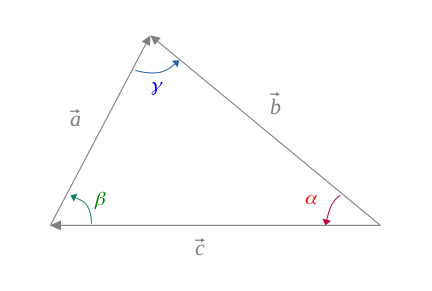
Then, we do have applying the Chasles relation :
$$ \vec{a} = \vec{b} - \vec{c} \qquad (7) $$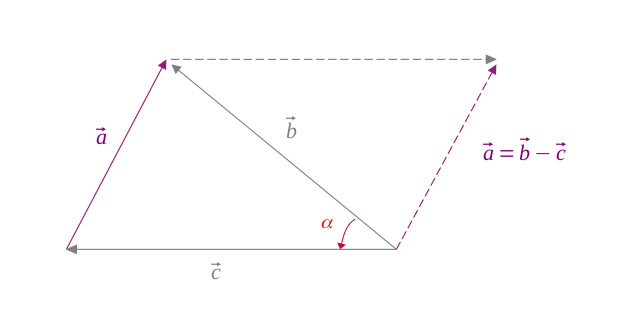
We know from the squared vector property that:
$$ \forall \vec{u},$$$$ \vec{u}\cdot\vec{u} = {|| \vec{u} ||}^2$$So,
$$ \vec{a}\cdot\vec{a} = {|| \vec{a} ||}^2$$Injecting \((7)\) into it, we now have:
$$ (\vec{b} - \vec{c})^2 = {|| \vec{a} ||}^2$$Likewise, with the scalar product remarkable identities , we do have the following property:
$$ \forall (\vec{u}, \vec{v}), $$$$ (\vec{u} - \vec{v})^2 = {|| \vec{u} ||}^2 - 2 \vec{u}\cdot\vec{v} + {|| \vec{v} ||}^2 $$So in our case,
$$ {|| \vec{b} ||}^2 - 2 \vec{b}\cdot\vec{c} + {|| \vec{c} ||}^2 = {|| \vec{a} ||}^2$$$$ b^2 - 2 bc \ \cos(\vec{b}, \vec{c}) + c^2 = a^2 $$And finally,
$$\forall (a, b, c) \in \hspace{0.04em} \mathbb{R}^3, \enspace \forall \alpha \in \mathbb{R}, $$$$ a^2 = b^2 + c^2 - 2bc \cdot \cos(\alpha) \qquad (Al-Kashi) $$ -
Conclusion
We demonstrated the first formula of the theorem:
$$ a^2 = b^2 + c^2 -2bc \cdot \cos(\alpha) \qquad (Al-Kashi)$$Repeating the same process again on the other sides of the triangle we can retrieve two other expressions.
$$ b^2 = a^2 + c^2 - 2ac \cdot \cos(\beta) \qquad (Al-Kashi^*) $$$$ c^2 = a^2 + b^2 - 2ab \cdot \cos(\gamma) \qquad (Al-Kashi^{**}) $$
Methods of calculating areas
Area formula
To demonstrate this, let's project a height \( h_c \) along the length \( c \), and such as the following figure:
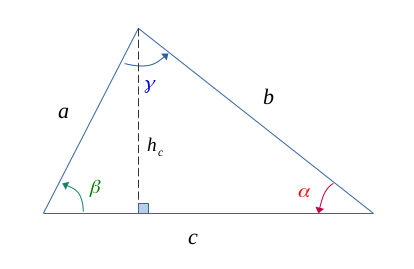
Immediately, the following relationships come:
As a result, it follows that:
But, the formula for the area of any triangle \(\{a, b, c\}\) is worth:
Now, by injecting the values of \(h_c\) coming from \((1')\) and \((2')\) in that of \((\mathcal{A})\), we obtain the double equality:
Finally, by projecting one of the other two heights, we find the third equality, and finally:
Héron's formula
To demonstrate this formula, we project the height \( h_c \) as before along the length \( c \):
Thanks to Al-Kashi's theorem , we have the following relationship:
And then,
But, we know that:
Now injecting the expression \((3)\) into the expression \((4)\), we do have this:
Arranging both parenthesis in order to obtain remarkable identities :
We now factorize to obtain the third remarkable identity :
We remove the parentheses:
Moreover, we have seen more with the area formula that:
And then also that:
So, by injecting the expression \((5)\) into the expression \((6)\), we do have:
Putting the elements in order, we now have:
At this stage, let us introduce the perimeter \(P\) of the triangle, then the expression becomes:
Then that of half-perimeter \(p\) :
We factorize all expressions in parentheses by \(2\):
And finally,
For any triplet of lengths \((a, b, c)\) of a triangle:
 Back to top