





 Index
Index
A third degree equation is of the form:
If there are one or more obvious roots, then the polynomial can be factored and reduced to a lower degree.
After the variable change:
The expression then becomes:
After calculating the discriminant \(\Delta_3\) :
We do have the following number of real roots depending on the cases:
|
Signe of the discriminant \( \Delta_3 \)
|
Number of roots
|
|---|---|
$$ \Delta_3 > 0 $$ |
1 real root
|
$$ \Delta_3 = 0 $$ |
3 real roots (including one double)
|
$$ \Delta_3 < 0 $$ |
3 real roots
|
-
if \( (\Delta_3 > 0) \)
-
a simple real root$$ X_1 = \sqrt[3]{\frac{-q + \sqrt{\Delta_3}}{2}} + \sqrt[3]{\frac{-q - \sqrt{\Delta_3}}{2}} - \frac{b}{3a} $$
-
two complex roots$$ C_2 = e^{\frac{2i\pi}{3}} \ \ \sqrt[3]{\frac{-q - \sqrt{\Delta_3}}{2}} + e^{-\frac{2i\pi}{3}} \ \ \sqrt[3]{\frac{-q + \sqrt{\Delta_3}}{2}} - \frac{b}{3a} $$$$ C_3 = e^{\frac{2i\pi}{3}} \ \ \sqrt[3]{\frac{-q + \sqrt{\Delta_3}}{2}} + e^{-\frac{2i\pi}{3}} \ \ \sqrt[3]{\frac{-q - \sqrt{\Delta_3}}{2}} - \frac{b}{3a} $$
And \( P_3(X) \) can be factorized as follows:
$$ P_3(X) = a(X - X_1)(X - C_2)(X - C_3) $$ -
-
if \( (\Delta_3 = 0) \)
-
a simple real root$$ X_1 = 2\sqrt[3]{-\frac{q}{2}} - \frac{b}{3a} $$
-
a double real root$$ X_2 = X_3 = -\sqrt[3]{-\frac{q}{2}} - \frac{b}{3a} $$
And \( P_3(X) \) can be factorized as follows:
$$ P_3(X) = a(X - X_1)(X - X_2)^2 $$
Moreover, these three solutions can merely be written as:
-
a simple real root$$ X_1 = \frac{3q}{p} - \frac{b}{3a} $$
-
a double real root$$ X_2 = X_3 = \frac{3q}{2p} - \frac{b}{3a} $$
-
-
if \( (\Delta_3 < 0) \)
-
three real roots$$ X_1 = \sqrt[3]{\frac{-q \ + \ i\sqrt{-\Delta_3}}{2}} + \sqrt[3]{\frac{-q \ - \ i\sqrt{-\Delta_3}}{2}} - \frac{b}{3a} $$$$ X_2 = e^{\frac{2i\pi}{3}}\sqrt[3]{\frac{-q \ + \ i\sqrt{-\Delta_3}}{2}} + e^{-\frac{2i\pi}{3}}\sqrt[3]{\frac{-q \ - \ i\sqrt{-\Delta_3}}{2}} - \frac{b}{3a} $$$$ X_3 = e^{\frac{2i\pi}{3}}\sqrt[3]{\frac{-q \ - \ i\sqrt{-\Delta_3}}{2}} + e^{-\frac{2i\pi}{3}}\sqrt[3]{\frac{-q \ + \ i\sqrt{-\Delta_3}}{2}} - \frac{b}{3a} $$
Even though they appear in a complex form , after solving these solutions definitely become real .
And \( P_3(X) \) can be factorized as follows:
$$ P_3(X) = a(X - X_1)(X - X_2)(X - X_3) $$ -
A third degree equation is of the form:
So, we are trying to solve:
Existence of obvious root(s)
If there are one or more obvious roots, then the polynomial can be factored and reduced to a lower degree.
Determination of the number of real roots according to the cases
In the general case, we can use a graphical approach to determine the number of roots according to the different cases.
We start from the equation \( (1) \) :
We factor by \( a \) :
From this point on, we will keep in mind that the general form \((2)\) contains \(a\) as a factor, but we will study the function inside the parenthesis:
We then seek to eliminate the second degree term.
We try to determine the real number \(\alpha \in \mathbb{R}\) such as the following change of variable:
eliminates the second-degree term.
We then expand our starting polynomial with the change of variable, in order to identify \(\alpha\). So, we start again with the expression \((2^*)\),
and we apply the change:
We develop the expression:
Then we arrange it:
Seeking to eliminate the second degree term, this amounts to determining \(\alpha\) such as:
We then have made our change of variable:
Let us also determine the correspondence between the coefficients \((a,b,c,d)\) and \((p,q)\), starting from \((3)\) :
but without the second degree term of the right-hand member, which disappeared following the change of variable.
This ultimately gives us:
The expression \((2^*)\) then becomes:
We will then study the function \((f)\):
Let us note from now on that \(f\) is an odd function , being the sum of odd functions.
Next, let's try to derive this function:
Let's factor this derivative \(f'\).
And let us seek these roots:
Let there be two roots:
So, we can rewrite it in its factorized form:
$$ \chi $$ |
$$ -\infty $$ |
$$ \chi_1 = -\sqrt{- \frac{p}{3}} $$ |
$$ \chi_2 = \sqrt{- \frac{p}{3}} $$ |
$$ +\infty $$ |
|||
|---|---|---|---|---|---|---|---|
$$ \chi + \sqrt{- \frac{p}{3}} $$ |
$$ \textcolor{rgb(232 124 124)}{-} $$ |
$$ \textcolor{rgb(232 124 124)}{-} $$ |
$$ 0 $$ |
$$ \textcolor{rgb(93 183 129)}{+} $$ |
$$ \textcolor{rgb(93 183 129)}{+} $$ |
$$ \textcolor{rgb(93 183 129)}{+} $$ |
$$ \textcolor{rgb(93 183 129)}{+} $$ |
$$ \chi - \sqrt{- \frac{p}{3}} $$ |
$$ \textcolor{rgb(232 124 124)}{-} $$ |
$$ \textcolor{rgb(232 124 124)}{-} $$ |
$$ \textcolor{rgb(232 124 124)}{-} $$ |
$$ \textcolor{rgb(232 124 124)}{-} $$ |
$$ 0 $$ |
$$ \textcolor{rgb(93 183 129)}{+} $$ |
$$ \textcolor{rgb(93 183 129)}{+} $$ |
|
$$ f'(\chi) = \left(\chi + \sqrt{- \frac{p}{3}} \right)\left(\chi -\sqrt{- \frac{p}{3}} \right) $$
|
$$ \textcolor{rgb(93 183 129)}{+} $$ |
$$ \textcolor{rgb(93 183 129)}{+} $$ |
$$ 0 $$ |
$$ \textcolor{rgb(232 124 124)}{-} $$ |
$$ 0 $$ |
$$ \textcolor{rgb(93 183 129)}{+} $$ |
$$ \textcolor{rgb(93 183 129)}{+} $$ |
$$ f(\chi) = \chi^3 + p\chi + q $$ |
$$ - \infty $$ |
|
$$ f(\chi_1) $$ |
|
$$ f(\chi_2) $$ |
|
$$ + \infty $$ |
As the derivative function \(f'\) changes sign before \(\chi_1\) and after \(\chi_2\), the function \(f\) has therefore has two local extrema in \(\chi_1\) and \(\chi_2\).
And as we know that \( P_3(\chi)\) is worth:
The variation table of \(P_3(\chi)\) will be that of \(f(\chi)\) if \((a > 0)\), but will be reversed if \((a < 0)\).
Let's look for the values of the images \( f\left(\chi_1 \right) \) and \( f\left(\chi_2 \right) \) :
For \( \chi_1 = - \sqrt{- \frac{p}{3}}\) :
For \( \chi_2 = \sqrt{- \frac{p}{3}}\) :
To know the number of roots of \(f(\chi)\), we try to know the sign at a given instant of the product of these two images.
which we will call third-degree discriminant \(\Delta_3\):
We will then have three sub-cases to consider:
For each case, there will always be its complement in the case of a negative coefficient in front of the third degree term, which only reverses the shape of the curve, but preserves the root values.
-
\( \alpha) \) if \(\Delta_3 > 0 \)
If the discriminant is positive, this means that \(f\left(\chi_1\right)\) and \(f\left(\chi_2\right)\) are of the same sign, therefore:
-
etiher both positive
According to the variation table of \(f\), there will be only one real root, located between \((\chi = -\infty)\) and \((\chi = \chi_1)\).
$$ \chi $$$$ -\infty $$$$ \textcolor{#6187B2}{\alpha_1} $$$$ \chi_1 = -\sqrt{- \frac{p}{3}} $$$$ \chi_2 = \sqrt{- \frac{p}{3}} $$$$ +\infty $$$$ f(\chi) = \chi^3 + p\chi + q $$$$ - \infty $$
$$ \textcolor{#6187B2}{f(\alpha_1) = 0} $$$$ \textcolor{rgb(93 183 129)}{f(\chi_1) > 0} $$
$$ \textcolor{rgb(93 183 129)}{f(\chi_2) > 0} $$
$$ + \infty $$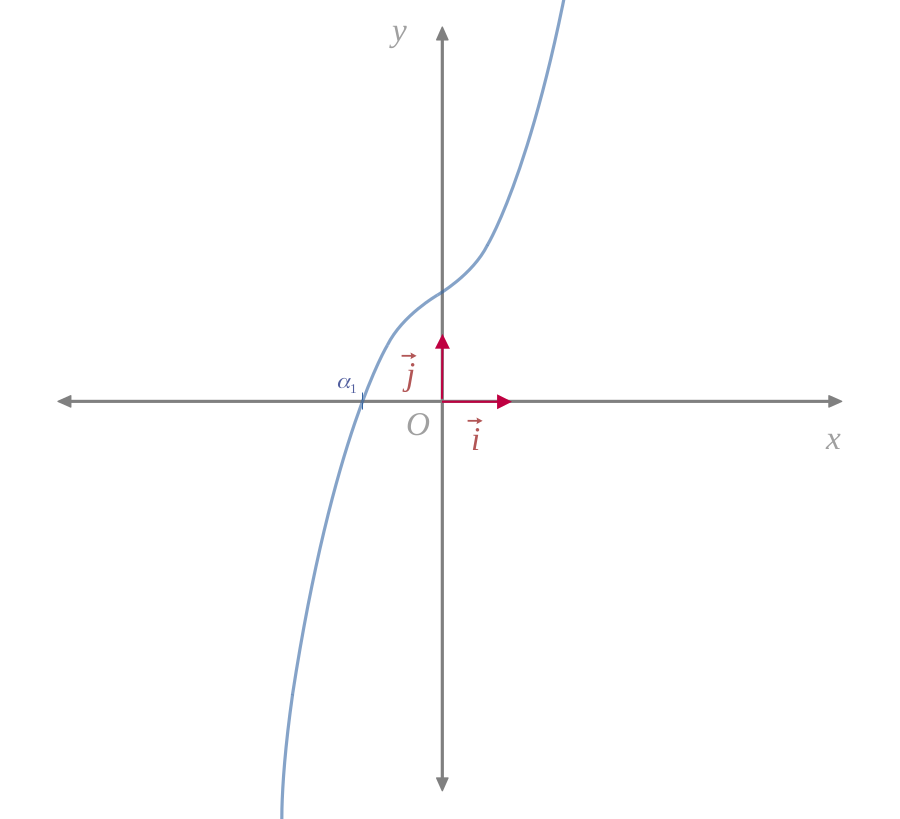
-
or both negative
According to the variation table of \(f\), there will be only one real root, located between \((\chi = \chi_2)\) and \((\chi = +\infty)\).
$$ \chi $$$$ -\infty $$$$ \chi_1 = -\sqrt{- \frac{p}{3}} $$$$ \chi_2 = \sqrt{- \frac{p}{3}} $$$$ \textcolor{#6187B2}{\alpha_1} $$$$ +\infty $$$$ f(\chi) = \chi^3 + p\chi + q $$$$ - \infty $$
$$ \textcolor{rgb(232 124 124)}{f(\chi_1) < 0} $$
$$ \textcolor{rgb(232 124 124)}{f(\chi_2) < 0} $$
$$ \textcolor{#6187B2}{f(\alpha_1) = 0} $$$$ + \infty $$
In both cases, there will be only one real root .
-
etiher both positive
-
\( \beta) \) if \( \Delta_3 = 0 \)
If the discriminant is zero, this means that one of the two images is zero, because according to the variation table, we always have:
$$ f(\chi_1) > f(\chi_2) $$-
\( f(\chi_1) = 0 \)
In this case, there will be a double root for \((\chi = \chi_1)\), and another root for \((\chi_2 < \chi < +\infty)\).
$$ \chi $$$$ -\infty $$$$ \textcolor{#6187B2}{\alpha_1 / \alpha_2 = \chi_1} $$$$ \chi_2 = \sqrt{- \frac{p}{3}} $$$$ \textcolor{#6187B2}{\alpha_3} $$$$ +\infty $$$$ f(\chi) = \chi^3 + p\chi + q $$$$ - \infty $$
$$ \textcolor{#6187B2}{f(\chi_1) = 0} $$
$$ \textcolor{rgb(232 124 124)}{f(\chi_2) < 0} $$
$$ \textcolor{#6187B2}{f(\chi_2) = 0} $$$$ + \infty $$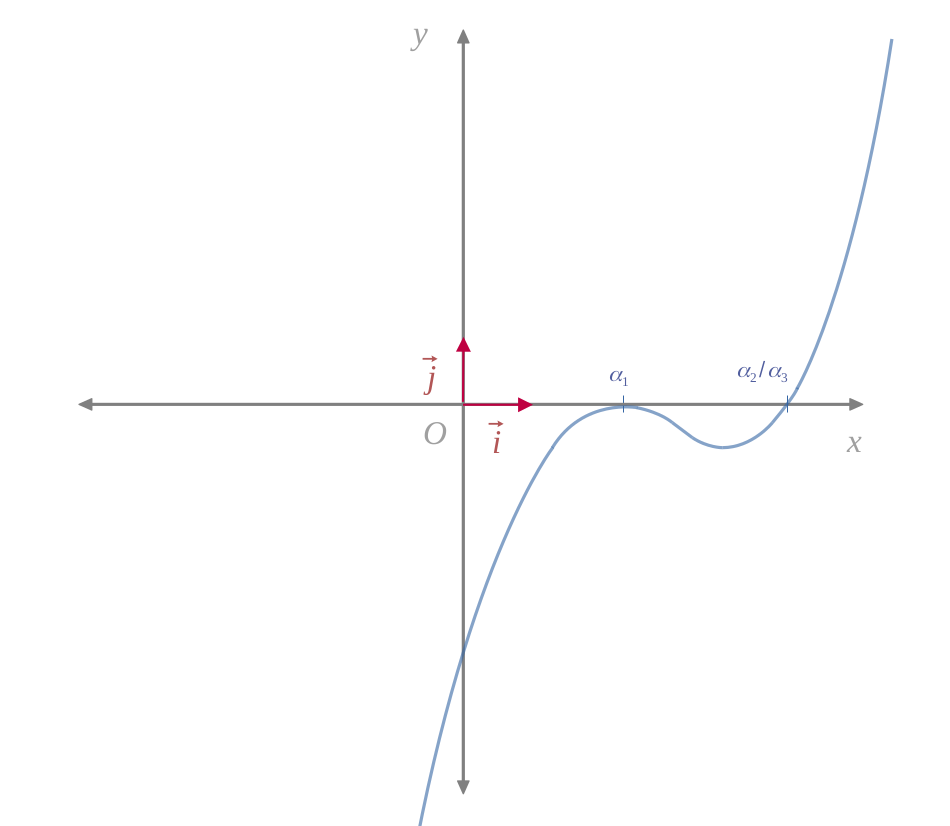
-
\( f(\chi_2) = 0 \)
Dans ce cas symétrique, il y aura une racine simple pour \((\chi_2 < \chi < +\infty)\), ainsi qu'une racine double pour \((\chi = \chi_1)\).
$$ \chi $$$$ -\infty $$$$ \textcolor{#6187B2}{\alpha_1} $$$$ \chi_1 = -\sqrt{- \frac{p}{3}} $$$$ \textcolor{#6187B2}{\alpha_2 / \alpha_3 = \chi_2} $$$$ +\infty $$$$ f(\chi) = \chi^3 + p\chi + q $$$$ - \infty $$
$$ \textcolor{#6187B2}{f(\alpha_1) = 0} $$$$ \textcolor{rgb(93 183 129)}{f(\chi_1) > 0} $$
$$ \textcolor{#6187B2}{f(\chi_2) = 0} $$
$$ + \infty $$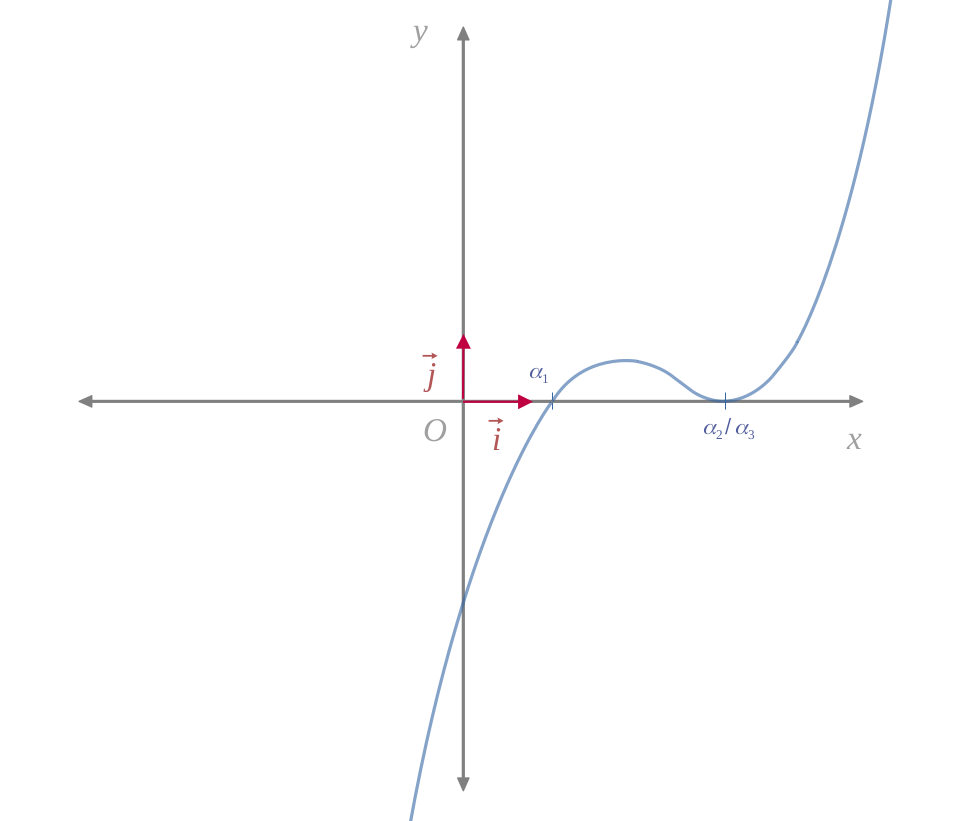
In both cases, we will have a double real root (which necessarily lies on the plateau) and a simple real root .
-
\( f(\chi_1) = 0 \)
-
\( \gamma) \) if \( \Delta_3 < 0 \)
If the discriminant is negative, the two images \(f(\chi_1)\) et \(f(\chi_2)\) are of opposite signs.
As we know that:
$$ f(\chi_1) > f(\chi_2) $$there is only one case, and we will distinguish three real roots .
$$ \chi $$$$ -\infty $$$$ \textcolor{#6187B2}{\alpha_1} $$$$ \chi_1 = -\sqrt{- \frac{p}{3}} $$$$ \textcolor{#6187B2}{\alpha_2} $$$$ \chi_2 = \sqrt{- \frac{p}{3}} $$$$ \textcolor{#6187B2}{\alpha_3} $$$$ +\infty $$$$ f(\chi) = \chi^3 + p\chi + q $$$$ - \infty $$
$$ \textcolor{#6187B2}{f(\alpha_1) = 0} $$$$ \textcolor{rgb(93 183 129)}{f(\chi_1) > 0} $$
$$ \textcolor{#6187B2}{f(\alpha_2) = 0} $$$$ \textcolor{rgb(232 124 124)}{f(\chi_2) < 0} $$
$$ \textcolor{#6187B2}{f(\alpha_3) = 0} $$$$ + \infty $$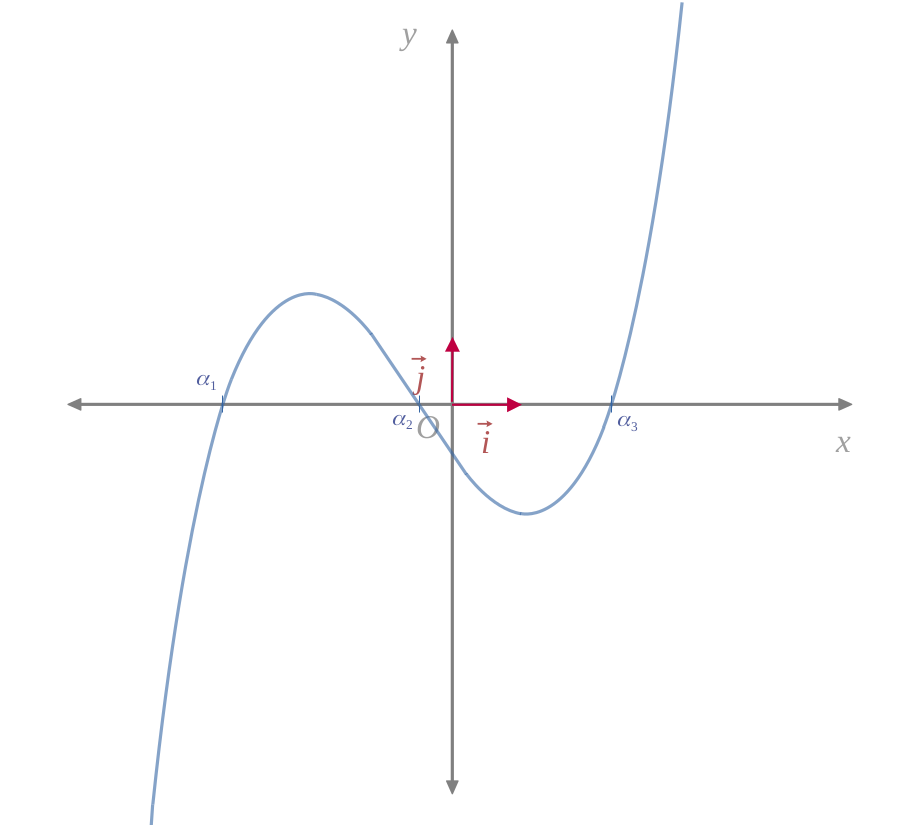
-
\( \delta) \) summary
In summary, here are the cases according to the result of the discriminant \(( \Delta_3 = q^2 + \frac{4p^3}{27} )\):
Sign of the discriminant \( \Delta_3 \)Numbers of roots$$ \Delta_3 > 0 $$1 real root$$ \Delta_3 = 0 $$3 real roots (including one double)$$ \Delta_3 < 0 $$3 real roots
Resolution
The following part will be treated using Vieta's substitution method .
Let's briefly summarize the path taken in the previous point. We started from the equation to be solved \((1)\):
Then, we factorized by \(a\) :
The \(a\) factor not changing the roots, we can get rid of it:
and make a first change of variable.
Having posed the change of variable:
We then arrived at:
We now pose a new change of variable:
Which gives us:
We develop the expression:
Now multiplying by \(w^3\), we obtain that:
We now have a second-degree equation by once again introducing a new variable:
Finally, we put down:
So, the expression\((4^*)\) now becomes:
With this second-degree equation , we can calculate the second degree discriminant, which we will call as above \(\Delta_3\) :
-
if \( (\Delta_3 > 0) \)
With the equation \((6)\):
$$ z^2 + qz - \frac{p^3}{27} = 0 \qquad (6) $$If \( (\Delta_3 > 0) \), we obtain two real solutions:
$$ z_1 / z_2 = \frac{- q \pm \ \sqrt{\Delta_3}}{2} $$$$ \Bigl(\text{with } \ \Delta_3 = q^2 + \frac{4p^3}{27} \Bigr) $$Which can be arranged in:
$$ z_1 / z_2 = -\frac{q}{2} \pm \frac{ \sqrt{q^2 + \frac{4p^3}{27}}}{2} $$$$ z_1 / z_2 = -\frac{q}{2} \pm \frac{ \sqrt{q^2 + \frac{4p^3}{27}}}{\sqrt{4}} $$$$ z_1 / z_2 = -\frac{q}{2} \pm \sqrt{\frac{q^2}{4} + \frac{p^3}{27} } $$$$ z_1 / z_2 = -\frac{q}{2} \pm \sqrt{\left(\frac{q}{2}\right)^2 + \left( \frac{p}{3} \right)^3 } $$We made these different variable changes as a result:
$$ \left[ X = \chi - \frac{b}{3a} \right] \ puis \ \biggl[ \chi = w - \frac{p}{3w} \biggr] \ puis \ \Bigl[ w^3 = z \Bigr] $$You must therefore reassemble them in the opposite direction:
$$ \Bigl[ z \longmapsto w \Bigr] \ puis \ \Bigl[ w \longmapsto \chi \Bigr] \ puis \ \Bigl[ \chi \longmapsto X \Bigr] $$-
\(z \longmapsto w \)
Taking the cube root of \(z\), we will have as coefficient the three roots of unity which are three unit roots of a complex number which are \( \Bigl \{1, \ e^{\frac{2i\pi}{3}}, \ e^{-\frac{2i\pi}{3}} \Bigr \} \), which gives us six roots in all:
$$ w_1 / w_2 = \sqrt[3]{-\frac{q}{2} \pm \sqrt{\left(\frac{q}{2}\right)^2 + \left( \frac{p}{3} \right)^3 }} $$$$ w_3 / w_4 = e^{\frac{2i\pi}{3}}\sqrt[3]{-\frac{q}{2} \pm \sqrt{\left(\frac{q}{2}\right)^2 + \left( \frac{p}{3} \right)^3 }} $$$$ w_5 / w_6 = e^{-\frac{2i\pi}{3}}\sqrt[3]{-\frac{q}{2} \pm \sqrt{\left(\frac{q}{2}\right)^2 + \left( \frac{p}{3} \right)^3 }} $$ -
\(w \longmapsto \chi \)
The six expressions then become:
$$ \chi_1 / \chi_2 = \sqrt[3]{-\frac{q}{2} \pm \sqrt{\left(\frac{q}{2}\right)^2 + \left( \frac{p}{3} \right)^3 }} - \frac{p}{3\sqrt[3]{-\frac{q}{2} \pm \sqrt{\left(\frac{q}{2}\right)^2 + \left( \frac{p}{3} \right)^3 }}} $$$$ \chi_3 / \chi_4 = e^{\frac{2i\pi}{3}} \sqrt[3]{-\frac{q}{2} \pm \sqrt{\left(\frac{q}{2}\right)^2 + \left( \frac{p}{3} \right)^3 }} - \frac{p}{3 e^{\frac{2i\pi}{3}}\sqrt[3]{-\frac{q}{2} \pm \sqrt{\left(\frac{q}{2}\right)^2 + \left( \frac{p}{3} \right)^3 }}} $$$$ \chi_5 / \chi_6 = e^{-\frac{2i\pi}{3}} \sqrt[3]{-\frac{q}{2} \pm \sqrt{\left(\frac{q}{2}\right)^2 + \left( \frac{p}{3} \right)^3 }} - \frac{p}{3 e^{-\frac{2i\pi}{3}}\sqrt[3]{-\frac{q}{2} \pm \sqrt{\left(\frac{q}{2}\right)^2 + \left( \frac{p}{3} \right)^3 }}} $$Then, we multiply the numerators and denominators by their respective conjugates.
For the first pair of solutions \(\chi_1 / \chi_2 \) :
$$ \chi_1 / \chi_2 = \sqrt[3]{-\frac{q}{2} \pm \sqrt{\left(\frac{q}{2}\right)^2 + \left( \frac{p}{3} \right)^3 }} - \frac{p \textcolor{rgb(232 124 124)}{\sqrt[3]{-\frac{q}{2} \mp \sqrt{\left(\frac{q}{2}\right)^2 + \left( \frac{p}{3} \right)^3 }}} }{3\sqrt[3]{-\frac{q}{2} \pm \sqrt{\left(\frac{q}{2}\right)^2 + \left( \frac{p}{3} \right)^3 }} \textcolor{rgb(232 124 124)}{\sqrt[3]{-\frac{q}{2} \mp \sqrt{\left(\frac{q}{2}\right)^2 + \left( \frac{p}{3} \right)^3 }}} } $$$$ \chi_1 / \chi_2 = \sqrt[3]{-\frac{q}{2} \pm \sqrt{\left(\frac{q}{2}\right)^2 + \left( \frac{p}{3} \right)^3 }} - \frac{p \sqrt[3]{-\frac{q}{2} \mp \sqrt{\left(\frac{q}{2}\right)^2 + \left( \frac{p}{3} \right)^3 }} }{3\sqrt[3]{\left( -\frac{q}{2} \right)^2 - \left(\left(\frac{q}{2}\right)^2 + \left( \frac{p}{3} \right)^3 \right) } } $$$$ \chi_1 / \chi_2 = \sqrt[3]{-\frac{q}{2} \pm \sqrt{\left(\frac{q}{2}\right)^2 + \left( \frac{p}{3} \right)^3 }} - \frac{p \sqrt[3]{-\frac{q}{2} \mp \sqrt{\left(\frac{q}{2}\right)^2 + \left( \frac{p}{3} \right)^3 }} }{3\sqrt[3]{\underbrace{\left(\frac{q}{2} \right)^2 - \left(\frac{q}{2}\right)^2 } _\text{= 0} - \left( \frac{p}{3} \right)^3 } } $$$$ \chi_1 / \chi_2 = \sqrt[3]{-\frac{q}{2} \pm \sqrt{\left(\frac{q}{2}\right)^2 + \left( \frac{p}{3} \right)^3 }} - \frac{p \sqrt[3]{-\frac{q}{2} \mp \sqrt{\left(\frac{q}{2}\right)^2 + \left( \frac{p}{3} \right)^3 }} }{3\sqrt[3]{ \left(- \frac{p}{3} \right)^3 } } $$$$ \chi_1 / \chi_2 = \sqrt[3]{-\frac{q}{2} \pm \sqrt{\left(\frac{q}{2}\right)^2 + \left( \frac{p}{3} \right)^3 }} - \frac{p \sqrt[3]{-\frac{q}{2} \mp \sqrt{\left(\frac{q}{2}\right)^2 + \left( \frac{p}{3} \right)^3 }} }{-\frac{3p}{3}} $$$$ \chi_1 / \chi_2 = \sqrt[3]{-\frac{q}{2} \pm \sqrt{\left(\frac{q}{2}\right)^2 + \left( \frac{p}{3} \right)^3 }} + \sqrt[3]{-\frac{q}{2} \mp \sqrt{\left(\frac{q}{2}\right)^2 + \left( \frac{p}{3} \right)^3 }} $$These two roots are actually one, because of double signs \(\pm\) and \(\mp \) present in each of the first two terms:
$$ \chi_1 = \chi_2 = \sqrt[3]{-\frac{q}{2} + \sqrt{\left(\frac{q}{2}\right)^2 + \left( \frac{p}{3} \right)^3 }} + \sqrt[3]{-\frac{q}{2} - \sqrt{\left(\frac{q}{2}\right)^2 + \left( \frac{p}{3} \right)^3 }} $$For the other two pairs of solutions \((\chi_3 / \chi_4, \ \chi_5 / \chi_6)\) , we follow the same approach, and after calculations we arrive at the following forms:
$$ \chi_3 / \chi_4 = e^{\frac{2i\pi}{3}}\sqrt[3]{-\frac{q}{2} \pm \sqrt{\left(\frac{q}{2}\right)^2 + \left( \frac{p}{3} \right)^3 }} + e^{-\frac{2i\pi}{3}}\sqrt[3]{-\frac{q}{2} \mp \sqrt{\left(\frac{q}{2}\right)^2 + \left( \frac{p}{3} \right)^3 }} $$$$ \chi_5 / \chi_6 = e^{-\frac{2i\pi}{3}}\sqrt[3]{-\frac{q}{2} \pm \sqrt{\left(\frac{q}{2}\right)^2 + \left( \frac{p}{3} \right)^3 }} + e^{\frac{2i\pi}{3}}\sqrt[3]{-\frac{q}{2} \mp \sqrt{\left(\frac{q}{2}\right)^2 + \left( \frac{p}{3} \right)^3 }} $$For them too, we can group them together because they are two by two identical:
$$ X_3 = X_6 = e^{\frac{2i\pi}{3}} \ \sqrt[3]{-\frac{q}{2} + \sqrt{\left(\frac{q}{2}\right)^2 + \left( \frac{p}{3} \right)^3 }} + e^{-\frac{2i\pi}{3}} \ \sqrt[3]{-\frac{q}{2} - \sqrt{\left(\frac{q}{2}\right)^2 + \left( \frac{p}{3} \right)^3 }} $$$$ X_4 = X_5 = e^{\frac{2i\pi}{3}} \ \sqrt[3]{-\frac{q}{2} - \sqrt{\left(\frac{q}{2}\right)^2 + \left( \frac{p}{3} \right)^3 }} + e^{-\frac{2i\pi}{3}} \ \sqrt[3]{-\frac{q}{2} + \sqrt{\left(\frac{q}{2}\right)^2 + \left( \frac{p}{3} \right)^3 }} $$ -
\(\chi \longmapsto X \)
For this last step, we just have to add to each solution the term \(-\frac{b}{3a}\).
$$ X_1 = X_2 = \sqrt[3]{-\frac{q}{2} \pm \sqrt{\left(\frac{q}{2}\right)^2 + \left( \frac{p}{3} \right)^3 }} + \sqrt[3]{-\frac{q}{2} \mp \sqrt{\left(\frac{q}{2}\right)^2 + \left( \frac{p}{3} \right)^3 }} -\frac{b}{3a} $$$$ X_3 = X_6 = e^{\frac{2i\pi}{3}} \ \sqrt[3]{-\frac{q}{2} + \sqrt{\left(\frac{q}{2}\right)^2 + \left( \frac{p}{3} \right)^3 }} + e^{-\frac{2i\pi}{3}} \ \sqrt[3]{-\frac{q}{2} - \sqrt{\left(\frac{q}{2}\right)^2 + \left( \frac{p}{3} \right)^3 }} -\frac{b}{3a} $$$$ X_4 = X_5 = e^{\frac{2i\pi}{3}} \ \sqrt[3]{-\frac{q}{2} - \sqrt{\left(\frac{q}{2}\right)^2 + \left( \frac{p}{3} \right)^3 }} + e^{-\frac{2i\pi}{3}} \ \sqrt[3]{-\frac{q}{2} + \sqrt{\left(\frac{q}{2}\right)^2 + \left( \frac{p}{3} \right)^3 }} -\frac{b}{3a} $$ -
conclusion
We saw this equality above:
$$ \frac{- q \pm \ \sqrt{\Delta_3}}{2} = -\frac{q}{2} \pm \sqrt{\left(\frac{q}{2}\right)^2 + \left( \frac{p}{3} \right)^3 } $$So, we put this equality back in place for the presentation of the solutions.
In this case of \( (\Delta_3 > 0) \) we then have that:
-
a simple real root$$ X_1 = \sqrt[3]{\frac{-q + \sqrt{\Delta_3}}{2}} + \sqrt[3]{\frac{-q - \sqrt{\Delta_3}}{2}} - \frac{b}{3a} $$
-
two complex roots$$ C_2 = e^{\frac{2i\pi}{3}} \ \ \sqrt[3]{\frac{-q - \sqrt{\Delta_3}}{2}} + e^{-\frac{2i\pi}{3}} \ \ \sqrt[3]{\frac{-q + \sqrt{\Delta_3}}{2}} - \frac{b}{3a} $$$$ C_3 = e^{\frac{2i\pi}{3}} \ \ \sqrt[3]{\frac{-q + \sqrt{\Delta_3}}{2}} + e^{-\frac{2i\pi}{3}} \ \ \sqrt[3]{\frac{-q - \sqrt{\Delta_3}}{2}} - \frac{b}{3a} $$
$$ \text{with } \ \left(\Delta_3 = q^2 + \frac{4p^3}{27} \right) $$$$ et \ \left \{ \begin{gather*} p = \frac{-b^2 + 3ac}{3a^2} \\ \\ q = \frac{2b^3 + 27a^2d - 9abc}{27a^3} \end{gather*} \right \} $$Hence, the polynomial \(P_3(X)\) admits the following factorization:
$$ P_3(X) = a(X - X_1)(X - C_2)(X - C_3) $$ -
-
-
if \( (\Delta_3 = 0) \)
With the equation \((6)\):
$$ z^2 + qz - \frac{p^3}{27} = 0 \qquad (6) $$if \( (\Delta_3 = 0) \), we have a real double solution:
$$ z_0 = -\frac{q}{2} $$In the same way as above, we go back through the different variable changes one after the other.
-
\(z \longmapsto w \)
$$ w_1 = \sqrt[3]{-\frac{q}{2}} $$$$ w_2 = e^{\frac{2i\pi}{3}}\sqrt[3]{-\frac{q}{2}} $$$$ w_3 = e^{-\frac{2i\pi}{3}}\sqrt[3]{-\frac{q}{2}} $$ -
\(w \longmapsto \chi \)
For the fisrt solution \(\chi_1 \) :
$$ \chi_1 = \sqrt[3]{-\frac{q}{2}} - \frac{p}{3\sqrt[3]{-\frac{q}{2}}}$$$$ \chi_1 = \sqrt[3]{-\frac{q}{2}} - \frac{p}{3\sqrt[3]{-\frac{q}{2}}} $$$$ \chi_1 = \sqrt[3]{-\frac{q}{2}} - \frac{p}{3}\frac{\textcolor{rgb(232 124 124)}{\sqrt[3]{\left(-\frac{q}{2} \right)^2}}}{\sqrt[3]{-\frac{q}{2}} \textcolor{rgb(232 124 124)}{\sqrt[3]{\left(-\frac{q}{2} \right)^2}}} $$$$ \chi_1 = \sqrt[3]{-\frac{q}{2}} - \frac{p}{3}\frac{\sqrt[3]{\left(-\frac{q}{2} \right)^2}}{-\frac{q}{2}} $$But as:
$$ \sqrt{\left(\frac{q}{2}\right)^2 + \left( \frac{p}{3} \right)^3 } = \frac{\Delta_3}{2} $$(voir plus haut)
And that we have as hypothesis that \( \Delta_3 = 0 \), then:
$$\Delta_3 = 0 \Longrightarrow 2 \sqrt{\left(\frac{q}{2}\right)^2 + \left( \frac{p}{3} \right)^3 } = 0 $$And so that:
$$\sqrt{\left(\frac{q}{2}\right)^2 + \left( \frac{p}{3} \right)^3 } = 0 $$Which also implies that:
$$\left(\frac{q}{2}\right)^2 + \left( \frac{p}{3} \right)^3 = 0 $$$$\left(\frac{q}{2}\right)^2 = - \left( \frac{p}{3} \right)^3 $$$$\sqrt[3]{ \left(\frac{q}{2}\right)^2 } = \sqrt[3]{ - \left( \frac{p}{3} \right)^3 } $$$$\sqrt[3]{ \left(\frac{q}{2}\right)^2 } = -\frac{p}{3} $$We can then replace in the previous expression:
$$ \chi_1 = \sqrt[3]{-\frac{q}{2}} - \frac{p}{3}\frac{\sqrt[3]{\left(-\frac{q}{2} \right)^2}}{-\frac{q}{2}} $$$$ \chi_1 = \sqrt[3]{-\frac{q}{2}} + \frac{ \sqrt[3]{ \left(\frac{q}{2}\right)^2 } \sqrt[3]{\left(-\frac{q}{2} \right)^2}}{-\frac{q}{2}} $$$$ \chi_1 = \sqrt[3]{-\frac{q}{2}} + \frac{ \sqrt[3]{ \left(-\frac{q}{2}\right)^2 } \sqrt[3]{\left(-\frac{q}{2} \right)^2}}{-\frac{q}{2}} $$Now, we can make the power formulas work:
$$ \chi_1 = \sqrt[3]{-\frac{q}{2}} + \left(-\frac{q}{2}\right)^{\frac{4}{3}} \left(-\frac{q}{2}\right)^{-1 } $$$$ \chi_1 = \sqrt[3]{-\frac{q}{2}} + \left(-\frac{q}{2}\right)^{\frac{1}{3}} $$$$ \chi_1 = 2\sqrt[3]{-\frac{q}{2}} $$For the other two solutions :
$$ w_2 = e^{\frac{2i\pi}{3}}\sqrt[3]{-\frac{q}{2}} \chi_2 = e^{\frac{2i\pi}{3}}\sqrt[3]{-\frac{q}{2}} + e^{-\frac{2i\pi}{3}}\sqrt[3]{-\frac{q}{2}} $$$$ w_3 = e^{-\frac{2i\pi}{3}}\sqrt[3]{-\frac{q}{2}} \chi_3 = e^{-\frac{2i\pi}{3}}\sqrt[3]{-\frac{q}{2}} + e^{\frac{2i\pi}{3}}\sqrt[3]{-\frac{q}{2}} $$These two solutions are one and the same solution:
$$ \chi_2 = \chi_3 = e^{\frac{2i\pi}{3}}\sqrt[3]{-\frac{q}{2}} + e^{-\frac{2i\pi}{3}}\sqrt[3]{-\frac{q}{2}} $$$$ \chi_2 = \chi_3 = \sqrt[3]{-\frac{q}{2}} \left(e^{\frac{2i\pi}{3}} + e^{-\frac{2i\pi}{3}} \right) $$$$ \chi_2 = \chi_3 = -\sqrt[3]{-\frac{q}{2}} $$ -
\(\chi \longmapsto X \)
$$ X_1 = 2\sqrt[3]{-\frac{q}{2}} - \frac{b}{3a} $$$$ X_2 = X_3 = -\sqrt[3]{-\frac{q}{2}} - \frac{b}{3a} $$ -
conclusion
In this case of \( (\Delta_3 = 0) \) we then have that:
-
a simple real root$$ X_1 = 2\sqrt[3]{-\frac{q}{2}} - \frac{b}{3a} $$
-
a double real root$$ X_2 = X_3 = -\sqrt[3]{-\frac{q}{2}} - \frac{b}{3a} $$
$$ \text{with } \ \left(q = \frac{2b^3 + 27a^2d - 9abc}{27a^3} \right) $$Hence, the polynomial \(P_3(X)\) admits the following factorization:
$$ P_3(X) = a(X - X_1)(X - X_2)^2 $$
Furthermore, starting from these two expressions \((3)\) and its derivative \((4)\):
$$ \chi^3 + p\chi + q = 0 \qquad (3)$$$$ 3\chi^2 + p = 0 \qquad (4) $$$$ p = -3\chi^2 \qquad (4^*) $$Now, by substituting \((4^*)\) into \((3)\) :
$$ \chi^3 + -3\chi^2\chi + q = 0 $$$$ \chi^3 + -3\chi^3 + q = 0 $$$$ -2\chi^3 + q = 0 $$$$ \chi^3 = \frac{q}{2} \qquad (\chi^3) $$And with the previous relationship \((4^*)\), we do also have this:
$$ \chi^2 = -\frac{p}{3} \qquad (\chi^2) $$Then by multiplying by \(\chi\) on both sides:
$$ \chi^3 = -\frac{p}{3}\chi \qquad (\chi^3)^* $$Finally, with both equal expressions \((\chi^3)\) and \((\chi^3)^*\), we can deduce a relationship between \(p\) and \(q\) :
$$ \frac{q}{2} = -\frac{p}{3}\chi $$$$ \chi = -\frac{3q}{2p} \qquad \Bigl(\chi = f(p, q)\Bigr) $$But, with the expression \((\chi^3)\), we saw that:
$$ -\chi^3 = -\frac{q}{2} \qquad (\chi^3) $$So, by taking the third root, we have now:
$$ \sqrt[3]{-\chi^3} = \sqrt[3]{-\frac{q}{2}} $$$$ -\chi = \sqrt[3]{-\frac{q}{2}} $$So, by replacing with the value found in \(\Bigl(\chi = f(p, q)\Bigr)\), we finally determined that:
$$ \frac{3q}{2p} = \sqrt[3]{-\frac{q}{2}} $$We can now replace the value of \(\sqrt[3]{-\frac{q}{2}}\) by \(-\frac{3q}{2p}\) in the three relationships \(X_1\), \(X_2\) and \(X_3\).
So, these three solutions can also be written as:
-
a simple real root$$ X_1 = \frac{3q}{p} - \frac{b}{3a} $$
-
a double real root$$ X_2 = X_3 = \frac{3q}{2p} - \frac{b}{3a} $$
-
-
-
if \( (\Delta_3 < 0) \)
With the equation \((6)\):
$$ z^2 + qz - \frac{p^3}{27} = 0 \qquad (6) $$If \( (\Delta_3 < 0) \), we do obtain two complex solutions:
$$ z_1 = \frac{- q \pm i\sqrt{|\Delta_3|}}{2} $$Which can be arranged as previously in:
$$ z_1 / z_2 = -\frac{q}{2} \pm i\sqrt{\left| \left(\frac{q}{2}\right)^2 + \left( \frac{p}{3} \right)^3 \right| } $$In the same way as above, we go back through the different variable changes one after the other.
-
\(z \longmapsto w \)
$$ w_1 / w_2 = \sqrt[3]{-\frac{q}{2} \ \pm \ i\sqrt{\left| \left(\frac{q}{2}\right)^2 + \left( \frac{p}{3} \right)^3 \right| }} $$$$ w_3 / w_4 = e^{\frac{2i\pi}{3}}\sqrt[3]{-\frac{q}{2} \ \pm \ i\sqrt{\left| \left(\frac{q}{2}\right)^2 + \left( \frac{p}{3} \right)^3 \right| }} $$$$ w_5 / w_6 = e^{-\frac{2i\pi}{3}}\sqrt[3]{-\frac{q}{2} \ \pm \ i\sqrt{\left| \left(\frac{q}{2}\right)^2 + \left( \frac{p}{3} \right)^3 \right| }} $$ -
\(w \longmapsto \chi \)
The six expressions then become:
$$ \chi_1 / \chi_2 = \sqrt[3]{-\frac{q}{2} \ \pm \ i\sqrt{\left| \left(\frac{q}{2}\right)^2 + \left( \frac{p}{3} \right)^3 \right| }} - \frac{p}{3\sqrt[3]{-\frac{q}{2} \ \pm \ i\sqrt{\left| \left(\frac{q}{2}\right)^2 + \left( \frac{p}{3} \right)^3 \right| }}} $$$$ \chi_3 / \chi_4 = e^{\frac{2i\pi}{3}} \sqrt[3]{-\frac{q}{2} \ \pm \ i\sqrt{\left| \left(\frac{q}{2}\right)^2 + \left( \frac{p}{3} \right)^3 \right| }} - \frac{p}{3 e^{\frac{2i\pi}{3}}\sqrt[3]{-\frac{q}{2} \ \pm \ i\sqrt{\left| \left(\frac{q}{2}\right)^2 + \left( \frac{p}{3} \right)^3 \right| }}} $$$$ \chi_5 / \chi_6 = e^{-\frac{2i\pi}{3}} \sqrt[3]{-\frac{q}{2} \ \pm \ i\sqrt{\left| \left(\frac{q}{2}\right)^2 + \left( \frac{p}{3} \right)^3 \right| }} - \frac{p}{3 e^{-\frac{2i\pi}{3}}\sqrt[3]{-\frac{q}{2} \ \pm \ i\sqrt{\left| \left(\frac{q}{2}\right)^2 + \left( \frac{p}{3} \right)^3 \right| }}} $$For the first couple of solutions \(\chi_1 / \chi_2 \) :
$$ \chi_1 / \chi_2 = \sqrt[3]{-\frac{q}{2} \ \pm \ i\sqrt{\left| \left(\frac{q}{2}\right)^2 + \left( \frac{p}{3} \right)^3 \right| }} - \frac{p \textcolor{rgb(232 124 124)}{\sqrt[3]{-\frac{q}{2} \ \mp\ i\sqrt{\left| \left(\frac{q}{2}\right)^2 + \left( \frac{p}{3} \right)^3 \right| }}} }{3\sqrt[3]{-\frac{q}{2} \ \pm \ i\sqrt{\left| \left(\frac{q}{2}\right)^2 + \left( \frac{p}{3} \right)^3 \right| }} \textcolor{rgb(232 124 124)}{\sqrt[3]{-\frac{q}{2} \ \mp\ i\sqrt{\left| \left(\frac{q}{2}\right)^2 + \left( \frac{p}{3} \right)^3 \right| }}} } $$$$ \chi_1 / \chi_2 = \sqrt[3]{-\frac{q}{2} \ \pm \ i\sqrt{\left| \left(\frac{q}{2}\right)^2 + \left( \frac{p}{3} \right)^3 \right| }} - \frac{p \sqrt[3]{-\frac{q}{2} \ \mp\ i\sqrt{\left| \left(\frac{q}{2}\right)^2 + \left( \frac{p}{3} \right)^3 \right| }} }{3\sqrt[3]{\left( -\frac{q}{2} \right)^2 + \left|\left(\frac{q}{2}\right)^2 + \left( \frac{p}{3} \right)^3 \right| } } $$$$ \chi_1 / \chi_2 = \sqrt[3]{-\frac{q}{2} \ \pm \ i\sqrt{\left| \left(\frac{q}{2}\right)^2 + \left( \frac{p}{3} \right)^3 \right| }} - \frac{p \sqrt[3]{-\frac{q}{2} \ \mp\ i\sqrt{\left| \left(\frac{q}{2}\right)^2 + \left( \frac{p}{3} \right)^3 \right| }} }{3\sqrt[3]{\left( -\frac{q}{2} \right)^2 + -\left(\frac{q}{2}\right)^2 - \left( \frac{p}{3} \right)^3 } } $$$$ \chi_1 / \chi_2 = \sqrt[3]{-\frac{q}{2} \ \pm \ i\sqrt{\left| \left(\frac{q}{2}\right)^2 + \left( \frac{p}{3} \right)^3 \right| }} - \frac{p \sqrt[3]{-\frac{q}{2} \ \mp\ i\sqrt{\left| \left(\frac{q}{2}\right)^2 + \left( \frac{p}{3} \right)^3 \right| }} }{3\sqrt[3]{\underbrace{\left(\frac{q}{2} \right)^2 + -\left(\frac{q}{2}\right)^2} _\text{ = 0 } - \left( \frac{p}{3} \right)^3 } } $$$$ \chi_1 / \chi_2 = \sqrt[3]{-\frac{q}{2} \ \pm \ i\sqrt{\left| \left(\frac{q}{2}\right)^2 + \left( \frac{p}{3} \right)^3 \right| }} - \frac{p \sqrt[3]{-\frac{q}{2} \ \mp\ i\sqrt{\left| \left(\frac{q}{2}\right)^2 + \left( \frac{p}{3} \right)^3 \right| }} }{3\sqrt[3]{- \left( \frac{p}{3} \right)^3 } } $$$$ \chi_1 / \chi_2 = \sqrt[3]{-\frac{q}{2} \ \pm \ i\sqrt{\left| \left(\frac{q}{2}\right)^2 + \left( \frac{p}{3} \right)^3 \right| }} - \frac{p \sqrt[3]{-\frac{q}{2} \ \mp\ i\sqrt{\left| \left(\frac{q}{2}\right)^2 + \left( \frac{p}{3} \right)^3 \right| }} }{-\frac{3p}{3}} $$$$ \chi_1 / \chi_2 = \sqrt[3]{-\frac{q}{2} \ \pm \ i\sqrt{\left| \left(\frac{q}{2}\right)^2 + \left( \frac{p}{3} \right)^3 \right| }} + \sqrt[3]{-\frac{q}{2} \ \mp\ i\sqrt{\left| \left(\frac{q}{2}\right)^2 + \left( \frac{p}{3} \right)^3 \right| }} $$These two solutions are one and the same solution.
$$ \chi_1 = \chi_2 = \sqrt[3]{-\frac{q}{2} \ + \ i\sqrt{\left| \left(\frac{q}{2}\right)^2 + \left( \frac{p}{3} \right)^3 \right| }} + \sqrt[3]{-\frac{q}{2} \ - \ i\sqrt{\left| \left(\frac{q}{2}\right)^2 + \left( \frac{p}{3} \right)^3 \right| }} $$For the other two pairs of solutions \((\chi_3 / \chi_4, \ \chi_5 / \chi_6)\) , we follow the same approach, and after calculations we arrive at the following forms:
$$ \chi_3 / \chi_4 = e^{\frac{2i\pi}{3}}\sqrt[3]{-\frac{q}{2} \ + \ i\sqrt{\left| \left(\frac{q}{2}\right)^2 + \left( \frac{p}{3} \right)^3 \right| }} + e^{-\frac{2i\pi}{3}}\sqrt[3]{-\frac{q}{2} \ - \ i\sqrt{\left| \left(\frac{q}{2}\right)^2 + \left( \frac{p}{3} \right)^3 \right| }} $$$$ \chi_5 / \chi_6 = e^{-\frac{2i\pi}{3}}\sqrt[3]{-\frac{q}{2} \ + \ i\sqrt{\left| \left(\frac{q}{2}\right)^2 + \left( \frac{p}{3} \right)^3 \right| }} + e^{\frac{2i\pi}{3}}\sqrt[3]{-\frac{q}{2} \ - \ i\sqrt{\left| \left(\frac{q}{2}\right)^2 + \left( \frac{p}{3} \right)^3 \right| }} $$ -
\(\chi \longmapsto X \)
$$ X_1 = X_2 = \sqrt[3]{-\frac{q}{2} \ + \ i\sqrt{\left| \left(\frac{q}{2}\right)^2 + \left( \frac{p}{3} \right)^3 \right| }} + \sqrt[3]{-\frac{q}{2} \ - i\sqrt{\left| \left(\frac{q}{2}\right)^2 + \left( \frac{p}{3} \right)^3 \right| }} - \frac{b}{3a} $$$$ \chi_3 = \chi_4 = e^{\frac{2i\pi}{3}}\sqrt[3]{-\frac{q}{2} \ + \ i\sqrt{\left| \left(\frac{q}{2}\right)^2 + \left( \frac{p}{3} \right)^3 \right| }} + e^{-\frac{2i\pi}{3}}\sqrt[3]{-\frac{q}{2} \ - \ i\sqrt{\left| \left(\frac{q}{2}\right)^2 + \left( \frac{p}{3} \right)^3 \right| }} - \frac{b}{3a} $$$$ \chi_5 = \chi_6 = e^{\frac{2i\pi}{3}}\sqrt[3]{-\frac{q}{2} \ - \ i\sqrt{\left| \left(\frac{q}{2}\right)^2 + \left( \frac{p}{3} \right)^3 \right| }} + e^{-\frac{2i\pi}{3}}\sqrt[3]{-\frac{q}{2} \ + \ i\sqrt{\left| \left(\frac{q}{2}\right)^2 + \left( \frac{p}{3} \right)^3 \right| }} - \frac{b}{3a} $$ -
conclusion
In the same way as above, we get rid of the absolute value in the presentation of the results.
In this case of \( (\Delta_3 < 0) \) we then have that:
-
three real roots$$ X_1 = \sqrt[3]{\frac{-q \ + \ i\sqrt{-\Delta_3}}{2}} + \sqrt[3]{\frac{-q \ - \ i\sqrt{-\Delta_3}}{2}} - \frac{b}{3a} $$$$ X_2 = e^{\frac{2i\pi}{3}}\sqrt[3]{\frac{-q \ + \ i\sqrt{-\Delta_3}}{2}} + e^{-\frac{2i\pi}{3}}\sqrt[3]{\frac{-q \ - \ i\sqrt{-\Delta_3}}{2}} - \frac{b}{3a} $$$$ X_3 = e^{\frac{2i\pi}{3}}\sqrt[3]{\frac{-q \ - \ i\sqrt{-\Delta_3}}{2}} + e^{-\frac{2i\pi}{3}}\sqrt[3]{\frac{-q \ + \ i\sqrt{-\Delta_3}}{2}} - \frac{b}{3a} $$
$$ \text{with } \ \left(\Delta_3 = q^2 + \frac{4p^3}{27} \right) $$$$ et \ \left \{ \begin{gather*} p = \frac{-b^2 + 3ac}{3a^2} \\ \\ q = \frac{2b^3 + 27a^2d - 9abc}{27a^3} \end{gather*} \right \} $$Even if they appear in complex form , after solving these solutions definitely become real .
Hence, the polynomial \(P_3(X)\) admits the following factorization:
$$ P_3(X) = a(X - X_1)(X - X_2)(X - X_3) $$ -
-
Examples
-
Existence of obvious root(s)
$$ P_3(X) = X^3 + X^2 + X + 1 $$We do notice that \( (X = -1) \) is an obvious root. Let us try to find the second-degree polynomial having coefficients \((\alpha, \beta, \gamma)\) such as:
$$ P_3(X) = (X + 1)(\alpha X^2 + \beta X + \gamma) $$Let us make a polynomial division to find it:
$$ X + 1 $$$$\hspace{1em} X^3 + X^2 + X + 1 $$$$ \textcolor{rgb(93 183 129)}{X^2} $$$$ \textcolor{rgb(232 124 124)}{-X^3} \textcolor{rgb(232 124 124)}{-X^2} + X + 1 $$$$ X^2 $$$$ \hspace{1em} 0 \hspace{1.2em} + \hspace{0.2em} 0 \hspace{0.4em} \textcolor{rgb(232 124 124)}{-X - 1} $$$$ X^2 \textcolor{rgb(93 183 129)}{+ 1} $$As a result,
$$ P_3(X) = (X + 1)(X^2 + 1) $$We now seek its roots.
$$ \Delta = 0^2 - 4 \times 1 \times 1$$$$ \Delta = -4 $$As \(\Delta\) is negative, there is two complex roots:
$$ C_1 = \frac{- 0 - i\sqrt{-(-4)}}{2 \times 1} C_1 = -i $$$$ C_2 = \frac{- 0 + i\sqrt{-(-4)}}{2 \times 1} C_2 = i $$So, the solution of \( \Bigl[ P_3(X) = 0 \Bigr] \) are:
$$ \mathcal{S} = \biggl \{X_{1} = -1 , \ C_{2} = -i, \ C_{3} = i \biggr \} $$\(P_3(X) \) can than be factorized as follows:
$$ P_3(X) = (X + 1)(X + i)(X - i) $$ -
Case of a discriminant equal to zero
$$ Q_3(X) = X^3 - 5X^2 + 8X - 4 $$We compute the third-degree discriminant \(\Delta_3\):
$$ \Delta_3 = q^2 + \frac{4p^3}{27}$$$$ \Delta_3 = \left(\frac{2b^3 + 27a^2d - 9abc}{27a^3}\right)^2 + \frac{4\left(\frac{-b^2 + 3ac}{3a^2}\right)^3}{27} $$$$ \Delta_3 = 0 $$As \(\Delta\) is worth zero, we do have three real roots:
-
a simple real root$$ X_1 = 2\sqrt[3]{-\frac{q}{2}} - \frac{b}{3a} $$$$ X_1 = 1 $$
-
a double real root$$ X_2 = X_3 = -\sqrt[3]{-\frac{q}{2}} - \frac{b}{3a} $$$$ X_2 = X_3 = 2 $$
\(Q_3(X) \) can than be factorized as follows:
$$ Q_3(X) = (X - 1)(X - 2)^2 $$ -
 Back to top