Let \( \vec{u}\) and \( \vec{v}\) be two non-null vectors.
We call vector product (or cross product of two vectors) \( \vec{u} \land \vec{v} \), a new vector extracted from \( \vec{u}\) and \( \vec{v}\) such as:
$$ \Biggl \{ \begin{gather*} (\vec{u} \land \vec{v}) \perp \vec{u}, \enspace (\vec{u} \land \vec{v}) \perp \vec{v} \\ || \vec{u} \land \vec{v} || = || \vec{u} || \times ||\vec{v} || \times \sin(\vec{u}, \vec{v}) \end{gather*} $$
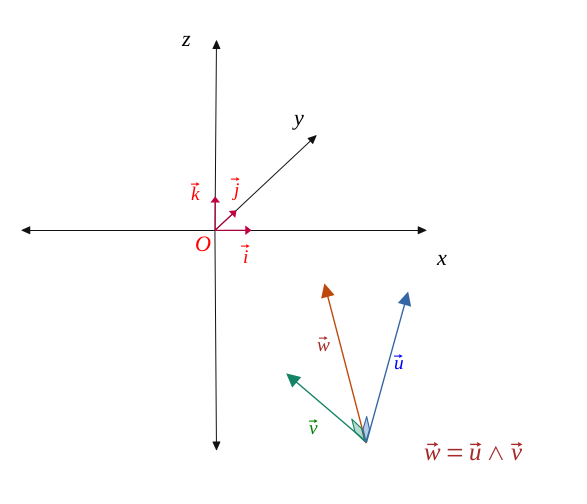
The vector product \( \vec{u} \land \vec{v} \) is
orthogonal
to both vectors \( \vec{u}\) and \( \vec{v}\).
$$ \forall \left [\vec{u}\begin{pmatrix} x_1\\ y_1\\z_1 \end{pmatrix} , \vec{v}\begin{pmatrix} x_2\\ y_2\\z_2 \end{pmatrix} \right] \neq \vec{0} \enspace (\text{with } \vec{u} \neq k \vec{v}), $$
$$ \vec{u} \land \vec{v} = \begin{pmatrix} y_1.z_2 - y_2.z_1 \\ x_2.z_1 - x_1.z_2 \\ x_1.y_2 - x_2.y_1 \end{pmatrix} $$
$$ \forall (\vec{u}, \vec{v}) \neq \vec{0},$$
$$ || \vec{u} \land \vec{v} || = || \vec{u}|| \times || \vec{v}|| \times \sin(\vec{u}, \vec{v})$$
$$ \forall (\vec{u}, \vec{v}) \neq \vec{0},$$
$$ {|| \vec{u} \land \vec{v} ||}^2 = {|| \vec{u} ||}^2 {|| \vec{v} ||}^2 - ( \vec{u} \cdot \vec{v})^2 \qquad \bigl( \text{Lagrange's identity} \bigr) $$
$$ \forall (\vec{u}, \vec{v}) \neq \vec{0},$$
$$ \vec{u} \text{ and } \vec{v} \text{ collinear } \Longleftrightarrow \vec{u} \land \vec{v} = \vec{0} $$
$$ \forall (\vec{u}, \vec{v}) \neq \vec{0},$$
$$ \vec{u} \land \vec{v} = - \ \vec{v} \land \vec{u} $$
$$ \forall (\vec{u}, \vec{v}, \vec{w}) \neq \vec{0},$$
$$ \vec{u} \land ( \vec{v} + \vec{w}) = \vec{u} \land \vec{v} + \vec{u} \land \vec{w} $$
And also the distributive law to the left:
$$ \forall (\vec{u}, \vec{v}, \vec{w}) \neq \vec{0},$$
$$(\vec{u} + \vec{v}) \land \vec{w}= \vec{u} \land \vec{w} + \vec{v} \land \vec{w} $$
$$ \forall \lambda \in \hspace{0.04em} \mathbb{R}, \ \forall (\vec{u}, \vec{v}) \neq \vec{0},$$
$$(\lambda\vec{u}) \land \vec{v}= \lambda (\vec{u} \land \vec{v} )= \vec{u} \land (\lambda\vec{v}) $$
$$ \forall (\vec{u}, \vec{v}, \vec{w}) \neq \vec{0},$$
$$ \vec{u} \land (\vec{v} \land \vec{w}) = \bigl(\vec{u}\cdot\vec{w}\bigr) \cdot \vec{v} - \bigl(\vec{u} \cdot \vec{v}\bigr) \cdot \vec{w} \qquad \bigl( \text{Gibbs Formula} \bigr) $$
$$ \forall (\vec{u}, \vec{v}, \vec{w}) \neq \vec{0},$$
$$ \vec{u} \land (\vec{v} \land \vec{w}) + \vec{v} \land (\vec{w} \land \vec{u}) + \vec{w} \land (\vec{u} \land \vec{v}) = \vec{0} \qquad \bigl( \text{Jacobi's identity} \bigr) $$
Click on the title to access to the recap table.
Proofs
Let \(\vec{u}\begin{pmatrix} x_1\\ y_1\\z_1 \end{pmatrix}\) and \(\vec{v}\begin{pmatrix} x_2\\ y_2\\z_2 \end{pmatrix}\) be two non-null vectors.
We are looking for a vector \( \vec{w} \begin{pmatrix} x\\ y\\z \end{pmatrix} \) orthogonal to these two vectors, and as the following figure shows it:
To obtain a fixed \(\vec{w}\), we do have to add another condition \((H)\), which is that both vectors \(\vec{u}\) and \(\vec{v}\) are non-collinear:
$$ \forall k \in \mathbb{R}, \ \vec{u} \neq k \ \vec{v} \qquad (H)$$
Which also implies that:
$$ \forall k \in \mathbb{R}, \enspace \begin{pmatrix} x_1\\ y_1\\z_1 \end{pmatrix} \neq \begin{pmatrix} k x_2\\ ky_2\\kz_2 \end{pmatrix}$$
$$ \forall k \in \mathbb{R}, \enspace \Biggl \{ \begin{gather*} x_1 \neq k x_2 \\ y_1 \neq k y_2 \\ z_1 \neq k z_2 \end{gather*} \ \Longrightarrow \ \frac{x_1}{x_2} \neq \frac{y_1}{y_2} \neq \frac{z_1}{z_2} \qquad (H') $$
The two vectors \( \vec{u}\) and \( \vec{v}\) being respectively
orthogonal
to the vector \( \vec{w}\), we do have:
$$ \Biggl \{ \begin{gather*} \vec{u}\cdot\vec{w} = 0 \\ \vec{v} \cdot \vec{w} = 0\end{gather*} $$
So,
$$ \Biggl \{ \begin{gather*} x. x_1 + y. y_1 + z. z_1 = 0 \\ x. x_2 + y. y_2 + z. z_2 = 0\end{gather*} $$
$$ \Biggl \{ \begin{gather*} x. x_1 + y. y_1 = - z. z_1 \\ x. x_2 + y. y_2 = - z. z_2 \end{gather*} $$
And then,
$$ (S) \enspace \left \{ \begin{gather*} \frac{x}{z}. x_1 + \frac{y}{z}. y_1 = - z_1 \\ \\ \frac{x}{z} . x_2 + \frac{y}{z}. y_2 = - z_2 \end{gather*} \right \} $$
Let us solve the system \((S)\).
We divide both equations respectively by \(x_1\) and \(x_2\), in order to isolate \(\frac{x}{z}\).
$$ (S) \Longleftrightarrow \left \{ \begin{gather*} \frac{x}{z} + \frac{y}{z}. \frac{y_1}{x_1} = - \frac{z_1}{x_1} \\ \\ \frac{x}{z} + \frac{y}{z}. \frac{y_2}{x_2} = - \frac{z_2}{x_2} \end{gather*} \right \} $$
$$ (S) \Longleftrightarrow \left \{ \begin{gather*} \frac{x}{z} = - \frac{y}{z}. \frac{y_1}{x_1} - \frac{z_1}{x_1} \\ \\ \frac{x}{z} = - \frac{y}{z}. \frac{y_2}{x_2} - \frac{z_2}{x_2} \end{gather*} \right \} $$
We then have a similar value for \(\frac{x}{z}\), hence the equality:
$$ - \frac{y}{z}. \frac{y_1}{x_1} - \frac{z_1}{x_1} = - \frac{y}{z}. \frac{y_2}{x_2} - \frac{z_2}{x_2} $$
$$ - \frac{y}{z}. \frac{y_1}{x_1} + \frac{y}{z}. \frac{y_2}{x_2} = \frac{z_1}{x_1} - \frac{z_2}{x_2} $$
$$ \frac{y}{z} \left(\frac{y_2}{x_2} - \frac{y_1}{x_1} \right) = \frac{z_1}{x_1} - \frac{z_2}{x_2} $$
Finally, by putting the two members under the same denominator, we do obtain:
$$ \frac{y}{z} \left(\frac{y_2.x_1}{x_1.x_2} - \frac{y_1.x_2}{x_1.x_2} \right) = \frac{z_1.x_2}{x_1.x_2} - \frac{z_2.x_1}{x_1.x_2} $$
$$ \frac{y}{z} \left(\frac{y_2.x_1 - y_1.x_2}{x_1.x_2} \right) = \frac{z_1.x_2 - z_2.x_1}{x_1.x_2} $$
$$ \frac{y}{z} = \frac{z_1.x_2 - z_2.x_1}{y_2.x_1 - y_1.x_2} \qquad (1) $$
To satisfy the expression \((1)\), we do have to ensure that:
$$ y_2.x_1 - y_1.x_2 \neq 0 $$
$$ y_2.x_1 \neq y_1.x_2 $$
$$ \frac{x_1}{x_2} \neq \frac{y_1}{y_2} $$
That is the case with the condition \((H')\) :
$$\frac{x_1}{x_2} \neq \frac{y_1}{y_2} \neq \frac{z_1}{z_2} \qquad (H') $$
Let us do the same thing for \(\frac{x}{z}\).
Starting from the initial form of \((S)\), we now divide the two equations respectively by \(y_1\) and \(y_2\).
$$ (S) \enspace \left \{ \begin{gather*} \frac{x}{z}. x_1 + \frac{y}{z}. y_1 = - z_1 \\ \\ \frac{x}{z} . x_2 + \frac{y}{z}. y_2 = - z_2 \end{gather*} \right \} $$
$$ (S) \Longleftrightarrow \left \{ \begin{gather*} \frac{x}{z}.\frac{x_1}{y_1} + \frac{y}{z} = - \frac{z_1}{y_1} \\ \\ \frac{x}{z}.\frac{x_2}{y_2} + \frac{y}{z} = - \frac{z_2}{y_2} \end{gather*} \right \} $$
$$ (S) \Longleftrightarrow \left \{ \begin{gather*} \frac{y}{z} = - \frac{x}{z}.\frac{x_1}{y_1} - \frac{z_1}{y_1} \\ \\ \frac{y}{z} = - \frac{x}{z}.\frac{x_2}{y_2} - \frac{z_2}{y_2} \end{gather*} \right \} $$
Hence the equality:
$$ - \frac{x}{z}.\frac{x_1}{y_1} - \frac{z_1}{y_1} = - \frac{x}{z}.\frac{x_2}{y_2} - \frac{z_2}{y_2} $$
$$ - \frac{x}{z}.\frac{x_1}{y_1}+ \frac{x}{z}.\frac{x_2}{y_2} = \frac{z_1}{y_1} - \frac{z_2}{y_2} $$
$$ \frac{x}{z} \left(\frac{x_2}{y_2} - \frac{x_1}{y_1} \right) = \frac{z_1}{y_1} - \frac{z_2}{y_2} $$
$$ \frac{x}{z} \left(\frac{x_2.y_1}{y_2.y_1} - \frac{x_1.y_2}{y_1.y_2} \right) = \frac{z_1.y_2}{y_1.y_2} - \frac{z_2.y_1}{y_1.y_2} $$
$$ \frac{x}{z} \left(\frac{x_2.y_1 - x_1.y_2}{y_2.y_1} \right) = \frac{z_1.y_2 - z_2.y_1}{y_1.y_2} $$
$$ \frac{x}{z} = \frac{z_1.y_2 - z_2.y_1}{x_2.y_1 - x_1.y_2} \qquad (2) $$
In the same way as previously, the equation \((2)\) is also satisfied thanks to the condition \((H')\).
Now, thanks to both equalities \((1)\) and \((2)\), we extract two new from it:
$$ \frac{y}{x_1.z_2 - x_2.z_1} = \frac{z}{x_1.y_2 - x_2.y_1} \qquad (1') $$
$$ \frac{x}{y_1.z_2 - y_2.z_1} = \frac{z}{x_1.y_2 - x_2.y_1} \qquad (2') $$
These two equalities \((1')\) and \((2')\) having a common term, so all these three ratios are equal:
$$ \frac{x}{y_1.z_2 - y_2.z_1} = \frac{y}{x_1.z_2 - x_2.z_1} = \frac{z}{x_1.y_2 - x_2.y_1} $$
The coordinates \((x, y, z)\) being themselves defined up to a constant, by applying this ratio for \( k = 1 \), we do obtain the coordinates of \( \vec{w} \):
$$ \vec{w} = \begin{pmatrix} y_1.z_2 - y_2.z_1 \\ x_2.z_1 - x_1.z_2 \\ x_1.y_2 - x_2.y_1 \end{pmatrix} $$
And as a result,
$$ \forall \left [\vec{u}\begin{pmatrix} x_1\\ y_1\\z_1 \end{pmatrix} , \vec{v}\begin{pmatrix} x_2\\ y_2\\z_2 \end{pmatrix} \right] \neq \vec{0} \enspace (\text{with } \vec{u} \neq k \vec{v}), $$
$$ \vec{u} \land \vec{v} = \begin{pmatrix} y_1.z_2 - y_2.z_1 \\ x_2.z_1 - x_1.z_2 \\ x_1.y_2 - x_2.y_1 \end{pmatrix} $$
Let \(\vec{u}\begin{pmatrix} x_1\\ y_1\\z_1 \end{pmatrix}\) and \(\vec{v}\begin{pmatrix} x_2\\ y_2\\z_2 \end{pmatrix}\) be two non-null vectors.
We know that the norm of a vector \(\vec{u}\begin{pmatrix} a\\ b\\c \end{pmatrix}\) is worth:
$$ || \vec{u} || = \sqrt{a^2 + b^2 + c^2}$$
So, using
the cartesian coordinates
seen above, we do have:
$$ || \vec{u} \land \vec{v} || = \sqrt{ \Bigl( y_1.z_2 - y_2.z_1\Bigr)^2 + \Bigl(x_2.z_1 - x_1.z_2\Bigr)^2 + \Bigl(x_1.y_2 - x_2.y_1\Bigr)^2} $$
So, by developing it:
$$ || \vec{u} \land \vec{v} || = \sqrt{ \begin{gather*} \Bigl(y_1^2.z_2^2 - 2 y_1.z_2.y_2.z_1 + y_2^2.z_1^2 \Bigr) + \Bigl(x_2^2.z_1^2 - 2 x_2.z_1.x_1.z_2 + x_1^2.z_2^2 \Bigr) + \Bigl(x_1^2.y_2^2 - 2 x_1.y_2.x_2.y_1 + x_2^2.y_1^2 \Bigr) \end{gather*} } $$
$$ || \vec{u} \land \vec{v} || = \sqrt{ \Bigl(x_1.y_2 \Bigr)^2 + \Bigl(x_1.z_2 \Bigr)^2 + \Bigl(y_1.x_2 \Bigr)^2 + \Bigl(y_1.z_2 \Bigr)^2 + \Bigl(z_1.x_2 \Bigr)^2 + \Bigl(z_1.y_2 \Bigr)^2 - 2 y_1.z_2.y_2.z_1 - 2 x_2.z_1.x_1.z_2 - 2 x_1.y_2.x_2.y_1 } $$
We notice that the left part of the square root almost corresponds to the product \( \Bigl(x_1^2 + y_1^2 + z_1^2 \Bigr) \Bigl(x_2^2 + y_2^2 + z_2^2 \Bigr)\). Effectively:
$$ \Bigl(x_1.y_2 \Bigr)^2 + \Bigl(x_1.z_2 \Bigr)^2 + \Bigl(y_1.x_2 \Bigr)^2 + \Bigl(y_1.z_2 \Bigr)^2 + \Bigl(z_1.x_2 \Bigr)^2 + \Bigl(z_1.y_2 \Bigr)^2 = \Bigl(x_1^2 + y_1^2 + z_1^2 \Bigr) \Bigl(x_2^2 + y_2^2 + z_2^2 \Bigr) - \Bigl(x_1.x_2 \Bigr)^2 - \Bigl(y_1.y_2 \Bigr)^2 - \Bigl(z_1.z_2 \Bigr)^2 $$
We then have:
$$ || \vec{u} \land \vec{v} || = \sqrt{ \Bigl(x_1^2 + y_1^2 + z_1^2 \Bigr) \Bigl(x_2^2 + y_2^2 + z_2^2 \Bigr) - \Bigl(x_1.x_2 \Bigr)^2 - \Bigl(y_1.y_2 \Bigr)^2 - \Bigl(z_1.z_2 \Bigr)^2 - 2 y_1.z_2.y_2.z_1 - 2 x_2.z_1.x_1.z_2 - 2 x_1.y_2.x_2.y_1 } $$
$$ || \vec{u} \land \vec{v} || = \sqrt{ \Bigl(x_1^2 + y_1^2 + z_1^2 \Bigr) \Bigl(x_2^2 + y_2^2 + z_2^2 \Bigr) - \biggl[ \Bigl(x_1.x_2 \Bigr)^2 + \Bigl(y_1.y_2 \Bigr)^2 + \Bigl(z_1.z_2 \Bigr)^2 + 2 \left(x_1.x_2 \right) \left(y_1.y_2 \right) + 2 \left(y_1.y_2 \right) \left(z_1.z_2 \right) + 2 \left(x_1.x_2 \right)\left(z_1.z_2 \right) \biggr] } $$
Likewise, by restoring a little order, we see another
remarkable identity
:
A
remarkable identity
of the second degree with three terms is worth:
$$ \forall (a, b, c) \in \hspace{0.04em} \mathbb{R}^3, $$
$$(a + b + c)^2 = a^2 + b^2 + c^2 + 2ab + 2bc + 2ac $$
So in our case:
$$ || \vec{u} \land \vec{v} || = \sqrt{ \Bigl(x_1^2 + y_1^2 + z_1^2 \Bigr) \Bigl(x_2^2 + y_2^2 + z_2^2 \Bigr) - \left(\underbrace{x_1 \cdot x_2 + y_1 \cdot y_2 + z_1 \cdot z_2 } _{\vec{u}\cdot\vec{v}} \right)^2 } $$
We recognize certain formulas of the
scalar product
.
$$ || \vec{u} \land \vec{v} || = \sqrt{ {|| \vec{u} ||}^2 \times {|| \vec{v} ||}^2 - \bigl( \vec{u}\cdot\vec{v} \bigr)^2 } \qquad (3) $$
$$ || \vec{u} \land \vec{v} || = \sqrt{ {|| \vec{u} ||}^2 \times {|| \vec{v} ||}^2 - \biggl[ || \vec{u}|| \times || \vec{v}|| \times \cos(\vec{u}, \vec{v})\biggr]^2 } $$
$$ || \vec{u} \land \vec{v} || = \sqrt{ \biggl( || \vec{u}|| \times || \vec{v}|| \biggr)^2 \biggl( 1 - \cos^2(\vec{u}, \vec{v})\biggr) } $$
And as a result,
$$ \forall (\vec{u}, \vec{v}) \neq \vec{0},$$
$$ || \vec{u} \land \vec{v} || = || \vec{u}|| \times || \vec{v}|| \times \sin(\vec{u}, \vec{v})$$
In the previous section, we found out the equation \((3)\):
$$ || \vec{u} \land \vec{v} || = \sqrt{ {|| \vec{u} ||}^2 \times {|| \vec{v} ||}^2 - \bigl( \vec{u}\cdot\vec{v} \bigr)^2 } \qquad (3) $$
By applying the square on both sides of this equation, we do obtain the Lagrange's identity:
$$ \forall (\vec{u}, \vec{v}) \neq \vec{0},$$
$$ {|| \vec{u} \land \vec{v} ||}^2 = {|| \vec{u} ||}^2 {|| \vec{v} ||}^2 - ( \vec{u} \cdot \vec{v})^2 \qquad \bigl( \text{Lagrange's identity} \bigr) $$
Let \(\vec{u}\begin{pmatrix} x_1\\ y_1\\z_1 \end{pmatrix}\) and \(\vec{v}\begin{pmatrix} x_2\\ y_2\\z_2 \end{pmatrix}\) be two non-null vectors.
-
From left to right implication
Let us start from the hypothesis that \(\vec{u} \) and \(\vec{v} \) are collinear.
So, we have the relationship:
$$ \exists k \in \mathbb{R}, \ \vec{u} = k\cdot \vec{v} $$
And the vector \(\vec{u}\) can be written in terms of \(\vec{v}\):
$$ \vec{u}\begin{pmatrix} x_1\\ y_1\\z_1 \end{pmatrix} = k \cdot\vec{v}\begin{pmatrix} x_2\\ y_2\\z_2 \end{pmatrix} = \vec{u}\begin{pmatrix} k . x_2 \\ k . y_2 \\ k . z_2 \end{pmatrix}$$
By determining
the coordinates
of \( \vec{u} \land \vec{v} \), we do have:
$$ \vec{u} \land \vec{v} = \begin{pmatrix} k . x_2 \\ k . y_2 \\ k . z_2 \end{pmatrix} \land \begin{pmatrix} x_2\\ y_2\\z_2 \end{pmatrix} = \begin{pmatrix} k.y_2.z_2 - y_2.k.z_2 \\ x_2.k.z_2 - k.x_2.z_2 \\ k.x_2.y_2 - x_2.k.y_2 \end{pmatrix} $$
$$ \vec{u} \land \vec{v} = \vec{0} $$
-
Reciprocal
Let us now start from the hypothesis that \(\vec{u} \land \vec{v} = \vec{0}\).
So, its norm is worth zero.
$$ || \vec{u} \land \vec{v} || = || \vec{u}|| \times || \vec{v}|| \times \sin(\vec{u}, \vec{v}) = 0$$
And as by hypothesis our two vectors are not zero, then we necessarily have:
$$ || \vec{u} \land \vec{v} || = 0 \ \Longrightarrow \ \sin(\vec{u}, \vec{v}) = 0$$
And,
$$ \forall k \in \mathbb{N}, \ \sin(\vec{u}, \vec{v}) = 0 \ \Longrightarrow \ \Biggl\{ (\vec{u}, \vec{v}) = k\pi \Biggr\} $$
Then the two vectors are collinear.
-
Conclusion
$$ \forall (\vec{u}, \vec{v}) \neq \vec{0},$$
$$ \vec{u} \text{ and } \cdot \vec{v} \text{ collinear } \Longleftrightarrow \vec{u} \land \vec{v} = \vec{0} $$
In a general way, it makes no sense to look for a unique vector orthogonal to two collinear vectors, because there exist an infinite of it.
Let \(\vec{u}\begin{pmatrix} x_1\\ y_1\\z_1 \end{pmatrix}\) and \(\vec{v}\begin{pmatrix} x_2\\ y_2\\z_2 \end{pmatrix}\) be two non-null vectors.
Let us calculate
the coordinates
of \( \vec{u} \land \vec{v} \) and \( \vec{v} \land \vec{u} \).
$$ \vec{u} \land \vec{v} \begin{pmatrix} y_1.z_2 - y_2.z_1 \\ x_2.z_1 - x_1.z_2 \\ x_1.y_2 - x_2.y_1 \end{pmatrix} $$
$$ \vec{v} \land \vec{u} \begin{pmatrix} y_2.z_1 - y_1.z_2 \\ x_1.z_2 - x_2.z_1 \\ x_2.y_1 - x_1.y_2\end{pmatrix} = \vec{v} \land \vec{u} \begin{pmatrix} -( y_1.z_2 - y_2.z_1) \\ -(x_2.z_1 - x_1.z_2) \\ -(x_1.y_2 - x_2.y_1) \end{pmatrix} $$
$$ \vec{v} \land \vec{u} \begin{pmatrix} y_2.z_1 - y_1.z_2 \\ x_1.z_2 - x_2.z_1 \\ x_2.y_1 - x_1.y_2\end{pmatrix} = - \ \vec{u} \land \vec{v} \begin{pmatrix} y_1.z_2 - y_2.z_1 \\ x_2.z_1 - x_1.z_2 \\ x_1.y_2 - x_2.y_1 \end{pmatrix} $$
And as a result,
$$ \forall (\vec{u}, \vec{v}) \neq \vec{0},$$
$$ \vec{u} \land \vec{v} = - \ \vec{v} \land \vec{u} $$
Let \(\vec{u}\begin{pmatrix} x_1\\ y_1\\z_1 \end{pmatrix}\), \(\vec{v}\begin{pmatrix} x_2\\ y_2\\z_2 \end{pmatrix}\) and \(\vec{w}\begin{pmatrix} x_3\\ y_3\\z_3 \end{pmatrix}\) be three non-null vectors.
-
Distributive law to the right
Let us calculate
the coordinates
of \( \vec{u} \land ( \vec{v} + \vec{w}) \).
$$\vec{u} \land ( \vec{v} + \vec{w}) = \begin{pmatrix} x_1\\ y_1\\z_1 \end{pmatrix} \land \begin{pmatrix} x_2 + x_3\\ y_2 + y_3 \\ z_2 + z_3 \end{pmatrix} $$
$$\vec{u} \land ( \vec{v} + \vec{w}) = \begin{pmatrix} y_1.\bigl[z_2 + z_3\bigr] - \bigl[y_2 + y_3 \bigr].z_1 \\ \bigl[x_2 + x_3\bigr].z_1 - x_1.\bigl[ z_2 + z_3 \bigr] \\ x_1.\bigl[y_2 + y_3 \bigr] -\bigl[x_2 + x_3 \bigr].y_1 \end{pmatrix} $$
$$\vec{u} \land ( \vec{v} + \vec{w}) = \begin{pmatrix} y_1.z_2 + y_1.z_3 - y_2.z_1 - y_3.z_1 \\ x_2.z_1 + x_3.z_1 - x_1.z_2 - x_1.z_3 \\ x_1.y_2 + x_1.y_3 - x_2.y_1 - x_3.y_1\end{pmatrix} $$
But, the vector products \( \vec{u} \land \vec{v} \) and \( \vec{u} \land \vec{w} \) are respectively worth:
$$ \vec{u} \land \vec{v} = \begin{pmatrix} y_1.z_2 - y_2.z_1 \\ x_2.z_1 - x_1.z_2 \\ x_1.y_2 - x_2.y_1 \end{pmatrix} $$
$$ \vec{u} \land \vec{w} = \begin{pmatrix} y_1.z_3 - y_3.z_1 \\ x_3.z_1 - x_1.z_3 \\ x_1.y_3 - x_3.y_1 \end{pmatrix} $$
And as a result,
$$ \forall (\vec{u}, \vec{v}, \vec{w}) \neq \vec{0},$$
$$ \vec{u} \land ( \vec{v} + \vec{w}) = \vec{u} \land \vec{v} + \vec{u} \land \vec{w} $$
-
Distributive law to the left
Thanks to
the anticommutative law
, we do have:
$$ (\vec{u} + \vec{v}) \land \vec{w}= - \ w \land ( \vec{u} + \vec{v}) $$
Now, distributing it to the right:
$$ (\vec{u} + \vec{v}) \land \vec{w}= - \vec{w} \land \vec{u} - \vec{w} \land \vec{v} $$
In the end, applying again
the anticommutative law
:
$$ (\vec{u} + \vec{v}) \land \vec{w}= \vec{u} \land \vec{w} + \vec{v} \land \vec{w} $$
And as a result,
$$ \forall (\vec{u}, \vec{v}, \vec{w}) \neq \vec{0},$$
$$(\vec{u} + \vec{v}) \land \vec{w}= \vec{u} \land \vec{w} + \vec{v} \land \vec{w} $$
Let \(\vec{u}\begin{pmatrix} x_1\\ y_1\\z_1 \end{pmatrix}\) and \(\vec{v}\begin{pmatrix} x_2\\ y_2\\z_2 \end{pmatrix}\) be two non-null vectors.
When we perform \( \lambda (\vec{u} \land \vec{v} ) \), we notice that:
$$ \lambda (\vec{u} \land \vec{v} ) = \lambda \left[ \begin{pmatrix} x_1\\ y_1\\z_1 \end{pmatrix} \land \begin{pmatrix} x_2\\ y_2\\z_2 \end{pmatrix} \right]$$
$$ \lambda (\vec{u} \land \vec{v} ) = \lambda \begin{pmatrix} y_1.z_2 - y_2.z_1 \\ x_2.z_1 - x_1.z_2 \\ x_1.y_2 - x_2.y_1 \end{pmatrix} $$
$$ \lambda (\vec{u} \land \vec{w} ) = \begin{pmatrix} \lambda \bigl(y_1.z_2 - y_2.z_1 \bigr) \\ \lambda \bigl(x_2.z_1 - x_1.z_2 \bigr) \\ \lambda \bigl(x_1.y_2 - x_2.y_1 \bigr) \end{pmatrix} $$
$$ \lambda (\vec{u} \land \vec{w} ) = \begin{pmatrix} \lambda \cdot y_1.z_2 - \lambda .y_2.z_1 \\ \lambda . x_2.z_1 - \lambda .x_1.z_2 \\ \lambda .x_1.y_2 - \lambda . x_2.y_1 \end{pmatrix} $$
But,
$$ (\lambda\vec{u}) \land \vec{v} = \begin{pmatrix} \lambda x_1\\ \lambda y_1\\ \lambda z_1 \end{pmatrix} \land \begin{pmatrix} x_2\\ y_2\\z_2 \end{pmatrix} $$
$$ (\lambda\vec{u}) \land \vec{v} = \begin{pmatrix} \lambda \cdot y_1.z_2 - \lambda .y_2.z_1 \\ \lambda . x_2.z_1 - \lambda .x_1.z_2 \\ \lambda .x_1.y_2 - \lambda . x_2.y_1 \end{pmatrix} $$
And in the same way on the right,
$$ \vec{u} \land (\lambda\vec{v}) = \begin{pmatrix} x_1\\ y_1\\ z_1 \end{pmatrix} \land \begin{pmatrix}\lambda x_2\\ \lambda y_2\\ \lambda z_2 \end{pmatrix} $$
$$ \vec{u} \land (\lambda\vec{v}) = \begin{pmatrix} \lambda \cdot y_1.z_2 - \lambda .y_2.z_1 \\ \lambda . x_2.z_1 - \lambda .x_1.z_2 \\ \lambda .x_1.y_2 - \lambda . x_2.y_1 \end{pmatrix} $$
All three expressions are equal.
And as a result,
$$ \forall \lambda \in \hspace{0.04em} \mathbb{R}, \ \forall (\vec{u}, \vec{v}) \neq \vec{0},$$
$$(\lambda\vec{u}) \land \vec{v}= \lambda (\vec{u} \land \vec{v} )= \vec{u} \land (\lambda\vec{v}) $$
Let \(\vec{u}\begin{pmatrix} x_1\\ y_1\\z_1 \end{pmatrix}\), \(\vec{v}\begin{pmatrix} x_2\\ y_2\\z_2 \end{pmatrix}\) and \(\vec{w}\begin{pmatrix} x_3\\ y_3\\z_3 \end{pmatrix}\) be three non-null vectors.
Let us calculate a vector product of vector product: \( \vec{u} \land (\vec{v} \land \vec{w})\).
$$ \vec{u} \land (\vec{v} \land \vec{w}) = \begin{pmatrix}x_1\\ y_1 \\ z_1 \end{pmatrix} \land \begin{pmatrix}y_2 \cdot z_3 - y_3 \cdot z_2 \\ x_3 \cdot z_2 - x_2 \cdot z_3 \\ x_2 \cdot y_3 - x_3 \cdot y_2 \end{pmatrix}$$
$$ \vec{u} \land (\vec{v} \land \vec{w}) = \begin{pmatrix}y_1 \cdot \bigl(x_2 \cdot y_3 - x_3 \cdot y_2\bigr) - \bigl(x_3 \cdot z_2 - x_2 \cdot z_3\bigr) \cdot z_1 \\ \bigl(y_2 \cdot z_3 - y_3 \cdot z_2\bigr) \cdot z_1 - x_1 \cdot \bigl(x_2 \cdot y_3 - x_3 \cdot y_2\bigr) \\ x_1 \cdot \bigl(x_3 \cdot z_2 - x_2 \cdot z_3\bigr) - \bigl(y_2 \cdot z_3 - y_3 \cdot z_2\bigr) \cdot y_1 \end{pmatrix}$$
$$ \vec{u} \land (\vec{v} \land \vec{w}) = \begin{pmatrix} x_2 \cdot y_1 \cdot y_3 - x_3 \cdot y_1 \cdot y_2 - x_3 \cdot z_1 \cdot z_2 + x_2 \cdot z_1 \cdot z_3 \\ y_2 \cdot z_1 \cdot z_3 - y_3 \cdot z_1 \cdot z_2 - x_1 \cdot x_2 \cdot y_3 + x_1 \cdot x_3 \cdot y_2 \\ x_1 \cdot x_3 \cdot z_2 - x_1 \cdot x_2 \cdot z_3 - y_1 \cdot y_2 \cdot z_3 + y_1 \cdot y_3 \cdot z_2 \end{pmatrix}$$
By factorizing, we notice that up to a term appear some
scalar product
:
$$ \vec{u} \land (\vec{v} \land \vec{w}) = \begin{pmatrix} x_2 \cdot \bigl(y_1 \cdot y_3 + z_1 \cdot z_3\bigr) - x_3 \cdot \bigl(y_1 \cdot y_2 + z_1 \cdot z_2\bigr) \\ y_2 \cdot \bigl(x_1 \cdot x_3 + z_1 \cdot z_3\bigr) - y_3 \cdot \bigl(x_1 \cdot x_2 + z_1 \cdot z_2\bigr) \\ z_2 \cdot \bigl(x_1 \cdot x_3 + y_1 \cdot y_3\bigr) - z_3 \cdot \bigl(x_1 \cdot x_2 + y_1 \cdot y_2\bigr) \end{pmatrix}$$
$$ \vec{u} \land (\vec{v} \land \vec{w}) = \begin{pmatrix} x_2 \cdot \Bigl(\vec{u} \cdot \vec{w} - x_1 \cdot x_3 \Bigr) - x_3 \cdot \Bigl(\vec{u} \cdot \vec{v} - x_1 \cdot x_2 \Bigr) \\ y_2 \cdot \Bigl(\vec{u} \cdot \vec{w} - y_1 \cdot y_3 \Bigr) - y_3 \cdot \Bigl(\vec{u} \cdot \vec{v} - y_1 \cdot y_2 \Bigr) \\ z_2 \cdot \Bigl(\vec{u} \cdot \vec{w} - z_1 \cdot z_3 \Bigr) - z_3 \cdot \Bigl(\vec{u} \cdot \vec{w} - z_1 \cdot z_2 \Bigr) \end{pmatrix}$$
$$ \vec{u} \land (\vec{v} \land \vec{w}) = \begin{pmatrix} x_2 \cdot \bigl(\vec{u} \cdot \vec{w}\bigr) - x_1 \cdot x_2 \cdot x_3 - x_3 \cdot \bigl(\vec{u} \cdot \vec{v} \bigr) + x_1 \cdot x_2 \cdot x_3 \\ y_2 \cdot \bigl(\vec{u} \cdot \vec{w}\bigr) - y_1 \cdot y_2 \cdot y_3 - y_3 \cdot \bigl(\vec{u} \cdot \vec{v} \bigr) + y_1 \cdot y_2 \cdot y_3 \\ z_2 \cdot \bigl(\vec{u} \cdot \vec{w}\bigr) - z_1 \cdot z_2 \cdot z_3 - z_3 \cdot \bigl(\vec{u} \cdot \vec{v} \bigr) + z_1 \cdot z_2 \cdot z_3 \end{pmatrix}$$
$$ \vec{u} \land (\vec{v} \land \vec{w}) = \begin{pmatrix} x_2 \cdot \bigl(\vec{u} \cdot \vec{w}\bigr) - x_3 \cdot \bigl(\vec{u} \cdot \vec{v} \bigr) \\ y_2 \cdot \bigl(\vec{u} \cdot \vec{w}\bigr) - y_3 \cdot \bigl(\vec{u} \cdot \vec{v} \bigr) \\ z_2 \cdot \bigl(\vec{u} \cdot \vec{w}\bigr) - z_3 \cdot \bigl(\vec{u} \cdot \vec{v} \bigr) \end{pmatrix}$$
$$ \vec{u} \land (\vec{v} \land \vec{w}) = \bigl(\vec{u} \cdot \vec{w}\bigr) \begin{pmatrix} x_2 \\ y_2 \\ z_2 \end{pmatrix} - \bigl(\vec{u} \cdot \vec{v}\bigr) \begin{pmatrix} x_3 \\ y_3 \\ z_3 \end{pmatrix}$$
And as a result,
$$ \forall (\vec{u}, \vec{v}, \vec{w}) \neq \vec{0},$$
$$ \vec{u} \land (\vec{v} \land \vec{w}) = \bigl(\vec{u}\cdot\vec{w}\bigr) \cdot \vec{v} - \bigl(\vec{u} \cdot \vec{v}\bigr) \cdot \vec{w} \qquad \bigl( \text{Gibbs Formula} \bigr) $$
Let \(\vec{u}\begin{pmatrix} x_1\\ y_1\\z_1 \end{pmatrix}\), \(\vec{v}\begin{pmatrix} x_2\\ y_2\\z_2 \end{pmatrix}\) and \(\vec{w}\begin{pmatrix} x_3\\ y_3\\z_3 \end{pmatrix}\) be three non-null vectors.
If we want to calculate three vector products of vector product, shifting each vector to the right, we do have:
$$ \vec{u} \land (\vec{v} \land \vec{w}) + \vec{v} \land (\vec{w} \land \vec{u}) + \vec{w} \land (\vec{u} \land \vec{v})$$
Thanks to
the Gibbs' formula
previously calculated, we will be able to easily simplify this expression.
$$ \vec{u} \land (\vec{v} \land \vec{w}) + \vec{v} \land (\vec{w} \land \vec{u}) + \vec{w} \land (\vec{u} \land \vec{v}) = \bigl(\vec{u}.\vec{w}\bigr) \cdot \vec{v} - \bigl(\vec{u} \cdot \vec{v}\bigr) \cdot \vec{w} + \bigl(\vec{v} \cdot \vec{u}\bigr) \cdot \vec{w} - \bigl(\vec{u}.\vec{w}\bigr) \cdot \vec{u} + \bigl(\vec{w}.\vec{v}\bigr) \cdot \vec{u} - \bigl(\vec{w} \cdot \vec{u}\bigr) \cdot \vec{v}$$
$$ \vec{u} \land (\vec{v} \land \vec{w}) + \vec{v} \land (\vec{w} \land \vec{u}) + \vec{w} \land (\vec{u} \land \vec{v}) = \ \underbrace{ \bigl(\vec{u} \cdot \vec{w}\bigr) \cdot \vec{v} - \bigl(\vec{w}.\vec{u}\bigr) \cdot \vec{v} } _{ = \ \vec{0} } \ + \ \underbrace{ \bigl(\vec{v}\cdot\vec{u}\bigr) \cdot \vec{w} - \bigl(\vec{u} \cdot \vec{v}\bigr) \cdot \vec{w} } _{ = \ \vec{0} } \ + \ \ \underbrace{ \bigl(\vec{w}.\vec{v}\bigr) \cdot \vec{u} - \bigl(\vec{u} \cdot \vec{w}\bigr) \cdot
\vec{u} } _{ = \ \vec{0} } $$
And as a result,
$$ \forall (\vec{u}, \vec{v}, \vec{w}) \neq \vec{0},$$
$$ \vec{u} \land (\vec{v} \land \vec{w}) + \vec{v} \land (\vec{w} \land \vec{u}) + \vec{w} \land (\vec{u} \land \vec{v}) = \vec{0} \qquad \bigl( \text{Jacobi's identity} \bigr) $$





 Index
Index
 Back to top