






 Index
Index
Let \((p,n) \in \hspace{0.04em}\mathbb{N}^2 \) be two natural numbers with \( p \leqslant n \).
We call \(\binom{n}{p} \) ("\( p \) among \( n \)") to number of ways to take \( p \) elements among a set of \( n \) elements.
We also call it the binom, and meets the following definition:
Proofs
Let \((p,n) \in \hspace{0.04em}\mathbb{N}^2 \) be two natural numbers.
"0 among n" / "n among n"
There is only one way to take none or all elements in a \( n \) elements set.
Otherwise, by the binom's formula, we do have:
The same thing happen with \(n\), we do have:
And finally,
"1 among n"
By the binom's formula, we do have:
And finally,
Symmetry
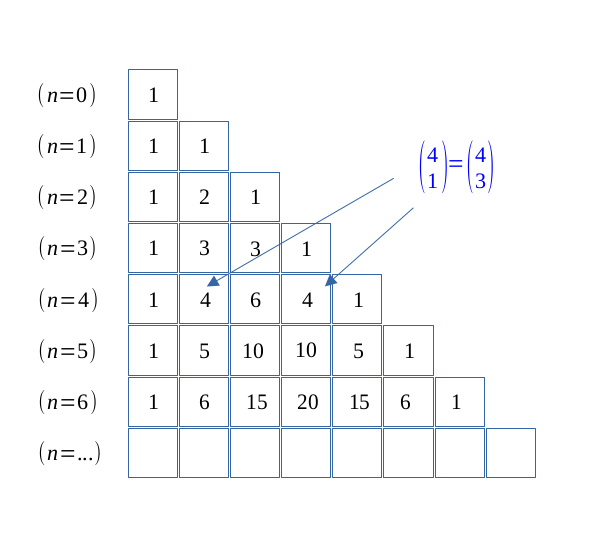
The Pascal's triangle definitely illustrates the symmetry between \( p\) and \( (n-p) \) elements among \(n\).
In addition, we can see by calculation that:
So,
The pawn's formula
By the binom's formula, we do have:
Now, we notice that for the denominator:
Therefore,
As a result we do have,
The Pascal's formula
-
By visualising by the Pascal's triangle
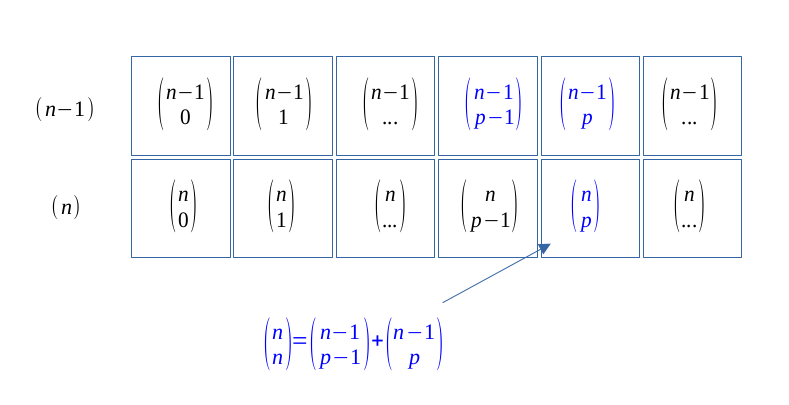
To retrieve the Pascal's triangle , we add the each case's value with its left neighbor to find the upwards neighbor.
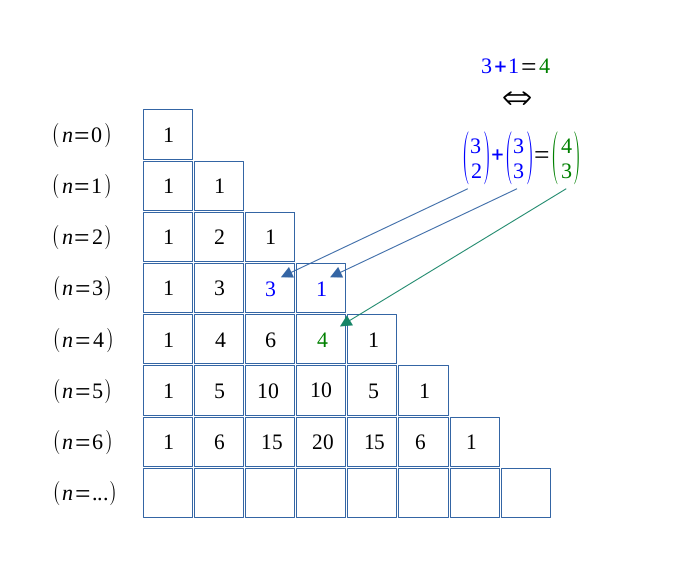
Moreover, if we consider the \( (n-1)\) and \(n\) ranks of the Pascal's triangle , the formula clearly appears.
By visualising we found out that,
$$ \forall (p,n) \in \hspace{0.04em}\mathbb{N}^2, \enspace p \leqslant n -1, $$$$ \binom{n}{p} = \binom{n -1}{p -1 } + \binom{n - 1}{p} \qquad \text{(Pascal's formula)} $$ -
By reasoning
Let consider a \( E \) set containing \(n\) elements.
$$ E = \Bigl \{ e_1, e_2 , \ ... \, e_{n} \Bigr \} $$In this set, the number possible part containing \( p \) elements is \( \binom{n}{p} \).
Let split this set in two subsets: \( E_1 \) and \( E_2 \).
-
\( E_1\): a set of the possible parts of \( E \) which contains \( e_n \)$$ E_1 = \begin{Bmatrix} \Bigl \{ e_1 , e_2, e_3, \ ... \ , e_n \Bigr \} \\ \Bigl \{ e_1 , e_3, e_4, \ ... \ , e_n \Bigr \} \\ \Bigl \{ e_1 , e_2, e_4, \ ... \ , e_n \Bigr \} \\ \Bigl \{................ \Bigr \} \\ \Bigl \{ \underbrace { e_1 , e_2, e_4, \ ... \ , e_n} _\text{ \(p\) elements } \Bigr \} \\ \end{Bmatrix} $$
Being said that all these parts contain\( e_n \), the \( E_1 \) set can be simplified:
$$ E_1 = \begin{Bmatrix} \Bigl \{ e_1 , e_2, e_3, \ ... \ , e_n \Bigr \} \\ \Bigl \{ e_1 , e_3, e_4, \ ... \ , e_n \Bigr \} \\ \Bigl \{ e_1 , e_2, e_4, \ ... \ , e_n \Bigr \} \\ \Bigl \{................ \Bigr \} \\ \Bigl \{ \underbrace { e_1 , e_2, e_4, \ ... \ , e_n} _\text{ \(p\) elements } \Bigr \} \\ \end{Bmatrix} \enspace \Longrightarrow \enspace \begin{Bmatrix} \Bigl \{ e_1 , e_2, e_3, \ ... \ \Bigr \} \\ \Bigl \{ e_1 , e_3, e_4, \ ... \ \Bigr \} \\ \Bigl \{ e_1 , e_2, e_4, \ ... \ \Bigr \} \\ \Bigl \{............. \Bigr \} \\ \Bigl \{ \underbrace { e_1 , e_2, e_4, \ .... } _\text{ \((p -1)\) elements } \Bigr \} \\ \end{Bmatrix} $$Then, the number of elements of \( E_1 \) is reduced to the number of ways to take \( (p -1) \) elements among \( (n-1) \) elements in \( E\), that is to say \( \binom{n -1}{p -1} \).
-
\( E_2 \): a set of the possible parts of \( E \) which not contains \( e_n \)$$ E_2 = \underbrace { \begin{Bmatrix} { e_1 , e_2, e_3, \ ... } \\ { e_1 , e_3, e_4, \ ... } \\ { e_1 , e_2, e_4, \ ... } \\ {............. } \\ { e_1 , e_2, e_4, \ ... } \\ \end{Bmatrix} } _\text{ \(p\) elements } $$
As \( E_2 \) does not contain \(e_n\), so there is a \( (n-1) \) elements choice left to take \( p \) elements in it. That is to say \( \binom{n -1}{p} \).
We thus showed that:
$$ \forall (p,n) \in \hspace{0.04em}\mathbb{N}^2, \enspace p \leqslant n -1, $$$$ \binom{n}{p} = \binom{n -1}{p -1 } + \binom{n - 1}{p} \qquad \text{(Pascal's formula)} $$ -
-
By calculation
Let us calculate \( \binom{n -1}{p -1} + \binom{n -1}{p} \):
$$ \binom{n -1}{p -1} + \binom{n -1}{p} = \frac{(n-1) !}{ p \hspace{0.1em} ! \ (n-1-p)!} + \frac{(n-1) !}{ (p-1)! \ (n-1-(p-1))!} $$$$ \binom{n -1}{p -1} + \binom{n -1}{p} = \frac{(n-1) !}{ p \hspace{0.1em} ! \ (n-1-p)!} + \frac{(n-1) !}{ (p-1)! \ (n-p) \hspace{0.1em} !} $$Now, we have to make both terms on a common denominator:
$$ \binom{n -1}{p -1} + \binom{n -1}{p} = \frac{(n-1) ! \ \textcolor{rgb(196 108 108)}{(n-p)}}{ p \hspace{0.1em} ! \ (n-1-p)! \ \textcolor{rgb(192 52 52)}{(n-p)}} + \frac{(n-1) ! \ \textcolor{rgb(196 108 108)}{p}}{ (p-1)! \ (n-p) \hspace{0.1em} ! \ \textcolor{rgb(196 108 108)}{p}} $$$$ \binom{n -1}{p -1} + \binom{n -1}{p} = \frac{(n-1) ! \ (n-p)}{ p \hspace{0.1em} ! (n-p) \hspace{0.1em} ! } + \frac{(n-1) ! \ p }{ p \hspace{0.1em} ! \ (n-p) \hspace{0.1em} !} $$Then we factorize it:
$$ \binom{n -1}{p -1} + \binom{n -1}{p} = \frac{(n-1) ! \ (n-p + p)}{ p \hspace{0.1em} ! (n-p) \hspace{0.1em} ! } $$$$ \binom{n -1}{p -1} + \binom{n -1}{p} = \frac{n \hspace{0.1em} !}{ p \hspace{0.1em} ! (n-p) \hspace{0.1em} ! } $$$$ \binom{n -1}{p -1} + \binom{n -1}{p} = \binom{n}{p} $$As a result we do have,
$$ \forall (p,n) \in \hspace{0.04em}\mathbb{N}^2, \enspace p \leqslant n -1, $$$$ \binom{n}{p} = \binom{n -1}{p -1 } + \binom{n - 1}{p} \qquad \text{(Pascal's formula)} $$
Horizontal sum from 0 to n
Let \( n \in \mathbb{N}\) be a natural number.
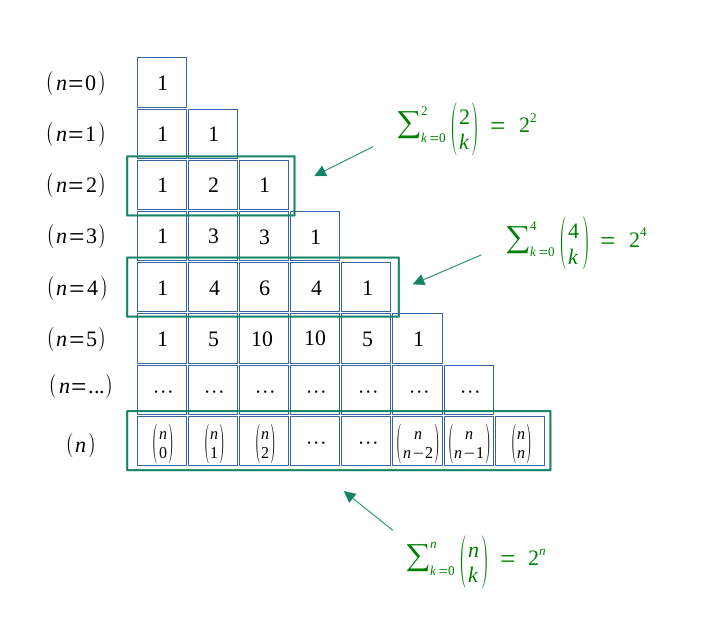
We want to compute the \( \binom{n}{k} \) sum, from \( 0\) to \( n\).
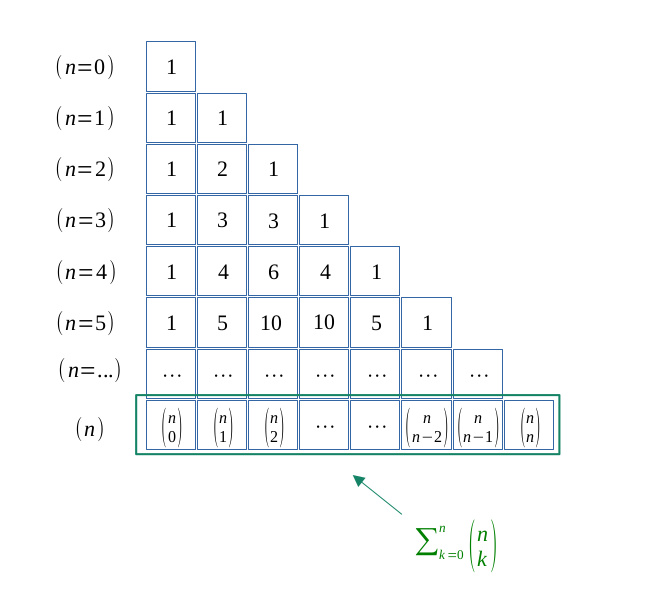
-
With the Newton's binomal
The Newton's binomal tells us that:
$$\forall n \in \mathbb{N}, \enspace \forall (a, b) \in \hspace{0.04em} \mathbb{R}^2,$$$$ (a + b)^n = \sum_{p = 0}^n \binom{n}{p} a^{n-p}b^p $$Taking the values \( \{ a = 1, \enspace b = 1 \}\), we do have:
$$ \sum_{p = 0}^n \binom{n}{p} = (1 + 1)^n $$And as a result,
$$\forall n \in \mathbb{N}, $$$$ \sum_{p = 0}^n \binom{n}{p} = \hspace{0.2em} 2^n $$So:
$$ \binom{n}{0} + \binom{n}{1} \enspace + ... + \enspace \binom{n}{n-1} + \binom{n}{n} = \hspace{0.02em} 2^n $$ -
By a recurrence
Let show that the following statement \((S_n)\) is true:
$$\forall n \in \mathbb{N}, $$$$ \binom{n}{0} + \binom{n}{1} \enspace + ... + \enspace \binom{n}{n-1} + \binom{n}{n} = \hspace{0.02em} 2^n \qquad (S_n) $$-
First terme calculation
Let verify if this is the case for the first term, that is to say when \( n = 0 \).
$$ \sum_{p = 0}^0 \binom{0}{p} = \binom{0}{0} = 1 $$But,
$$ 2^0 = 1 $$We definitely do have:
$$ \sum_{p = 0}^0 \binom{0}{p} = \hspace{0.2em} 2^0 $$\((S_0)\) is true.
-
Heredity
Let \( k \in \mathbb{N} \) be a natural number.
Let us assume that the following statement \((S_k)\) is true for all \( k \).
$$ \binom{k}{0} + \binom{k}{1} \enspace + ... + \enspace \binom{k}{k} + \binom{k}{k} = \hspace{0.2em} 2^{k} \qquad (S_{k}) $$And let verify if it is also the case for \((S_{k + 1})\).
$$ \binom{k + 1}{0} + \binom{k + 1}{1} \enspace + ... + \enspace \binom{k + 1}{k} + \binom{k + 1}{k + 1} = \hspace{0.2em} 2^{k + 1} \qquad (S_{k + 1}) $$Let us calculate the right member of \(( S_{k + 1} ) \):
$$ \binom{k + 1}{0} + \binom{k + 1}{1} \enspace + ... + \enspace \binom{k + 1}{k} + \binom{k + 1}{k + 1} $$But thanks to the Pascal's formula , we know that:
$$ \forall (p,n) \in \hspace{0.04em}\mathbb{N}^2, \enspace p \leqslant n -1, $$$$ \binom{n}{p} = \binom{n - 1}{p - 1} + \binom{n - 1}{p} \qquad \text{(Pascal's formula)} $$So also that:
$$ \binom{n + 1}{p + 1} = \binom{n}{p} + \binom{n}{p + 1} \qquad (Pascal^*) $$$$ \textcolor{rgb(118 139 240)}{\binom{k + 1}{0}} + \textcolor{rgb(93 183 129)}{\binom{k + 1}{1}} + \textcolor{rgb(196 108 108)}{ \binom{k + 1}{2}} \enspace + ... + \enspace \textcolor{rgb(213 101 255)}{\binom{k + 1}{k}} + \textcolor{rgb(118 139 240)}{\binom{k + 1}{k + 1}} $$Then, thanks to \( (Pascal^*) \), we do have:
$$ \textcolor{rgb(118 139 240)}{\binom{k + 1}{0}} + \textcolor{rgb(93 183 129)}{\binom{k}{0} + \binom{k}{1}} + \textcolor{rgb(192 52 52)}{\binom{k}{1} + \binom{k}{2}} \enspace + ... + \enspace \textcolor{rgb(213 101 255)}{\binom{k}{k - 1} + \binom{k}{k}} + \textcolor{rgb(118 139 240)}{\binom{k + 1}{k + 1}} $$Now, the first term equals the second one.
$$ \binom{k + 1}{0} = \binom{k}{0} $$As well, the last equals to the second to last one.
$$ \binom{k + 1}{k + 1} = \binom{k}{k} $$That leads us to:
$$ \binom{k}{0} + \binom{k}{0} + \binom{k}{1} + \binom{k}{1} + \binom{k}{2} \enspace + ... + \enspace \binom{k}{k - 1} + \binom{k}{k} +\binom{k}{k} $$And finally:
$$ 2 \left[ \binom{k}{0} + \binom{k}{1} + \binom{k}{2} \enspace + ... + \enspace \binom{k}{k - 1} + \binom{k}{k} \right] $$But, our hypothesis was that:
$$ \binom{k}{0} + \binom{k}{1} \enspace + ... + \enspace \binom{k}{k-1} + \binom{k}{k} = \hspace{0.2em} 2^k \qquad (S_k) $$Thus, we deduce from it that:
$$ \binom{k + 1}{0} + \binom{k + 1}{1} \enspace + ... + \enspace \binom{k + 1}{k} + \binom{k + 1}{k + 1} = \hspace{0.2em} 2 \times 2^{k} $$So:
$$ \binom{k + 1}{0} + \binom{k + 1}{1} \enspace + ... + \enspace \binom{k + 1}{k} + \binom{k + 1}{k + 1} = \hspace{0.2em} 2^{k + 1} \qquad (S_{k+1}) $$Therefore, \((S_{k + 1})\) is true.
-
Conclusion
The statement \((S_n)\) is true for its first terme \(n_0 = 0\) and it is hereditary from terms to terms for all \(k \in \mathbb{N}\).
By the recurrence principle, that statement is true for all \(n \in \mathbb{N}\).
We thus showed by recurrence that:
$$\forall n \in \mathbb{N}, $$$$ \sum_{p = 0}^n \binom{n}{p} = \hspace{0.2em} 2^n $$
-
Vertical sum from r to n
Let \( (r, n) \in \hspace{0.04em} \mathbb{N}^2\) be two natural numbers.
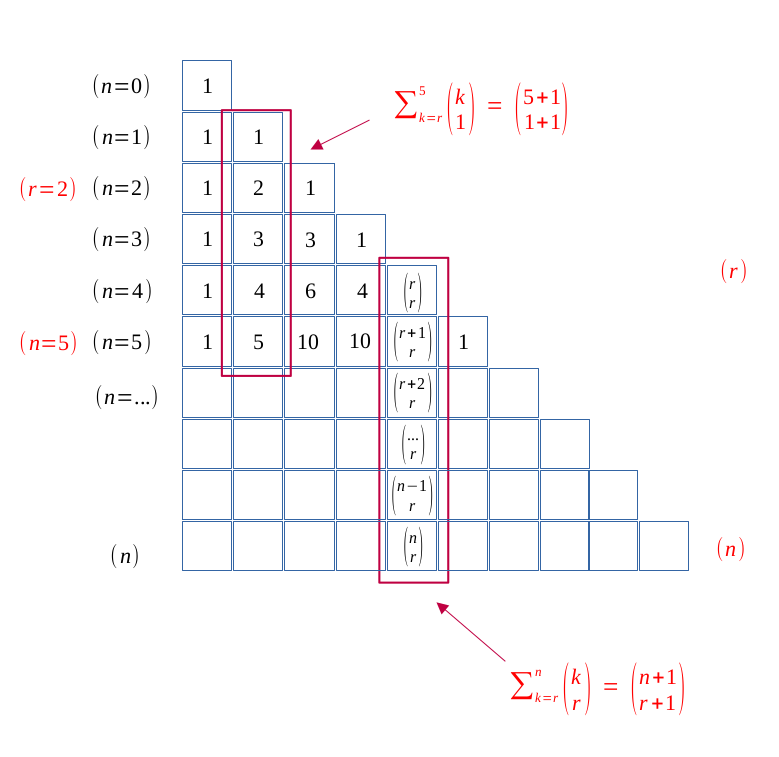
We want to calculalte the vertical sum of \( \binom{k}{r} \), from \( r\) until \( n\).
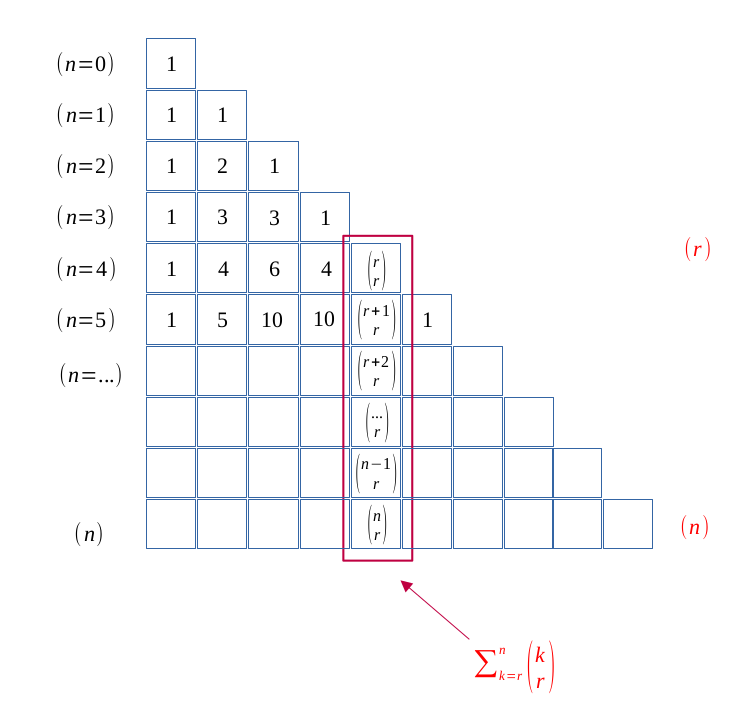
We know from the Pascal's formula , that:
But it can also be written as:
Therefore, replacing by what we want to calculate,
And,
Performing the wished sum, we firstly extract the first term of it:
Now we can inject the value of \((1) \):
And we notice that we have a case of a telescopic sum , we then have after simplification:
And finally,
 Back to top